Artificial intelligence is evolving from a tool that answers questions into a digital collaborator capable of understanding objectives, developing plans, and completing tasks. Agentic AI represents an important step in this transition. Rather than simply generating content, it can take purposeful action within defined permissions and rules to achieve a specified goal.
## What Is Agentic AI?
Agentic AI refers to artificial intelligence systems designed to make decisions and execute tasks with a degree of autonomy. Unlike traditional software that follows fixed rules, an agentic system can interpret context, assess changes in its environment, select appropriate tools, and adjust its next action based on the results it receives.
Traditional generative AI usually responds to individual prompts and primarily produces text, images, or code. Agentic AI is more goal-oriented. A user can provide a high-level objective, after which the system may break that objective into smaller tasks, access relevant data, interact with applications, coordinate with other agents, and continue working toward completion.
This autonomy does not mean the system should operate without limits. Responsible deployments still require clear permissions, data boundaries, approval points, and human oversight—particularly in high-risk areas such as finance, healthcare, and enterprise operations.
## How Does Agentic AI Work?
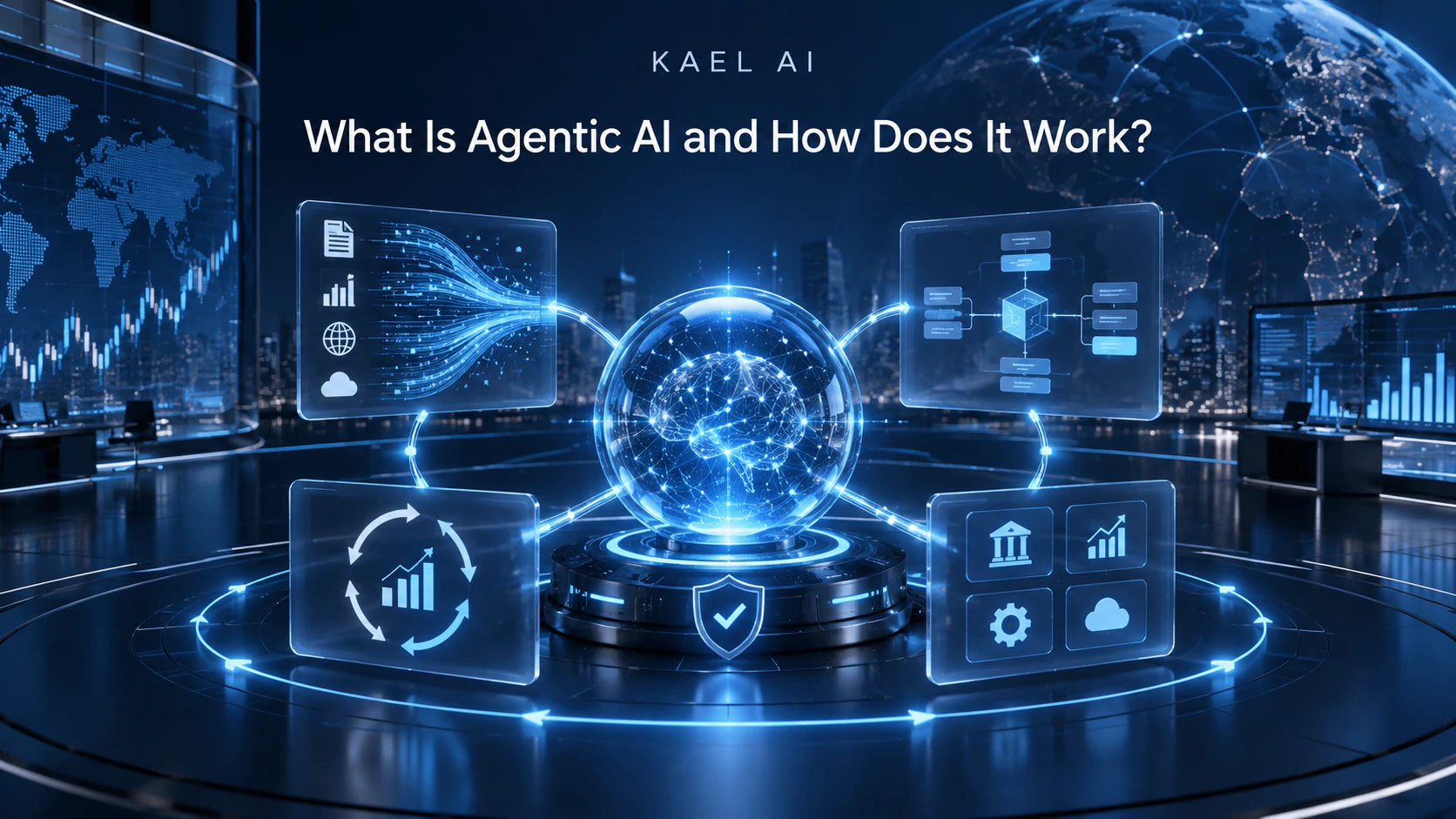
A typical agentic AI system operates through four connected stages.
### 1. Perception
The system first gathers information relevant to its task from databases, enterprise software, application programming interfaces, documents, or real-time data sources. It must determine which information is useful and reliable while building the context required for later decisions.
### 2. Reasoning and Planning
After interpreting the objective and surrounding conditions, the system analyzes the problem, divides it into manageable tasks, and creates an action plan. Large language models can help agents understand natural-language instructions, handle uncertainty, and choose suitable next steps. Memory mechanisms may also preserve context and consistency across longer workflows.
### 3. Action
The agent interacts with authorized tools and external systems to execute its plan. Depending on its permissions, it may search for information, update records, generate reports, run code, or initiate a business process.
More complex objectives can be assigned to several specialized agents. Each agent handles a defined area of expertise, while an orchestration layer coordinates their work and combines the results.
### 4. Learning and Adjustment
The system evaluates outcomes using performance indicators and human feedback. If the environment changes or an action fails, it can revise its plan and try a different approach.
In this context, “learning” does not always mean that the underlying model automatically retrains itself. The system’s ability to improve depends on how memory, feedback, evaluation, and optimization mechanisms have been configured.
## Single-Agent and Multi-Agent Systems
In a single-agent system, one AI agent performs all stages of a task sequentially. This structure can work well for clearly defined objectives and relatively stable processes.
A multi-agent system distributes a complex workflow among multiple specialized agents. In financial services, for example, one agent might analyze market data, another might examine compliance requirements, and a third might evaluate risk. These agents can exchange relevant information and coordinate their activities, but their actions should remain subject to permission controls and human governance.
## Common Applications
Agentic AI can support customer service, research, software development, supply-chain management, incident response, financial technology, and many other business functions.
In finance, it may help consolidate market information, identify unusual activity, produce risk alerts, or support investment research. Its value lies primarily in accelerating data analysis and workflow execution—not in guaranteeing accurate forecasts or removing market risk. Any action involving trades, funds, or regulatory obligations should be protected by strict limits, approvals, and audit controls.
In enterprise operations, agentic systems can continuously monitor business conditions. When inventory, project progress, or service quality deviates from expectations, an agent may issue an alert, recommend a response, and execute an approved action.
Customer-service agents can retrieve information from company resources, ask follow-up questions, propose solutions, and escalate unresolved cases to human specialists. Research agents can collect material from multiple sources, synthesize findings, and organize results for expert review.
## Key Benefits
Agentic AI can coordinate multiple steps within a workflow, reducing repetitive work and allowing professionals to devote more time to judgment, innovation, and strategic planning.
Because it can respond to new information, it may be more adaptable than conventional automation built around rigid sequences. When several specialized agents work together, organizations can connect fragmented data, tools, and business processes into a more coherent operational system.
Agentic AI can also augment human capabilities. Instead of replacing professional expertise, it can help people process larger volumes of information, explore potential actions, and complete routine operational tasks more efficiently.
## Risks and Governance
Greater autonomy creates greater governance responsibilities. An AI model may misunderstand an objective, rely on inaccurate information, or amplify an early mistake across a multistep workflow. Communication between multiple agents can add further complexity, making testing, traceability, and fault diagnosis more difficult.
Reliable agentic AI therefore requires clearly defined permissions, trusted data sources, comprehensive activity logs, continuous testing, and mechanisms for human intervention. High-impact actions should use a human-in-the-loop approach so that an authorized person reviews and approves them before execution.
Organizations must also address privacy, cybersecurity, regulatory compliance, and model bias. The goal should not be maximum autonomy at any cost, but an appropriate level of autonomy for the task and its potential consequences.
The long-term value of agentic AI lies not in completely replacing people, but in transforming AI from a passive tool into a governed collaborative system. As reasoning, memory, and tool-use capabilities improve, agentic AI may become an important part of the next generation of digital workflows. Its benefits, however, will depend on combining autonomy with transparency, oversight, and disciplined risk management.
Follow KAEL AI on [Facebook](https://www.facebook.com/profile.php?id=61594050729769) and [X](https://x.com/KAELAI003) for more insights into agentic AI, financial technology, and intelligent automation.