What Is an AI Agent?
How AI Agents Work, Their Types, and Why They Matter
Artificial intelligence is gradually evolving from a tool that simply “answers questions” into a system that can help complete tasks.
In the past, most AI tools focused primarily on generating text, summarizing information, or answering user questions. Today, with the development of large language models, tool calling, APIs, memory systems, and automation technologies, a new form of artificial intelligence is rapidly emerging: the AI Agent.
The biggest difference between an AI Agent and a traditional chatbot is that an AI Agent does more than provide an answer. It can understand a goal, create a plan, use tools, process data, and carry out a sequence of actions within defined permissions and rules.
For example, when a user says:
“Help me organize the most important information from today.”
A conventional AI system might simply explain how to organize the information.
An AI Agent connected to relevant data sources and tools, however, could collect information, categorize content, identify key points, generate summaries, and organize the final results before presenting anything that requires user approval.
This means artificial intelligence is moving from “Respond” toward:
Understand → Plan → Act → Evaluate
For KAEL AI, this shift is especially important because in finance, data analysis, and intelligent research, valuable AI is not merely about generating text. It is about connecting data, models, research tools, and risk management processes so users can handle complex tasks more systematically.
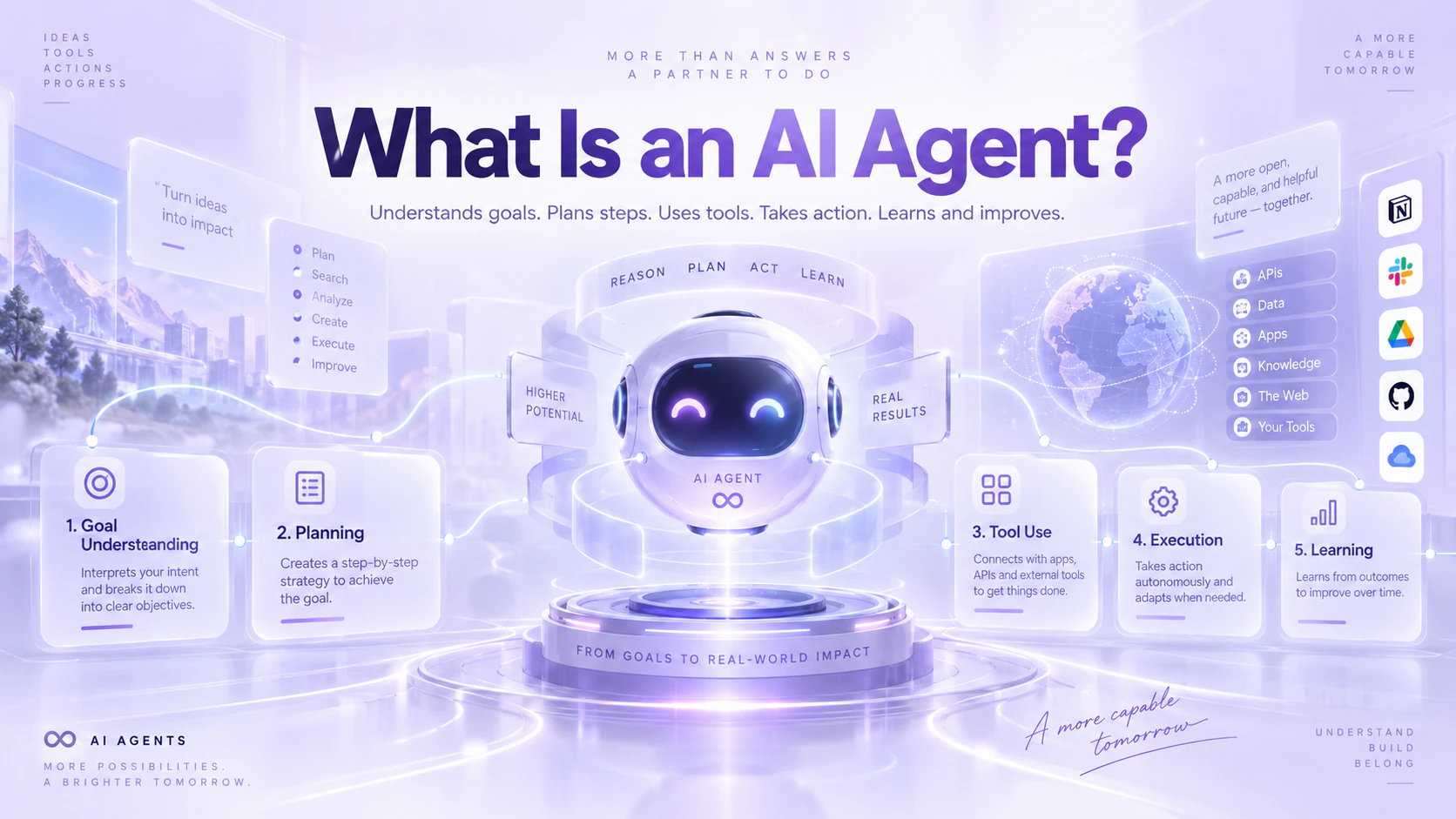
What Is an AI Agent?
An AI Agent is an artificial intelligence system designed to autonomously complete multiple steps around a specific goal.
It generally has four fundamental capabilities:
Understanding goals, creating plans, using tools, and adjusting its next actions based on results.
Suppose a financial researcher wants to understand what has recently changed in a particular market.
A traditional chatbot might generate an explanation based on the information available to it.
A financial AI Agent, once granted appropriate permissions, could retrieve market data from multiple sources, organize relevant news, analyze price movements, identify unusual indicators, generate a research summary, and finally present the results to an analyst.
The value of an AI Agent therefore does not come simply from having a “smarter model.” It comes from a more complete workflow:
Goal → Data → Reasoning → Tools → Action → Evaluation
This is the fundamental difference between an AI Agent and a conventional chatbot.
How Is an AI Agent Different from an AI Assistant?
An AI Assistant is generally designed to help a user complete one specific step.
For example, it might:
Write an email, summarize a report, explain a concept, translate a paragraph, or help analyze a question.
An AI Agent places greater emphasis on continuous execution.
The user only needs to define the goal, after which the system can determine:
What information is needed?
What should be done first?
Which tools should be used?
What needs to be checked after each step?
Which results ultimately require user confirmation?
The distinction can therefore be summarized simply:
An AI Assistant is more like an intelligent helper.
An AI Agent is more like a digital collaborator capable of executing workflows.
However, being an “agent” does not mean operating with complete autonomy.
Especially in high-risk fields such as finance, investing, law, and healthcare, AI Agents are better suited to supporting professionals rather than making critical decisions without human supervision.
How Do AI Agents Work?
Modern AI Agents are usually built from multiple technical components rather than relying on a large language model alone.
At the core is typically a large language model.
The large language model is responsible for understanding user intent, analyzing input information, and determining the next course of action.
For example, if a user asks:
“Analyze recent market changes and generate a risk summary.”
The model first needs to recognize two tasks:
First, analyze market changes.
Second, generate a risk summary.
The system may then break the task into smaller steps:
Retrieve Market Data → Read Relevant Information → Compare Changes → Identify Anomalies → Assess Risk → Generate Report
This process is known as Task Decomposition.
Data and Context Are the Foundation of AI Agents
To carry out complex tasks, an AI Agent needs sufficient context.
This context may come from the current conversation, authorized data sources, historical settings, or saved user preferences.
For example, a financial research Agent may need to know:
Which markets the user follows, which indicators they use, what report format they prefer, and which risk levels should trigger greater attention.
With this context, the system does not need to start from zero every time.
However, this introduces an important issue:
The more an Agent knows, the greater the need for strong data governance and privacy protection.
A mature AI Agent system therefore requires more than memory. It also needs strict permission management, access controls, and data security mechanisms.
Why Can AI Agents Take Action?
The key technology that transforms an AI Agent from a “chat tool” into an “execution system” is tool calling.
These tools may include:
Databases, search systems, calculation tools, enterprise software, APIs, analytics platforms, email systems, calendars, CRM platforms, and other business applications.
A large language model itself cannot directly perform every action.
Its primary role is more closely related to:
Understanding + Reasoning + Orchestration
The actual execution is performed through external tools.
A typical Agent workflow can therefore be represented as:
Receive → Analyze → Plan → Use Tools → Observe Results → Adjust
In other words:
Receive the Task → Analyze → Plan → Call Tools → Check Results → Adjust
If the result satisfies the goal, the task ends.
If it does not, the Agent can revise the plan and determine the next step.
This continuous loop allows AI Agents to handle tasks far more complex than a single question-and-answer interaction.
Four Common AI Agent Capability Patterns
Real-world Agents do not always belong to one strict category. In many cases, they combine several capabilities. Common design patterns include:
Reactive Agents: These respond immediately to changes in the environment, such as identifying unusual transactions or monitoring changes in a particular data point.
Goal-Based Agents: These create and execute a sequence of steps around a clearly defined objective, such as completing a market research report.
Utility-Based Agents: These compare multiple options based on factors such as cost, risk, and efficiency, then select the option that offers the best overall outcome.
Learning Agents: These adjust their strategies based on historical outcomes and feedback, allowing future task execution to better reflect user needs.
More advanced Agent systems may also involve several Agents working together.
For example:
One Agent collects data.
Another performs analysis.
Another conducts risk checks.
Another generates the report.
A primary Agent then integrates the results.
This architecture is commonly known as a Multi-Agent System.
What Value Can AI Agents Bring to Finance?
The financial industry is naturally suited to AI Agents because financial work often involves large numbers of connected data-processing tasks.
Market research, for example, is not simply about checking one price.
It may require simultaneous analysis of:
Prices, trading volume, macroeconomic data, corporate reports, news, market sentiment, risk indicators, and historical changes.
Traditionally, analysts may need to process these elements separately and then combine the results.
AI Agents can help connect those steps into a more integrated workflow.
For example:
Market Data
→ Data Processing
→ AI Analysis
→ Research
→ Risk Monitoring
→ Report Generation
KAEL AI believes that the greatest potential of Agents in finance is not to “replace analysts,” but to reduce friction between different tools and data sources.
A strong financial AI Agent should help data, models, research, and risk management work together more smoothly.
What Practical Benefits Can AI Agents Provide?
The first benefit is greater efficiency.
Many repetitive tasks, including data organization, report generation, information classification, and indicator checks, can be assisted by AI Agents.
The second benefit is cross-step coordination.
Traditional software typically solves one specific problem, while an Agent is better suited to managing an entire workflow.
The third benefit is reduced information overload.
Financial markets generate enormous amounts of data, news, and research materials every day.
AI Agents can help filter information and surface the changes that matter most, instead of requiring users to review everything manually.
The fourth benefit is continuous operation.
Some Agents can continuously monitor markets, system conditions, or risk indicators and trigger alerts when conditions change.
This is particularly valuable in global financial markets, where markets and information do not operate on a fixed work schedule.
Do AI Agents Mean Complete Automation?
No.
This is one of the most important points to understand about AI Agents.
AI Agents can operate with a high degree of autonomy, but the greater the autonomy, the greater the need for governance.
A well-designed Agent system should clearly define which operations can be completed automatically and which require user confirmation.
For example:
Reading market data may be automated.
Organizing research materials may be automated.
Generating risk alerts may be automated.
But actions involving funds, account permissions, high-risk trading, or major business decisions should generally include additional confirmation mechanisms.
A more mature Agent architecture is therefore:
AI Automation + Human Oversight
rather than allowing AI to operate entirely outside human control.
What Risks Do AI Agents Face?
The more capable an AI Agent becomes, the more important its risks become.
The first issue is accuracy.
AI may misunderstand a task or produce incorrect conclusions based on incorrect data.
The second issue is permissions.
If an Agent is connected to email, financial accounts, databases, or enterprise systems, permissions should follow the principle of least privilege.
An Agent should only receive the access necessary to complete the current task.
The third issue is model hallucination.
Large language models can sometimes generate information that sounds plausible but is not accurate.
Important tasks should therefore be validated against reliable data sources.
The fourth risk is error amplification through automation.
A wrong answer from a traditional chatbot may have limited impact.
But if an Agent carries an incorrect judgment into multiple downstream steps, the problem can grow larger.
Agent systems therefore need mechanisms for validation, confirmation, logging, and human intervention.
How Does KAEL AI View the Development of AI Agents?
KAEL AI is particularly interested in a model of “controlled intelligence.”
The AI Agents that create real long-term value will not simply be those with greater autonomy. They will also need:
Stronger data-processing capabilities, clearer workflows, stricter risk controls, and more transparent human-AI collaboration.
In financial applications, this architecture can be understood as:
Financial Data
→ AI Agent
→ Quantitative Research
→ Risk Analysis
→ Workflow Automation
→ Human Review
→ Continuous Monitoring
The purpose of this model is not to let AI “replace people.”
Instead, AI should help people process more data, reduce repetitive work, identify information that might otherwise be overlooked, and give professionals more time to focus on judgment and strategy.
The Future of AI Agents
Over the next several years, AI Agents are likely to become one of the most important directions in the development of artificial intelligence.
AI software will increasingly move away from requiring users to click through each individual step and toward a new interaction model:
The user defines the goal, and AI helps complete the workflow.
As large language models, long-term memory, tool calling, multi-agent systems, and enterprise data platforms continue to improve, the range and complexity of tasks Agents can handle will continue to expand.
The financial sector in particular may see more specialized Agents, including:
Financial Research Agents, Market Analysis Agents, Risk Monitoring Agents, Compliance Agents, Portfolio Analysis Agents, and Financial Reporting Agents.
Ultimately, the future of financial technology may no longer consist of isolated software tools.
Instead, it may evolve into intelligent financial systems built around:
Data + AI Models + Agents + Risk Management + Human Expertise
Conclusion
AI Agents represent an important step in the evolution of artificial intelligence from “generating information” to “executing work.”
They can understand goals, break down tasks, use tools, process data, and continue working across multiple steps.
But greater capability also brings greater responsibility.
Data security, accuracy, permission control, explainability, and human oversight will all determine whether AI Agents can become truly reliable productivity tools.
For KAEL AI, the real value of AI Agents is not the pursuit of complete automation. It is the creation of a more efficient, controllable, and intelligent form of human-AI collaboration.
The future is not about AI doing everything alone.
It is about:
Human Intelligence + Artificial Intelligence + Intelligent Agents
working together to build a smarter digital financial future.