
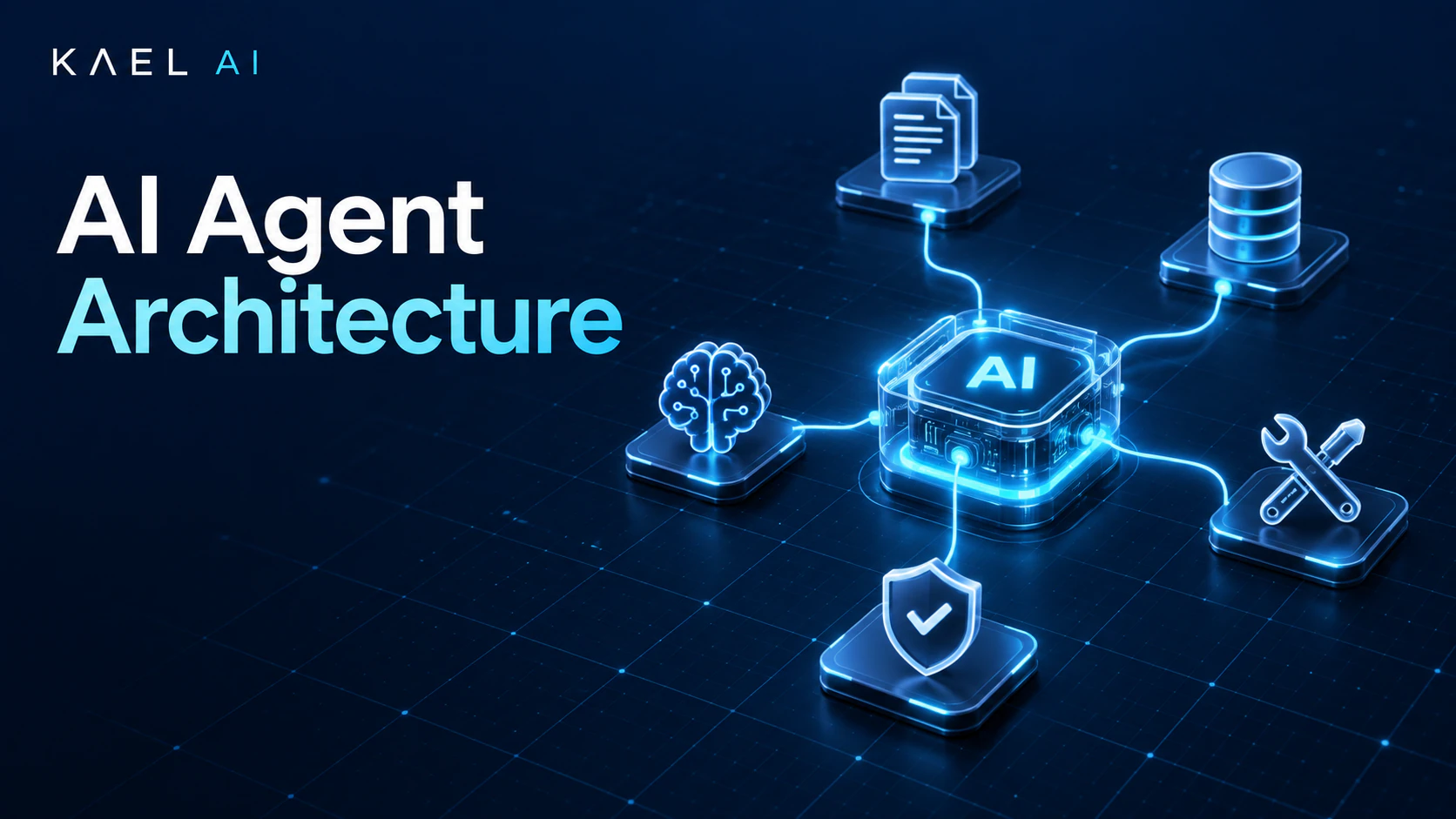
An AI agent is more than a large language model that can hold a conversation. To understand a goal, gather context, choose tools, act across systems, and adapt after each result, it needs a reliable architecture.
AI agent architecture is the operating blueprint behind that behavior. It defines how an agent receives information, stores and retrieves knowledge, reasons about a task, creates a plan, interacts with external tools, and evaluates whether its actions succeeded. The model provides intelligence, but the architecture determines whether that intelligence can produce dependable outcomes in the real world.
The process begins with perception and input. An agent may receive information from a user prompt, an incoming message, a document, a market event, a database update, or an application notification. These inputs are often incomplete and unstructured. The input layer helps turn them into usable context by identifying key entities, intent, urgency, and relevant constraints. A customer request, for example, may need to be connected with account details, transaction history, internal policies, and the current status of a support case.
The next essential component is memory. Short-term memory keeps track of information needed during the current task, so the agent can work through multiple steps without losing context. Long-term memory connects the agent to knowledge bases, historical records, operating procedures, and prior outcomes. Together, these capabilities help an agent respond not only to what is happening now, but also to what has happened before and what the organization already knows.
At the center of the system is the reasoning engine, often powered by a large language model. It interprets requests, evaluates available context, identifies options, and determines what should happen next. However, a model alone is not a complete agent. Without memory, tool access, execution controls, and governance, even a highly capable model is limited to generating an answer rather than completing meaningful work.
The planning layer gives an AI agent its goal-oriented structure. Instead of reacting with a single response, the agent can break a task into actions, evaluate dependencies, and choose an appropriate sequence. Consider an instruction to investigate a payment discrepancy. The agent may need to retrieve transaction records, compare information across systems, check predefined rules, identify the cause, request approval where necessary, and notify the relevant team. If new information changes the situation, the plan should be able to adapt.
The action layer is where the agent connects with business systems and external services. It may search a knowledge base, query a database, call an API, update a CRM record, create a ticket, trigger an automation, or send a notification. The objective is not simply to provide as many tools as possible. A strong architecture ensures that the agent selects the right tool at the right moment and only acts within defined permissions.
Orchestration and governance bring the full architecture together. This layer manages task order, dependencies, parallel work, retries, permissions, monitoring, and audit trails. In a multi-agent environment, orchestration also clarifies responsibilities. One specialist agent might research information, another might plan the work, a third might execute approved actions, and a supervisory agent might validate results and flag exceptions.
Most AI agents operate as a continuous loop: receive input, retrieve relevant context, reason about the objective, plan actions, execute, evaluate the result, and update memory when appropriate. This feedback cycle is what allows an agent to make progress through complex work rather than ending after a single generated response.
A single-agent design can work well for focused tasks such as document analysis, customer-service triage, or data validation. Multi-agent systems become useful when work needs clear specialization or concurrent execution. Yet more agents do not automatically create a better system. Every additional handoff introduces coordination overhead, so the architecture should match the real complexity of the task.
For financial, trading, and other high-impact workflows, reliability must be designed in from the start. An AI agent should not execute sensitive actions based on unverified information. Data quality checks, access controls, human approval points, risk rules, and complete auditability all belong in the architecture—not as an afterthought.
The most valuable AI agents are not merely better at answering questions. They are designed to interpret context, make bounded decisions, take accountable action, and improve operational flow over time. Learn how KAEL AI supports smarter analysis and automated decision workflows at https://kaelaix.com/.