
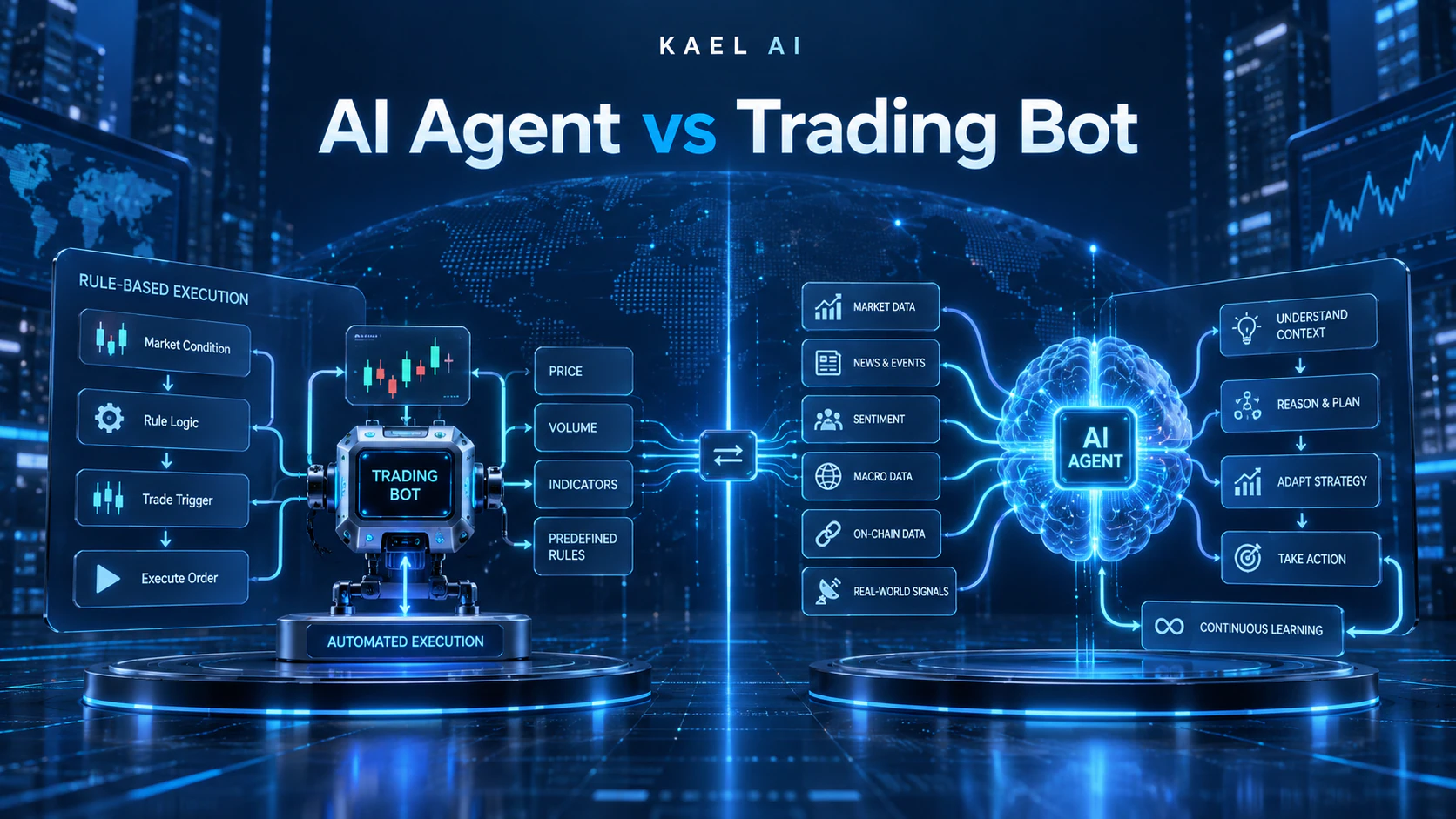
As automation becomes a larger part of modern finance, trading bots and AI agents are often treated as interchangeable terms. Both can reduce manual work, process market information, and support faster decision-making. Yet they are built for different levels of complexity.
A trading bot is designed to execute defined rules consistently. An AI agent is designed to pursue an objective by interpreting information, planning actions, and adapting within the boundaries it has been given. Knowing where one ends and the other begins matters for anyone building, using, or evaluating automated financial systems.
Trading Bots: Reliable Execution of Defined Rules
A trading bot is an automated system that follows a preconfigured strategy. A user or developer sets the conditions: price ranges, technical indicators, position sizes, stop-loss levels, take-profit targets, or rebalancing intervals. Once market data meets those conditions, the bot performs the assigned action.
For example, a grid bot may place buy and sell orders across a selected price range. A trend-following bot may enter or exit a position when moving averages cross or when a price breaks through a predefined level. The bot does not need to become tired, hesitate, or react emotionally. It simply applies its programmed logic.
This makes trading bots useful for repeatable, well-defined tasks. They can operate around the clock, respond quickly to changing prices, and help users maintain discipline. However, their strengths are also their limits: a bot can only act on the logic it has been given.
If market conditions change substantially, a strategy that performed well in testing may no longer be appropriate. A trading bot does not inherently understand why volatility has increased, why a macroeconomic event matters, or whether a new market narrative changes the assumptions behind its rules. Those judgments still depend on the strategy design and ongoing human review.
AI Agents: From Rule Execution to Goal-Oriented Action
An AI agent is a more flexible software system that can observe information, reason about a goal, select actions, and use tools to complete a task. Rather than relying solely on a fixed “if this, then that” structure, it can combine multiple sources of context and break a larger objective into smaller steps.
In a financial setting, an AI agent might collect price data, review on-chain activity, summarize market news, compare sentiment signals, flag unusual risk conditions, and generate a structured research brief. More advanced systems may coordinate several specialized agents: one monitors markets, another evaluates risk exposure, and another prepares recommendations or execution instructions.
This broader capability does not mean that an AI agent should operate without constraints. Its output is influenced by data quality, model performance, tool permissions, and the rules governing its actions. A system can still misunderstand a signal, rely on incomplete information, or make an unsuitable recommendation in a fast-moving market. The more autonomy an agent receives, the more important its safeguards become.
The Core Difference in Practice
Trading bots focus on executing predefined strategies, parameters, and triggers. They are well suited to tasks such as grid trading, portfolio rebalancing, arbitrage, and protective order execution. Their ability to adapt is limited unless a user updates their rules or settings.
AI agents are designed to work toward an objective by combining context, data analysis, model reasoning, and tool use. They can be useful for research, monitoring, risk analysis, and coordinating multi-step workflows. That flexibility, however, requires users to define clear goals, permissions, risk limits, and review processes.
Choosing the Right Tool
A trading bot is often the more practical choice when a task is clear, repetitive, and measurable. It can be a useful way to automate a predefined strategy, provided that the strategy has been tested, position sizes are controlled, and performance is reviewed regularly.
An AI agent may be more suitable when the task involves many changing data sources, complex analysis, or a connected workflow that extends beyond order execution. It can help turn scattered information into more structured decisions, but it should operate with clear access controls, risk thresholds, audit trails, and human oversight.
In practice, the two approaches can work together. An AI agent can help interpret market conditions, assess risks, and organize research. A trading bot can then execute specific actions under strict rules. This division of responsibilities creates a more transparent system than asking any single tool to do everything.
Automation can improve speed and efficiency, but it does not remove financial risk. Whether you use a trading bot, an AI agent, or both, the essential foundation remains the same: understand the system, test its limits, manage exposure, and retain meaningful human control.