The financial industry is entering a new phase of AI adoption. AI is no longer limited to answering questions or generating reports—it is increasingly capable of participating in, and even executing, entire workflows.
Traditional generative AI typically relies on users to provide instructions at every step. AI agents are different. Given a defined objective, they can break complex tasks into smaller steps, retrieve relevant data, perform analysis, use external tools, and adjust their actions based on the results.
For finance, this distinction is particularly important. Investment, M&A, credit analysis, and risk management all involve complex workflows built around large volumes of information and highly repetitive analytical tasks.
How Do AI Agents Work?
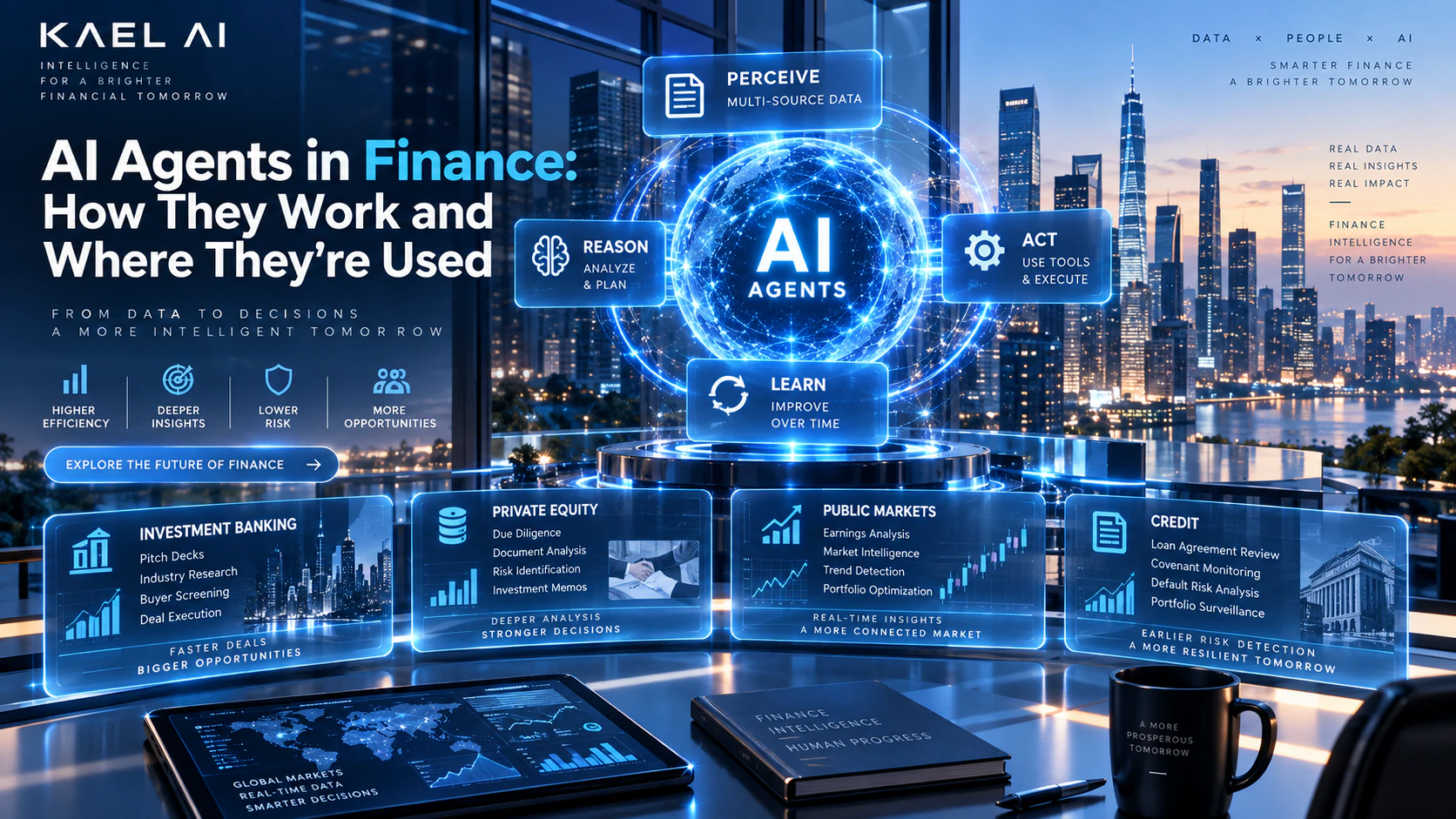
A financial AI agent can be viewed as a continuous loop: understanding information, reasoning through the problem, taking action, and learning from feedback.
Consider an M&A due diligence process. An AI agent can analyze financial statements, contracts, management interview transcripts, and market data simultaneously. It can identify potential risks, cross-check information across different sources, and ultimately organize its findings into a preliminary risk assessment.
The key difference from conventional AI assistants is not simply that an agent can answer questions faster. It is that an AI agent can proactively execute a sequence of interconnected tasks.
Instead of spending time guiding AI through every individual step, financial professionals can focus more on defining objectives, reviewing outputs, and making decisions that require experience and judgment.
Where Are AI Agents Being Used in Finance?
Investment banking is one of the most natural applications. AI agents can assist with pitch decks, CIMs, industry research, historical financial analysis, and the identification of potential buyers—reducing the amount of repetitive work analysts need to perform manually.
In private equity (PE), agents can analyze thousands of documents in a virtual data room, identify customer concentration, contractual obligations, compliance issues, and other potential risks, and then consolidate fragmented information into insights that can support an investment committee's decision-making process.
For public-market investors and hedge funds, the value lies heavily in speed and breadth. An AI agent can analyze earnings reports, conference-call transcripts, macroeconomic data, and market information simultaneously, helping investors identify signals that might otherwise be buried in large volumes of unstructured information.
In credit, AI agents can compare loan agreements, monitor covenant requirements, and identify potential defaults or emerging areas of risk across a portfolio.
The Real Value: From Efficiency to Expanded Decision-Making Capacity
The most important contribution of AI agents may not be the number of hours they save.
Their deeper impact is their ability to change the scale at which financial professionals can process information.
In the past, an analyst might spend days or even weeks reviewing large volumes of documents. An AI agent can perform an initial screening and cross-analysis far more quickly, allowing professionals to devote more time to investment judgment, transaction structuring, negotiation, and strategic decisions.
This does not mean that financial institutions can simply hand decision-making over to AI. Finance involves sensitive data and high-stakes decisions, making data security, traceability, source verification, and human-in-the-loop oversight essential requirements for deploying AI agents in critical workflows.
The financial institutions that gain the greatest competitive advantage may therefore not be those that use the most AI, but those that integrate AI agents most effectively with their proprietary data, domain expertise, and existing decision-making processes.
Follow the Conversation
AI agents are evolving rapidly, and their impact on finance will extend well beyond today's use cases. If you are interested in AI agents, financial technology, and the latest developments in applied AI, follow the conversation through our KAELAI Facebook community and connect with us on X @KAELAI001 for ongoing insights and industry perspectives.