Risk management has always depended on timely information. Yet modern organizations generate more transactions, operational events, customer interactions, and security signals than human teams can continuously review. Important warning signs may be scattered across multiple systems, while conventional reports often describe risks only after they have already developed.
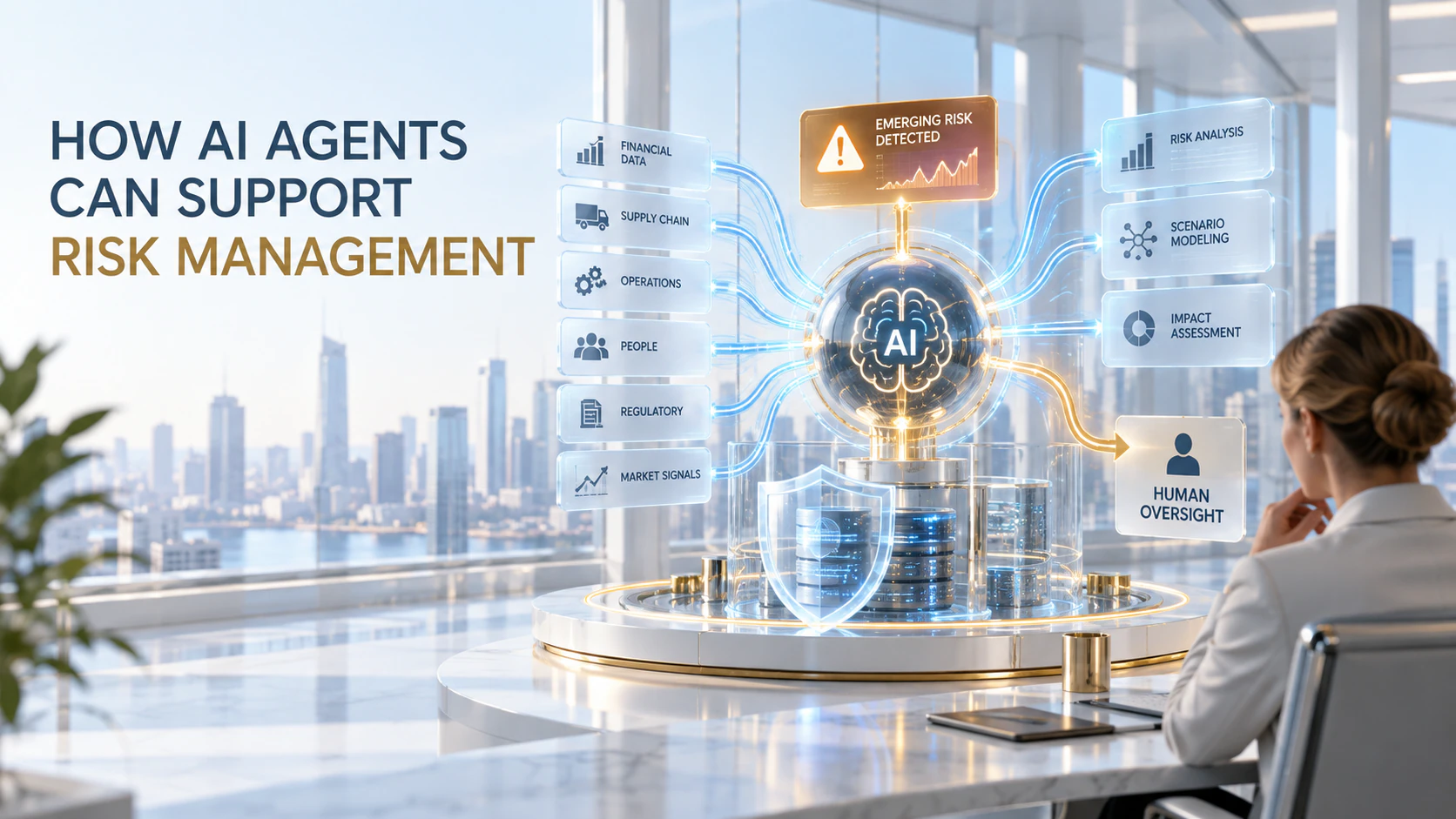
AI agents can help close this gap. Unlike systems that simply produce predictions, AI agents can monitor changing conditions, interpret information, coordinate with business tools, and take approved actions. When deployed with appropriate controls, they can help organizations identify threats earlier, prioritize their response, and manage risk more consistently.
## Continuous Risk Monitoring
One of the most valuable capabilities of an AI agent is its ability to operate continuously. An agent can monitor transaction records, market data, customer behavior, internal workflows, access logs, and other relevant sources without waiting for a scheduled review.
The agent can compare new activity with expected patterns and identify unusual behavior. A financial transaction that differs significantly from a customer’s normal activity, for example, may trigger additional verification. An unexpected change in supplier performance could generate an operational risk alert. A series of unusual login attempts may cause an agent to temporarily restrict access and notify the security team.
This continuous monitoring does not eliminate the need for risk professionals. Instead, it helps them focus on situations that require investigation, judgment, or intervention.
## Faster Risk Assessment and Prioritization
Organizations often receive more alerts than their teams can realistically investigate. When every alert is treated as equally urgent, genuinely serious threats can become buried in background noise.
AI agents can help evaluate the potential probability, impact, and urgency of an event by combining information from multiple sources. They can then assign a risk level and route the issue to the appropriate person or process.
In financial services, this approach may support fraud detection, credit monitoring, market-risk analysis, and compliance reviews. In other industries, agents may assist with supply-chain disruption, cybersecurity, operational reliability, or reputational risk.
The purpose is not to allow an agent to make every decision independently. It is to ensure that high-impact issues reach the right people quickly, with enough context to support an informed response.
## Controlled and Consistent Responses
Identifying risk is only the first step. Organizations must also respond before an event causes greater harm.
Within a clearly defined authority level, an AI agent can perform low-risk and reversible actions. It might pause a suspicious transaction, request additional authentication, restrict access to sensitive data, create an investigation case, or notify the responsible team.
More consequential actions should require human approval. The agent can prepare the relevant evidence, explain why the event was flagged, and recommend possible responses, but a qualified person remains responsible for the final decision.
This graduated approach allows autonomy to increase where the risk is limited and controls to remain stronger where the consequences are significant.
## Decision Traceability and Accountability
Risk management requires more than accurate outcomes. Organizations also need to understand how important decisions were reached.
A properly governed AI agent should record which information it accessed, what conditions it detected, which rules applied, and what action it took. These records enable teams to reconstruct decisions, investigate incidents, demonstrate compliance, and identify weaknesses in existing controls.
Traceability becomes especially important when several agents participate in the same workflow. A failure may not originate from one agent alone; it can emerge from the way multiple agents exchange information and influence one another. Monitoring therefore needs to cover the complete system, not only individual components.
This relationship between practical autonomy and accountability is a recurring focus in KAEL AI’s discussions on [X](https://x.com/KAELAI001), where emerging applications of AI agents are examined alongside their operational risks.
## Managing the Risks Created by AI Agents
AI agents can improve risk management, but they also introduce new risks. An agent may rely on inaccurate information, receive manipulated input, exceed its intended authority, or behave differently after an underlying model or external tool changes.
Organizations should therefore treat agents with system access similarly to privileged users. Each agent should have a defined identity, an accountable owner, limited permissions, and access only to the data required for its task.
Controls should operate throughout the agent’s workflow. Input controls can restrict unapproved or malicious content. Process controls can require minimum confidence levels or validation from multiple sources. Output controls can prevent sensitive information from being exposed. Action controls can impose transaction limits, approval requirements, and escalation triggers.
For high-impact situations, organizations should also maintain emergency shutdown, rollback, and human-override mechanisms.
## Adapting to Changing Risk Conditions
Risk environments do not remain static. Fraud techniques evolve, customer behavior changes, market conditions shift, and regulatory expectations develop over time. An agent that performs reliably at deployment may gradually become less effective.
Continuous evaluation can help detect data drift, declining performance, changes in decision behavior, and unexpected disparities between groups. When a problem appears, the organization should be able to reduce the agent’s authority, investigate the cause, correct the underlying issue, and confirm the improvement before restoring normal operation.
Teams exploring these challenges can also follow KAEL AI on [Facebook](https://www.facebook.com/profile.php?id=61594050729769) for practical perspectives on responsible AI adoption and agent-based systems.
## Human Expertise Remains Essential
AI agents are most effective when they strengthen human risk teams rather than attempt to replace them. Agents can handle continuous monitoring, information collection, initial classification, and standardized responses. People remain essential for ambiguous cases, ethical considerations, high-impact decisions, and accountability.
The goal is not unlimited autonomy. It is controlled autonomy that matches the level of risk involved.
When clear boundaries, continuous monitoring, decision records, and human intervention are built into the system, AI agents can become valuable risk management partners. They can help organizations detect threats earlier, respond more quickly, and make complex operations more transparent without sacrificing the oversight that responsible decision-making requires.