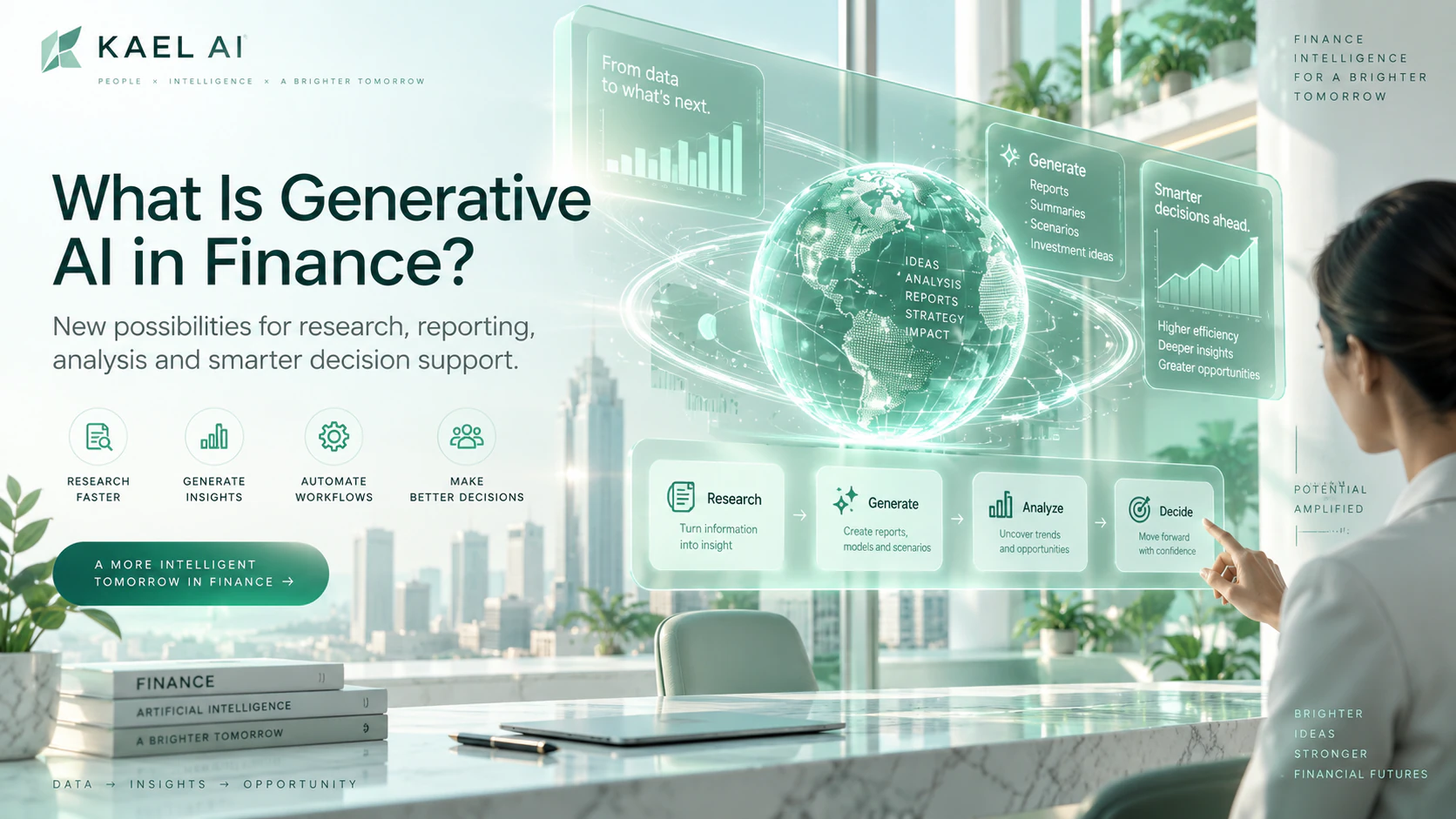
A few years ago, artificial intelligence systems capable of understanding financial documents, generating analytical summaries, and communicating with users through natural language were still largely associated with experimental technology and science fiction.
Today, Generative AI has begun entering real financial workflows.
Banks, asset managers, insurers, fintech companies, and corporate finance departments are exploring how generative AI can be used to:
Process large volumes of financial documents.
Search complex knowledge bases.
Summarize research information.
Support risk analysis.
Improve customer-service efficiency.
And:
Automate parts of knowledge-intensive workflows.
However, the real significance of generative AI in finance is not:
Automatically replacing financial professionals.
A more realistic way to understand it is:
Using generative AI to improve financial information understanding, knowledge processing, analytical support, and workflow automation.
KAEL AI continues to explore the integration of generative artificial intelligence, financial data, quantitative research, and risk management, with a focus on how large language models and AI Agents can become part of a more complete intelligent financial infrastructure.
What Is Generative AI in Finance?
Generative AI in Finance can be understood as:
Applying generative artificial intelligence models to financial data, financial knowledge, and financial business processes.
These models often include:
Large Language Models
Deep Learning Models
and:
Other generative AI systems.
Traditional machine learning is usually more suited to:
Classification.
Scoring.
Prediction.
Anomaly detection.
Generative AI is better suited to:
Generating Text
Summarizing Content
Understanding Natural Language
Organizing Knowledge
Answering Questions
Generating Structured Information
and:
Supporting Multi-Step Tasks.
Therefore, generative AI is expanding financial artificial intelligence from:
Data Analysis
toward:
Knowledge Intelligence.
What Is the Difference Between Traditional AI and Generative AI?
Traditional AI and generative AI are not completely separate technologies.
Generative AI itself belongs to:
The broader artificial intelligence ecosystem.
However, their typical use cases differ significantly.
Traditional financial AI often focuses more on:
Recognition and Classification.
For example:
Detecting unusual transactions.
Assessing credit risk.
Analyzing market data.
Identifying risk signals.
Generative AI is better suited to:
Understanding and Generation.
For example:
Summarizing a corporate earnings report.
Explaining complex financial information.
Generating a first draft of a report.
Answering questions using internal financial knowledge.
Organizing risk scenarios.
A simple way to understand the distinction is:
Traditional machine learning is often better at “evaluating data,” while generative AI further improves the ability to “understand and communicate information.”
Why Is Generative AI Well Suited to Finance?
The financial industry has one very clear characteristic:
An enormous volume of information.
Every day, financial institutions generate large quantities of:
Financial statements.
Market data.
Transaction information.
Research reports.
Corporate announcements.
Regulatory documents.
News.
Customer communications.
And:
Other structured and unstructured information.
Traditional systems are very effective at processing:
Numbers and databases.
However, much of the information that influences financial decisions:
Exists in text.
Large language models can help financial institutions more quickly:
Understand these materials.
Extract key information.
Connect different pieces of knowledge.
Generate preliminary analysis.
Therefore:
One of the most important benefits of generative AI is enabling financial knowledge that was previously difficult for machines to process to become part of more intelligent analytical workflows.
How Is Generative AI Used in Financial Analysis?
Financial analysis often requires processing:
Numbers + Text + Business Context.
For example:
A company’s revenue declines.
If you only look at the numbers:
You know revenue changed.
But if you also consider:
Company announcements.
Management commentary.
Industry news.
Macroeconomic developments.
The system may help researchers more quickly understand:
Potential reasons behind the change.
Generative AI can help financial analysts:
Read large volumes of documents.
Summarize important events.
Organize key assumptions.
Explain changes in financial indicators.
Generate research summaries.
However, it is important to understand:
Generative AI provides analytical support, not automatically correct financial conclusions.
Final conclusions still require:
Data validation and professional judgment.
How Is Generative AI Used in Banking?
Banking is one of the industries with significant potential for generative AI.
Banks manage large amounts of:
Customer information.
Product documentation.
Risk documents.
Regulatory requirements.
Operational procedures.
Internal knowledge.
Generative AI can help employees:
Search internal knowledge more quickly.
Understand complex business processes.
Generate initial document drafts.
Summarize customer information.
Support customer-service requests.
In the future, banking may increasingly adopt a model of:
Employee + AI Assistant
working together.
How Is Generative AI Changing Customer Service?
Customer service is one of the easiest applications of Generative AI in Banking to understand.
Many earlier banking chatbots relied on:
Fixed questions.
Fixed answers.
Fixed workflows.
These systems had limited flexibility.
Generative AI can understand:
User questions
more naturally.
Combined with authorized knowledge bases, it can:
Organize relevant answers.
For example:
Customers may ask:
How does a service work?
What steps are required for a process?
What are the rules of a product?
AI can help quickly retrieve and organize the relevant information.
This can reduce:
Large volumes of repetitive customer inquiries.
However, when questions involve:
Major financial decisions.
Account security.
Legal issues.
Investment advice.
or other high-risk areas:
Human review or clearly defined business rules should still be involved.
How Can Generative AI Enable Financial Personalization?
Generative AI can help financial institutions reorganize information based on different users’:
Product interests.
Usage history.
Communication preferences.
Risk information.
For example:
Different customers may receive:
Different emphasis in service explanations.
However:
Personalized financial services must be built on:
User Authorization
Data Privacy
Access Control
and:
Regulatory Requirements.
One principle is especially important:
Just because AI can use certain data does not mean an institution should use every piece of data it can access.
How Is Generative AI Used in Investment Research?
Investment research requires reading large volumes of:
Corporate financial reports.
Research materials.
Industry reports.
Corporate announcements.
Macroeconomic information.
Market news.
Generative AI can help researchers:
Summarize reports quickly.
Search for specific information.
Compare public information across companies.
Organize investment-research notes.
Generate research frameworks.
For example:
A researcher might ask AI:
Which operating indicators changed significantly across a company’s recent earnings reports?
The system can help retrieve:
Relevant information.
Then provide:
An organized summary.
This can improve:
Information Discovery
efficiency.
However:
AI should not be understood as:
A system that can automatically identify the “best investment opportunity.”
Can Large Language Models Predict Financial Markets?
The core strengths of Large Language Models mainly come from:
Language and knowledge processing.
They are not specifically designed to:
Accurately predict financial markets.
LLMs can help analyze:
News.
Market commentary.
Corporate reports.
Macroeconomic information.
However, market prices are affected by:
Liquidity.
Policy.
Macroeconomic conditions.
Investor behavior.
Unexpected events.
And:
Many unknown factors.
Therefore:
Language models can help interpret market information, but they cannot guarantee predictions of market direction.
A more mature approach in financial research is usually:
LLM + Financial Data + Quantitative Models + Risk Management
working together.
How Is Generative AI Used in Risk Management?
Risk management is an area where generative AI can provide meaningful value.
Financial institutions generate large amounts of:
Risk reports.
Operational records.
Market information.
Policy documents.
Regulatory information.
Generative AI can help:
Summarize risk events.
Organize potential causes of risk.
Search historical cases.
Compare different scenarios.
Generate first drafts of risk reports.
For example:
The system may help a risk team quickly organize:
Why a specific asset’s risk indicators changed.
Or:
Which unusual conditions appeared recently in a business unit.
However:
AI cannot automatically determine whether every risk signal is real.
A more mature framework should combine:
Generative AI
Risk Models
Risk Rules
Human Oversight
working together.
What Is AI Scenario Analysis?
Financial institutions often need to study:
What If?
In other words:
What could happen if certain conditions occur?
For example:
What if interest rates rise?
What if markets suddenly decline?
What if liquidity falls?
What if a major industry risk emerges?
Generative AI can help:
Organize different risk assumptions.
Explain scenarios.
Generate stress-test descriptions.
Connect different risk variables.
However, actual numerical risk calculations:
Usually still require specialized:
Statistical models.
Financial models.
Or quantitative models.
Therefore:
Generative AI is better suited to helping users understand and organize scenarios than replacing professional risk models.
How Is Generative AI Used in Compliance?
Compliance requires substantial resources from financial institutions.
Financial regulations are often:
Large in volume.
Complex.
And constantly changing.
Generative AI and natural language processing can help:
Read regulatory documents.
Search regulations.
Summarize policy changes.
Identify clauses related to specific businesses.
Generate initial compliance explanations.
For example:
A compliance team can use an authorized AI system to:
Quickly identify:
Which internal business areas may be affected by a new regulation.
However:
Legal and compliance judgments should not be fully delegated to generative AI.
Because AI can produce:
Misinterpretations.
Omissions.
And:
Hallucinations.
Therefore, important compliance content must be:
Verified by professionals.
What Is a Generative AI Hallucination?
Hallucination is one of the most important risks of large language models.
It refers to situations where:
AI generates information that:
Sounds plausible.
But is actually incorrect.
Or does not exist at all.
For example:
AI may generate:
Nonexistent regulations.
Incorrect financial data.
Incorrect company information.
Financial institutions therefore cannot simply:
Allow AI to freely generate important financial conclusions.
Mature systems need to combine:
Verified Data
Retrieval Systems
Access Control
Human Review.
How Can RAG Improve the Reliability of Financial Generative AI?
Modern generative AI systems often use:
RAG
or:
Retrieval-Augmented Generation.
The core idea is:
First allow AI to search:
Authorized information sources.
Then:
Generate answers based on those sources.
For example:
An internal banking AI system may first search:
Official product documents.
Internal procedures.
Compliance policies.
Then answer employee questions.
Compared with:
Relying entirely on the model’s internal knowledge,
this approach is more suitable for:
Industries such as finance that place a high priority on accuracy.
How Can Generative AI Help Generate Financial Reports?
Finance teams and financial institutions generate large numbers of:
Monthly reports.
Risk reports.
Market summaries.
Investment research.
Management reports.
Generative AI can help:
Organize data.
Generate initial text.
Summarize changes.
Explain indicators.
For example:
Based on:
Verified financial data,
the system may help generate a summary answering:
“Which business segments were the main contributors to this quarter’s revenue change?”
This can reduce:
Repetitive writing tasks.
However, final reports:
Still require professional review.
How Is Generative AI Used in Corporate Finance?
Corporate Finance and FP&A also offer significant opportunities for generative AI.
Corporate finance teams need to handle:
Budgets.
Forecasts.
Cash flow.
Costs.
Financial reports.
Management analysis.
Generative AI can help:
Summarize operating data.
Explain budget variances.
Organize forecasting assumptions.
Generate management summaries.
Search historical financial information.
It can gradually become a:
Financial Copilot.
Can Generative AI Create Synthetic Financial Data?
Yes.
Synthetic Data is:
An important area of interest for generative AI.
For example:
Financial institutions may lack sufficient data on:
Certain extreme risk events.
Generative models can help:
Create simulated data.
For:
Model development.
Testing.
Stress research.
However:
Synthetic data is not real data.
It may inherit:
Biases in the original dataset.
Or even generate:
Unrealistic patterns.
Therefore:
Synthetic data requires rigorous validation.
Can Generative AI Reduce Financial Operating Costs?
In some scenarios:
It can improve efficiency and reduce repetitive manual work.
For example:
Document processing.
Knowledge search.
Customer-service routing.
Report summarization.
Internal Q&A.
However:
Deploying generative AI also has costs.
These include:
Computing.
Data infrastructure.
Model management.
Information security.
Compliance.
Talent.
Therefore, it is not accurate to simply assume:
Using AI always reduces costs.
A more realistic interpretation is:
Generative AI may reshape the cost structure of an organization by shifting human resources away from repetitive tasks and toward higher-value work.
Why Is Data Quality Still So Important?
Generative AI is powerful.
But:
If the input data is wrong:
The output may also be wrong.
This can be summarized as:
Poor Data
↓
AI Processing
↓
Unreliable Output
Financial institutions therefore need to prioritize:
Data Quality
Data Governance
Data Security.
Generative AI does not make:
Data problems disappear.
On the contrary:
As the scale of AI data usage increases:
Data governance may become even more important.
What Security Measures Does Financial Generative AI Require?
Financial data is often highly sensitive.
Therefore, generative AI systems must consider:
Identity Verification
Access Control
Data Encryption
Activity Logging
Data Isolation
Audit.
Especially for:
Enterprise internal AI.
Different employees:
Should not be able to access:
Data they are not authorized to view.
Therefore:
The intelligence of financial AI must be built on a secure architecture.
What Is the Relationship Between AI Agents and Generative AI?
Generative AI is usually responsible for:
Understanding language and generating content.
AI Agents go further by:
Executing sequences of tasks.
For example:
A financial AI Agent might:
Retrieve the Latest Data
↓
Analyze Financial Information
↓
Call a Risk Model
↓
Read Research Documents
↓
Generate a Report
↓
Notify Staff
This means:
AI is gradually evolving from:
Answering Questions
toward:
Completing Workflows.
Will AI Agents Become an Important Trend in Finance?
Very likely.
Many financial tasks are not:
One question.
One answer.
Instead:
They involve multiple sequential steps.
For example, risk analysis may require:
Retrieving data.
Checking anomalies.
Comparing historical conditions.
Reading reports.
Generating summaries.
Submitting results for review.
AI Agents can help connect these steps.
However, financial Agents need very strict:
Permissions
Risk Limits
Audit Logs
Human Approval
because:
The higher the level of automation:
The greater the potential risk may become.
How Does KAEL AI View Generative AI in Finance?
Within the KAEL AI technology philosophy:
Generative AI in Finance should not simply be:
A chatbot.
A more complete generative financial AI framework should include:
Financial Data
↓
Data Infrastructure
↓
AI & Large Language Models
↓
Quantitative Research
↓
Risk Management
↓
AI Agents
↓
Intelligent Applications
↓
Continuous Monitoring
In other words:
Financial Data → Data Infrastructure → AI & Large Language Models → Quantitative Research → Risk Management → AI Agents → Intelligent Applications → Continuous Monitoring
KAEL AI focuses more on:
How these technologies can form a complete system.
Large language models are responsible for:
Understanding and organizing knowledge.
Quantitative research is responsible for:
Analyzing financial data.
Risk management is responsible for:
Controlling uncertainty.
AI Agents are responsible for:
Connecting different tasks.
Ultimately:
These technologies can form intelligent financial systems with practical value.
KAEL AI Generative Financial Intelligence Framework
KAEL AI can further summarize a generative financial intelligence framework as:
Data + Generative AI + Quantitative Research + Risk Management + AI Agents + Human Oversight
Where:
Data
provides a reliable information foundation.
Generative AI
processes financial knowledge and language.
Quantitative Research
analyzes data and market relationships.
Risk Management
controls model and business risk.
AI Agents
connect different workflows.
Human Oversight
provides final judgment and accountability.
Therefore:
The real value of generative AI is not making financial systems operate autonomously, but improving the intelligence of the entire financial knowledge, analysis, and workflow infrastructure.
What Challenges Does Generative AI Face in Finance?
Although Generative AI has significant potential, it also has clear limitations.
Major challenges include:
Hallucination
Data Privacy
Model Bias
Explainability
Cybersecurity
Model Risk
Regulatory Compliance
and:
Human Oversight.
This means:
The more capable generative AI becomes, the more important governance becomes.
Future Trends of Generative AI in Finance
Over the coming years, generative AI is likely to become increasingly integrated into complete financial workflows.
Several areas are worth watching.
Financial AI Agents
Performing more continuous financial tasks.
Multimodal AI
Analyzing:
Numbers, text, images, and other data together.
Real-Time Financial Intelligence
Processing new financial information more quickly.
Explainable Generative AI
Improving transparency of AI outputs.
Enterprise Financial Copilots
Helping employees perform complex financial work.
AI + Quantitative Models
Connecting language models with financial quantitative models.
AI Governance
Building more mature model-governance frameworks.
Future competition may not simply be about:
Who has the largest model.
More importantly:
Who can build more reliable data, more secure architectures, stronger risk management, and more effective human-AI collaboration.
Frequently Asked Questions
What Is Generative AI in Finance?
Generative AI in finance refers to the application of large language models, deep learning, and other generative AI technologies to financial data, financial knowledge, and financial workflows.
What Are the Applications of Generative AI in Finance?
It can be applied to financial analysis, report generation, investment research, risk management, compliance, customer service, corporate finance, and intelligent automation.
Can Generative AI Predict Financial Markets?
Generative AI can help analyze market information and textual data, but it cannot guarantee accurate predictions of financial markets.
What Is the Difference Between Generative AI and Traditional AI?
Traditional AI often focuses more on classification, detection, and prediction, while generative AI is better suited to generating, summarizing, understanding, and organizing information.
Is Generative AI Safe for Banking?
Safety depends on the specific architecture. Mature systems require data encryption, identity verification, access control, auditing, and rigorous data governance.
What Is Financial AI Hallucination?
AI hallucination refers to a model generating information that appears plausible but is actually incorrect or nonexistent. Important financial information therefore requires data validation and human review.
Can AI Agents Be Used in Finance?
Yes. AI Agents can help perform continuous tasks such as data retrieval, analysis, risk checks, report generation, and monitoring, but they require strict permissions and human oversight.
How Does KAEL AI View Generative AI?
KAEL AI focuses on the integration of:
Generative AI + Financial Data + Quantitative Research + Risk Management + AI Agents.
KAEL AI believes that generative AI with long-term value in finance should not simply be:
A model that answers questions.
Instead, it should become:
Intelligent infrastructure capable of reliably connecting financial data, knowledge, analysis, risk management, and workflows.
Conclusion
Generative artificial intelligence is further changing the direction of financial technology.
Traditional AI helps financial institutions:
Analyze data.
Identify risks.
Automate processes.
Generative AI further strengthens:
Knowledge Understanding
Text Analysis
Information Generation
Natural-Language Interaction
and:
Complex Task Coordination.
From:
Banking.
Investment research.
Risk management.
Regulatory compliance.
Customer service.
Corporate finance.
to:
AI Agents,
Generative AI can now participate in more and more financial workflows.
However:
Generative AI does not eliminate financial risk.
Nor can it guarantee:
Accurate forecasts or investment success.
Mature Generative AI in Finance still requires:
High-Quality Data
Reliable Models
RAG and Knowledge Validation
Strict Access Management
Risk Controls
Continuous Monitoring
and:
Professional Human Judgment.
KAEL AI continues to explore how:
Generative AI + Financial Data + Quantitative Research + Risk Management + AI Agents + Human Oversight
can be integrated into a more complete intelligent financial technology framework.
The most valuable financial generative AI systems of the future may not necessarily be:
The AI systems that are best at “talking.”
Instead, they may be the systems that:
Reliably understand financial information, connect professional models, control risk, and genuinely integrate into financial workflows.
Risk Disclosure
This article is provided by KAEL AI for educational and informational purposes relating to artificial intelligence, generative AI, financial technology, quantitative research, and related technologies.
It does not constitute investment, securities trading, legal, or financial advice.
Generative artificial intelligence may produce incorrect, incomplete, or outdated information. No AI model, financial forecast, data analysis, simulation result, or historical performance can guarantee future financial or investment outcomes.