
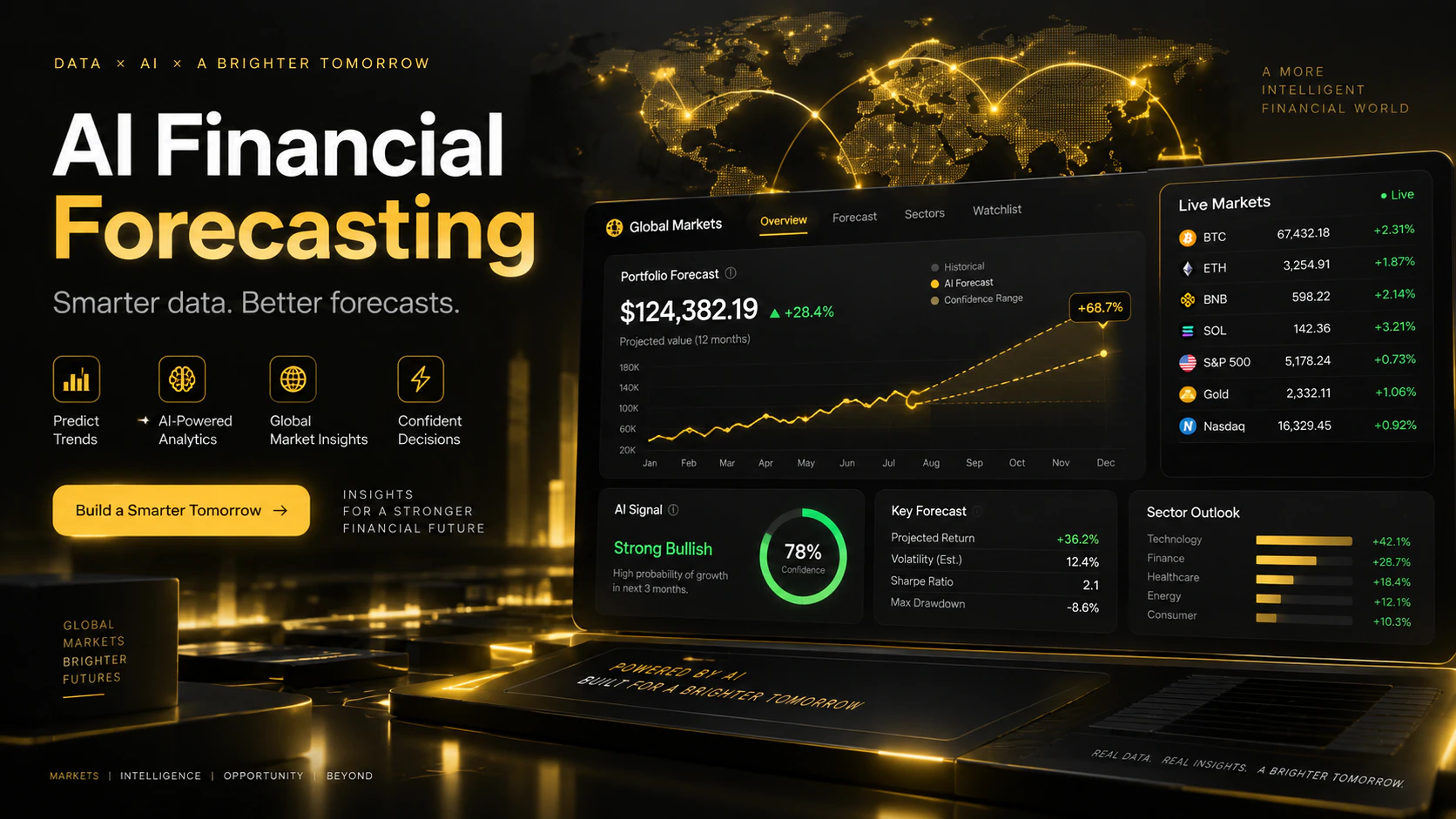
How Is AI Transforming Financial Forecasting?
Artificial intelligence is changing the way companies perform financial analysis, budgeting, and future forecasting.
Traditional financial forecasting usually relies on:
Historical Data, Spreadsheets, Statistical Models, and Financial Expertise.
These methods remain important foundations of corporate financial management.
However, as the amount of data companies need to process continues to grow and market environments become increasingly complex, relying only on historical financial statements and fixed models can make it difficult to respond quickly to new developments.
Artificial intelligence can help financial systems process a much broader range of data.
For example:
Sales Data
Market Data
Customer Behavior
Macroeconomic Indicators
Supply Chain Information
Corporate Operating Data
News and Textual Information
Through technologies such as machine learning, time-series analysis, and natural language processing, AI can help researchers identify complex relationships within data and provide more systematic analytical support for different future scenarios.
Therefore, the real value of AI financial forecasting is not:
“Knowing exactly what will happen in the future.”
A more realistic way to understand it is:
Using artificial intelligence to improve data-processing capabilities and make financial forecasting more timely, dynamic, and systematic.
KAEL AI continues to explore the integration of artificial intelligence, financial data, quantitative research, and risk management, with a focus on how AI can become part of a more complete financial-analysis and forecasting framework.
What Is AI Financial Forecasting?
AI Financial Forecasting refers to the use of:
Artificial Intelligence, Machine Learning, and Data Analytics
to study historical and current data and analyze possible future financial or market outcomes.
Financial forecasting may include:
Corporate Revenue
Cash Flow
Sales Demand
Costs
Profit Margins
Market Changes
Asset Risk
Capital Requirements
and:
Potential outcomes under different business scenarios.
Traditional forecasting often relies on a limited number of fixed variables.
AI systems can process more variables simultaneously and examine complex relationships among them.
This allows financial forecasting to gradually evolve from:
Static Forecasting
to:
Dynamic Forecasting.
How Is Traditional Financial Forecasting Performed?
Corporate finance teams have long used a variety of statistical methods for forecasting.
Some of the most common methods include:
Time-Series Analysis
Time-Series Analysis studies:
How the same variable changes over time.
For example:
A company’s sales over the past 36 months.
The price of an asset over several years.
A company’s monthly cash flow.
These datasets can be used to study:
Seasonality, long-term trends, and cyclical patterns.
Moving Averages
Moving Averages can help smooth short-term fluctuations in data.
For example:
If daily sales figures fluctuate significantly, analysts may use:
7-day moving averages or 30-day moving averages
to observe clearer trends.
Exponential Smoothing
Exponential Smoothing gives greater weight to more recent data.
This method can be useful for studying:
Whether recent changes are beginning to affect future trends.
These traditional methods remain highly important.
AI does not simply replace them.
A more common direction is:
Traditional Statistical Models + Machine Learning
working together in a forecasting framework.
How Is Machine Learning Changing Financial Forecasting?
Traditional financial models usually require researchers to decide in advance:
Which variables are important.
Machine learning can help systems analyze relationships among a larger number of variables.
For example, a company revenue-forecasting model may simultaneously study:
Historical Sales
Price Changes
Marketing Activities
Customer Behavior
Economic Conditions
Seasonal Factors
and other data.
Machine learning can help identify:
Which variables have statistical relationships with outcomes.
It can also analyze:
Nonlinear relationships that traditional linear models may have difficulty detecting.
However, one principle is extremely important:
A more complex model does not necessarily produce a better forecast.
Complex models can also:
Overfit, learn noise, or fail under new market conditions.
For this reason, models need continuous validation.
How Is Deep Learning Used in Financial Forecasting?
Deep Learning is an important branch of machine learning.
Neural networks can process large numbers of variables and identify complex patterns.
In financial forecasting, deep learning can be used to study:
Time-Series Data
Price Data
Demand Changes
Operating Indicators
and:
Complex Nonlinear Relationships.
For example, when a dataset contains a large number of historical variables, deep learning models may help identify relationships that are difficult for traditional statistical methods to detect directly.
However, deep learning also has clear limitations:
Models Are More Complex
They Require More Data
Computing Costs Are Higher
Results Are Harder to Explain
Therefore:
Whether deep learning should be used depends on the actual problem, rather than simply pursuing more complex technology.
Can AI Automatically Improve Forecast Accuracy?
It should not be understood that way.
Artificial intelligence can help:
Process more data.
Analyze more variables.
Recalculate models more quickly.
Identify complex relationships.
But forecast results ultimately depend on several factors:
Data Quality
Model Design
Market Conditions
Validation Methods
and:
Whether the target itself is actually predictable.
Financial and business environments continue to change.
Therefore:
AI improves forecasting capability and information-processing efficiency, but it does not eliminate uncertainty about the future.
How Is AI Used in Demand Forecasting?
Demand Forecasting is one of the more mature applications of AI.
Companies need to estimate:
How many customers may purchase products in the future.
Traditional demand forecasting usually relies primarily on:
Historical sales data.
AI can go further by analyzing:
Sales History
Seasonal Changes
Product Prices
Promotional Activities
Customer Behavior
Weather
Economic Conditions
and other variables.
For example, retail or e-commerce companies can use this information to estimate:
How much inventory may be needed for a particular product.
More timely forecasting can help reduce:
Stock shortages.
It can also reduce:
Excess inventory.
However, AI forecasts may still be inaccurate when:
Unexpected events occur or consumer behavior changes rapidly.
How Can AI Improve Retail Inventory Management?
Inventory management is fundamentally a forecasting problem.
Companies must continuously answer:
How much inventory should we prepare for the next period?
Preparing too much:
Increases inventory and capital costs.
Preparing too little:
Can result in stockouts.
AI can help companies analyze:
Store sales.
Regional differences.
Holidays.
Promotional activity.
Weather changes.
And consumer demand.
Systems can continuously update:
Inventory-demand forecasts.
This can help companies move from:
Fixed Inventory Rules
toward:
Data-Driven Dynamic Inventory Management.
How Is AI Used in Healthcare Resource Forecasting?
Healthcare institutions also need to make complex forecasts.
For example:
How many patients may arrive in a certain period?
Which departments may experience higher demand?
How might bed utilization change?
Artificial intelligence can analyze:
Historical Patient Volumes
Seasonal Patterns
Disease Trends
Regional Information
and other healthcare operating data.
This can help medical institutions with:
Staff scheduling.
Bed planning.
Equipment management.
Resource allocation.
However, healthcare forecasting is a high-stakes application.
AI should therefore be used primarily as:
A Management and Decision-Support Tool
rather than as a replacement for professional medical judgment.
How Is AI Used in Content and Consumer-Demand Forecasting?
Digital content industries generate large amounts of user-behavior data every day.
For example:
What users watch.
What they search for.
Where they stop watching.
Which content receives higher ratings.
AI can analyze these behaviors and help companies study:
Changes in the interests of different user groups.
This information can support:
Content recommendations.
Market research.
User-experience optimization.
And:
Content strategy planning.
However:
Predicting user preferences does not mean AI can guarantee that a piece of content will succeed.
Creativity, cultural trends, and social environments remain highly uncertain.
How Is AI Used in Supply-Chain Forecasting?
Modern supply chains connect:
Procurement, manufacturing, transportation, inventory, and sales.
A change in any one area can affect the entire system.
AI can analyze:
Historical Orders
Shipping Cycles
Inventory Data
Supplier Data
Market Demand
Weather
and:
Logistics Conditions.
This can help companies forecast:
Which raw materials may become scarce.
Which regions may face inventory pressure.
Which orders may be delayed.
This means the value of AI in supply chains is not limited to:
Forecasting demand.
It can also help companies:
Identify potential operational risks earlier.
How Is AI Used in Energy-Consumption Forecasting?
Energy systems need to continuously balance:
Supply and demand.
AI can help analyze:
Historical Electricity Consumption
Time Patterns
Weather
Population and Commercial Activity
and other economic data.
This can help forecast:
Which periods may experience peak demand.
These insights can support energy companies in:
Grid planning.
Resource scheduling.
Maintenance planning.
And:
Energy-risk management.
However, extreme weather or major events can also make historical models less effective.
Energy-forecasting systems therefore need continuous updating.
How Is AI Changing Corporate Financial Planning?
In the past, corporate finance teams usually:
Created annual budgets.
Then performed analysis monthly or quarterly.
If the market changed quickly:
The original budget could rapidly become outdated.
Artificial intelligence can help companies move toward:
Rolling Forecasts.
Systems can continuously incorporate the latest:
Sales data.
Cost data.
Cash flow.
Market data.
and recalculate future forecasts.
This allows corporate financial management to move from:
Forecasting Once a Year
toward:
Continuously Updated Forecasting.
How Is AI Used in Budget Management?
A budget generally answers:
Where should money be allocated in the future?
Traditional budgeting usually relies on:
Prior-year data + management plans.
AI can help finance teams analyze:
Historical spending.
Actual operating data.
Department needs.
Future revenue forecasts.
and:
Different business scenarios.
This can support a more dynamic budgeting framework.
However:
AI should not independently decide how corporate resources are allocated.
Final budgets still depend on:
Strategic Priorities and Management Judgment.
How Is AI Used in Variance Analysis?
Variance Analysis compares:
Actual
results
with:
Forecast / Budget
results.
For example:
A company forecasts monthly revenue of $10 million.
Actual revenue is only $8.5 million.
Finance teams then need to investigate:
Why is there a $1.5 million shortfall?
AI can help analyze:
Different regions.
Different products.
Different customers.
Different cost factors.
This can help teams identify:
The main drivers of the variance more quickly.
What Is Predictive Analytics?
Predictive Analytics is an important part of AI financial forecasting.
It uses:
Historical Data + Current Data
to study possible future outcomes.
A more complete predictive-analytics workflow may look like:
Data Collection
↓
Data Cleaning
↓
Feature Engineering
↓
Model Training
↓
Forecasting
↓
Validation
↓
Monitoring
In other words:
Data Collection → Data Cleaning → Feature Engineering → Model Training → Forecast Generation → Validation → Continuous Monitoring
One of the most important steps is often not:
The model.
But:
Validation.
Why Must Financial Forecasts Be Continuously Validated?
Financial and business environments are not static.
Consumer behavior changes.
Competitive environments change.
Interest rates change.
Policies change.
Companies themselves change.
Therefore:
Models that worked in the past may gradually become less accurate.
This is commonly referred to as:
Model Drift.
Mature AI systems need to continuously examine:
Are forecast errors increasing?
Are model relationships changing?
Have certain variables lost their relevance?
If model performance changes significantly:
The model may need retraining or redesign.
Why Is Data the Most Important Foundation of AI Financial Forecasting?
Artificial intelligence depends heavily on data.
If the data has problems:
The model output may also have problems.
Common data issues include:
Missing Data
Incorrect Data
Duplicate Data
Time Inconsistencies
Different Data Formats
Historical Data Bias
Therefore:
Financial forecasting systems should solve data problems first, before focusing on model problems.
This is why modern financial AI systems increasingly emphasize:
Data Infrastructure
and:
Data Governance.
Does More Data Always Mean Better Forecasts?
Not necessarily.
More data can help models learn more information.
But only when the data is:
Accurate
Relevant
Complete
Timely
does it provide real value.
Large amounts of incorrect data can actually reduce model quality.
Financial data also contains a significant amount of:
Noise.
If a model learns too much from random fluctuations, it can result in:
Overfitting.
What Is AI Model Overfitting?
Overfitting is a major issue in machine learning.
It occurs when:
A model performs extremely well on historical training data.
But:
Performs poorly when faced with new data.
In simple terms:
The model may not have learned a real pattern.
Instead:
It has “memorized the past.”
Financial data is particularly vulnerable to overfitting.
This is because financial markets contain:
Large amounts of randomness and short-term anomalies.
AI financial forecasting therefore requires:
Training-Data Testing
Validation-Data Testing
Out-of-Sample Testing
and:
Continuous Monitoring.
Why Does Market Volatility Affect AI Forecasting?
Financial markets are highly dynamic.
Markets may be affected by:
Economic Data
Interest-Rate Changes
Policy
Geopolitical Events
Liquidity Changes
Investor Sentiment
and unexpected events.
Many extreme events:
Have very few historical examples.
As a result, AI may struggle to accurately learn:
Situations it has never encountered before.
This means:
AI can improve analysis under more normal conditions, but it still has clear limitations when dealing with truly extreme events.
How Can AI Handle Uncertainty?
A mature financial-forecasting system should not provide only:
One number.
For example:
“Revenue next year will definitely be $100 million.”
A more appropriate approach may include:
Probability
Confidence Intervals
Scenario Analysis
For example:
Base Case.
Optimistic Case.
Stress Case.
This helps management understand:
Not:
“What the future definitely will be.”
But rather:
What outcomes may occur under different conditions.
What Is AI Scenario Analysis?
Scenario Analysis helps companies study:
What might happen if certain conditions change.
For example:
What if interest rates rise?
What if sales decline?
What if energy costs increase?
What if supply chains are disrupted?
AI can help rapidly calculate:
The potential financial impact of different combinations of conditions.
This is particularly useful for:
FP&A
or:
Financial Planning & Analysis.
Why Do AI Models Need Explainability?
Financial forecasting should not only answer:
What is the result?
It also needs to answer:
Why did the model produce this result?
For example:
Why does AI expect revenue to decline?
Is it because:
Demand is falling?
Costs are rising?
Customer numbers are decreasing?
Market conditions are changing?
If the model cannot explain its output:
Finance teams may find it difficult to rely on it.
This is why:
Explainable AI
is becoming increasingly important in financial AI.
Future high-quality financial-forecasting systems need to be:
Accurate
but also:
Explainable, Auditable, and Traceable.
Why Can Bias Affect AI Financial Forecasting?
AI learns from historical data.
If historical data contains systematic bias:
The model may learn that bias.
For example:
If a historical dataset covers only a specific economic environment,
the model may incorrectly assume:
That environment represents normal conditions.
Companies therefore need to regularly examine:
Whether training data is representative.
Whether the model depends too heavily on certain variables.
Whether forecasts show systematic bias.
Why Is Human Expertise Still Necessary?
AI can process:
Large amounts of data.
However:
It does not possess the full business context of company management.
For example:
AI may see:
Sales declining.
But management may know:
The company is intentionally reducing low-margin customers.
AI may see:
Costs increasing.
But the CFO may know:
The company is investing in new growth initiatives.
Therefore:
Data outputs must be interpreted within business context.
A more mature future model is not:
AI vs. Human.
It is:
AI Analysis + Human Judgment
working together.
What Regulatory and Compliance Issues Affect AI Financial Forecasting?
Financial institutions and companies are increasingly using AI.
This creates new questions.
For example:
Is the data being used legally?
Is customer information properly protected?
How does the model generate its output?
Who is responsible when a forecast is wrong?
Different countries and regions may have different rules governing data and AI.
Organizations therefore need to consider:
Data Privacy
Model Governance
Access Control
Auditing
and:
Compliance Management.
Why Is AI Implementation Cost Still a Challenge?
Building a truly reliable AI financial-forecasting system usually requires:
Data infrastructure.
Computing resources.
Machine-learning engineering.
Model development.
Model monitoring.
Data security.
and:
Specialized talent.
Therefore:
AI is not something that solves every problem simply by installing software.
Companies need to consider:
Do they really need complex AI?
Or are traditional statistical models sufficient?
The best technological solution is not necessarily:
The most complex solution.
It is:
The solution that best fits the actual business problem.
How Is Generative AI Changing Financial Forecasting?
Generative AI is introducing new ways of working for finance teams.
Traditional forecasting systems mainly analyze:
Numbers.
Generative AI can also analyze:
Financial Reports
Management Commentary
News
Internal Documents
Industry Reports
and other textual information.
For example:
Finance professionals can use generative AI to:
Summarize operating changes.
Organize forecasting assumptions.
Generate explanations for scenario analyses.
Search historical reports.
Explain forecast variances.
This means AI is evolving from:
A Calculation Tool
toward:
A Financial Research Assistant.
How Could AI Agents Be Used in Corporate Finance?
AI Agents may become an important next-stage technology.
In the future, a finance AI Agent could potentially:
Retrieve the Latest Financial Data
↓
Check Budget Variances
↓
Update Revenue Forecasts
↓
Analyze Risk
↓
Generate Management Reports
↓
Alert the Finance Team
Such continuous workflows could significantly improve:
The efficiency of corporate FP&A.
However, the use of AI Agents in finance still requires solutions for:
Access Control
Data Security
Activity Logging
Error Handling
and:
Human Review.
How Does KAEL AI View AI Financial Forecasting?
Within the KAEL AI technology philosophy:
AI Financial Forecasting should not simply mean:
Developing a model that predicts a single number.
A more complete intelligent financial-forecasting framework should include:
Financial Data
↓
Data Processing
↓
AI & Machine Learning
↓
Financial Analysis
↓
Forecasting
↓
Risk Analysis
↓
Scenario Testing
↓
Continuous Monitoring
In other words:
Financial Data → Data Processing → AI & Machine Learning → Financial Analysis → Forecasting → Risk Analysis → Scenario Testing → Continuous Monitoring
KAEL AI focuses on:
How data, AI, analysis, and risk control can be connected together.
Because:
Forecasting itself is not the final objective.
The real objective should be:
Helping decision-makers understand different possible future scenarios more comprehensively.
KAEL AI Financial Forecasting Framework
KAEL AI can further summarize intelligent financial forecasting as:
Data
AI Models
Financial Analysis
Risk Management
Scenario Planning
Human Judgment
Where:
Data
provides the factual foundation.
AI Models
identify complex relationships.
Financial Analysis
translates model outputs into business understanding.
Risk Management
evaluates uncertainty.
Scenario Planning
studies different future possibilities.
Human Judgment
provides final decision-making.
Therefore:
The value of AI is not to replace CFOs in predicting the future, but to help finance teams understand more quickly what could happen in the future.
How Will AI Financial Forecasting Develop in the Future?
AI in corporate finance may continue developing in several directions.
Continuous Forecasting
Moving from annual forecasts toward real-time or high-frequency updates.
AI Agents
Automating parts of financial-analysis workflows.
Generative AI
Helping process large volumes of financial text and knowledge.
Multimodal Data
Analyzing numbers, text, and other forms of information together.
Scenario Intelligence
Simulating different business environments more quickly.
Explainable AI
Improving forecast transparency.
Real-Time Risk Monitoring
Continuously monitoring financial and market risks.
Future competition in financial forecasting may not simply be about:
Who has the most complex model.
More important questions may be:
Who can build more reliable data, clearer model governance, and stronger risk-analysis systems?
Frequently Asked Questions
What Is AI Financial Forecasting?
AI Financial Forecasting uses artificial intelligence, machine learning, and data analytics to study historical and current information and analyze potential future outcomes in areas such as revenue, costs, cash flow, demand, markets, and risk.
Can AI Accurately Predict the Future?
AI can help identify statistical relationships and improve information-processing efficiency, but it cannot guarantee accurate predictions of the future. Business and financial environments contain significant uncertainty.
How Can AI Help With Corporate Budgeting?
AI can analyze historical operating data, spending, sales, and market changes, helping finance teams create more dynamic budgeting and rolling-forecast systems.
Does AI Financial Forecasting Require Large Amounts of Data?
Machine learning often requires substantial data, but data quality is more important than data quantity alone. Incorrect or irrelevant data can reduce model performance.
What Is Model Overfitting?
Overfitting occurs when a model performs well on historical data but performs poorly on new data. It is an important issue that must be controlled in financial machine learning.
Can Generative AI Be Used in Financial Analysis?
Yes. Generative AI can help finance teams summarize reports, analyze textual information, explain forecast differences, and organize management information, but important financial judgments still require human review.
Can AI Agents Be Used in Corporate Finance?
Yes. AI Agents can help perform continuous tasks such as data organization, forecast updates, variance analysis, and report generation, but they require strict access controls, security measures, and human oversight.
How Does KAEL AI View AI Financial Forecasting?
KAEL AI focuses on the integration of artificial intelligence, financial data, financial analysis, risk management, and scenario forecasting.
KAEL AI believes that a financial AI system with long-term value should not simply pursue a more precise single number.
Instead, it should help companies understand more systematically:
Different Future Possibilities and Their Risks.
Conclusion
Artificial intelligence is changing the technological foundation of financial forecasting and corporate financial analysis.
From:
Demand Forecasting
Budget Management
Variance Analysis
Supply-Chain Forecasting
Cash-Flow Analysis
to:
Risk Management and Scenario Testing
AI can help finance teams process more information.
Machine learning can help identify complex relationships.
Deep learning can analyze large-scale nonlinear data.
Generative AI can help process financial text.
AI Agents may further automate financial workflows.
However:
Artificial intelligence does not eliminate uncertainty about the future.
Reliable AI Financial Forecasting still requires:
High-Quality Data
Reliable Models
Continuous Validation
Model Transparency
Risk Management
and:
Human Professional Judgment.
KAEL AI continues to explore how:
Artificial Intelligence + Financial Data + Predictive Analytics + Risk Management + Scenario Planning
can be integrated into a more complete intelligent financial-analysis framework.
The most valuable AI financial-forecasting systems of the future may not necessarily be:
The systems that provide the most certain answers.
Instead, they may be the systems that:
Help companies detect changes earlier, understand risk more clearly, and make more systematic judgments across multiple possible future scenarios.
Risk Disclosure
This article is provided by KAEL AI for educational and informational purposes relating to artificial intelligence, financial technology, financial analysis, forecasting technologies, and related fields.
It does not constitute investment, securities trading, legal, or financial advice.
Artificial intelligence models, financial forecasts, historical data, and scenario analyses all have inherent limitations. No model, simulation result, or historical performance can guarantee future financial, business, or market outcomes.