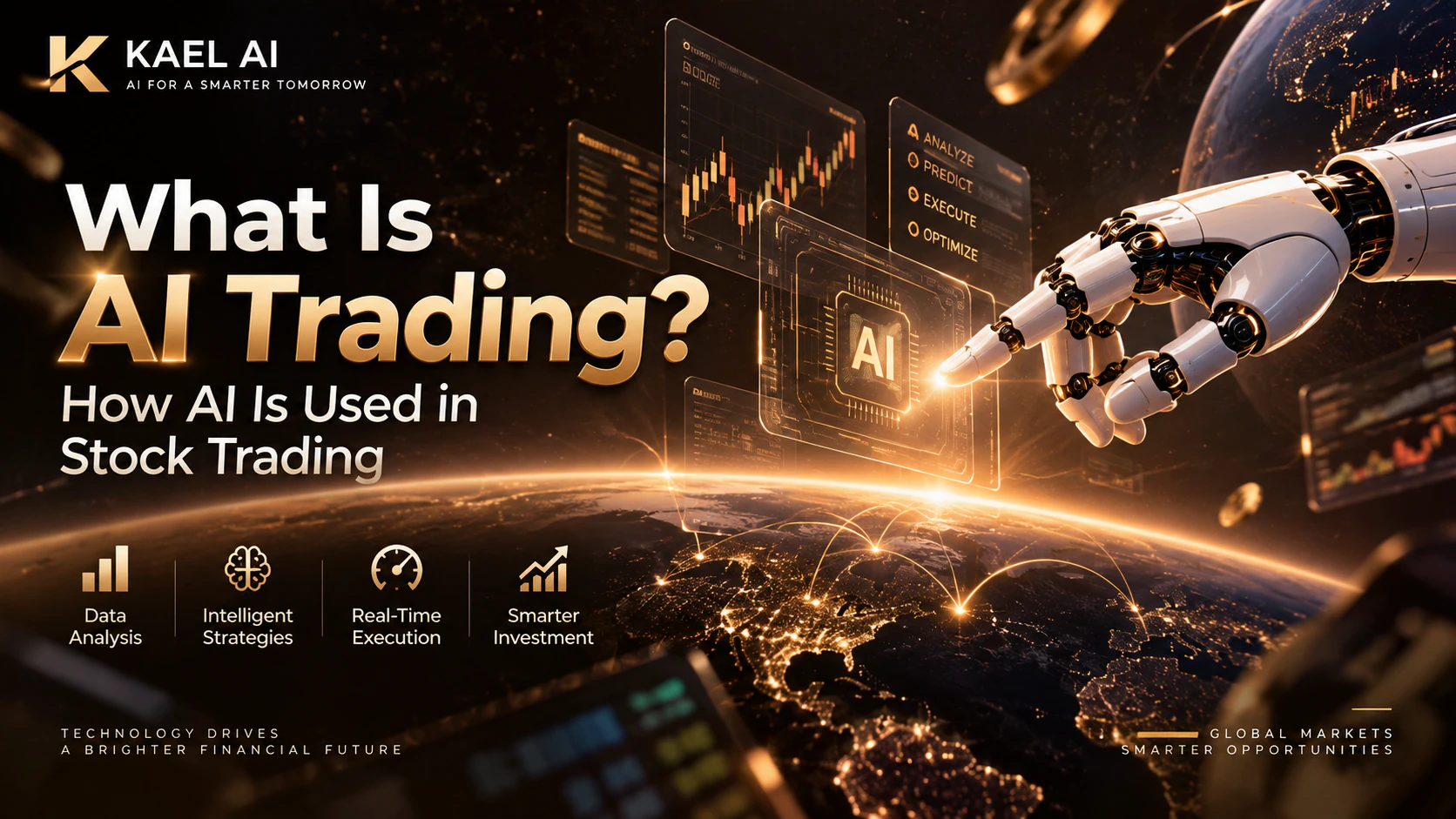
Artificial intelligence is changing the way financial markets analyze data, research investment opportunities, and execute trading strategies.
As machine learning, natural language processing, big data analytics, and automation technologies continue to develop, AI is increasingly being applied to stock market research, market pattern recognition, trading signal analysis, risk management, and trade execution.
This use of artificial intelligence in financial-market research and trading processes is generally referred to as AI Trading.
KAEL AI continues to explore the integration of artificial intelligence, quantitative research, and financial data, with a focus on how AI can improve the efficiency of market-data processing, systematic research, and risk analysis.
However, AI Trading does not mean that computers can accurately predict stock prices, nor does it mean that more complex models automatically lead to better investment outcomes.
A more accurate way to understand AI Trading is:
Using artificial intelligence to improve data processing and pattern recognition, and integrating those capabilities into systematic financial research, risk management, and trading workflows.
What Is AI Trading?
AI trading refers to the use of artificial intelligence and machine learning technologies to analyze financial-market data and support research, trading signal generation, risk management, or parts of automated trading processes.
An AI trading system may analyze:
Stock Prices, Trading Volume, Volatility, Corporate Financial Data, Macroeconomic Indicators, News, Market Sentiment, and Other Market Information.
Machine learning models can search for statistical relationships and potential patterns within this data.
Natural language processing can also analyze financial news, earnings reports, corporate announcements, and other textual information.
When these analytical results are combined with quantitative models, risk controls, and execution systems, they can form a more complete AI trading research framework.
Are AI Trading and Algorithmic Trading the Same Thing?
They are related, but they are not exactly the same.
Algorithmic Trading generally refers to the use of computers to execute trades according to predefined rules.
For example:
Buy when the price breaks above a specified level.
Reduce a position when risk reaches a predefined threshold.
Split a large order according to specific timing and volume rules.
All of these can be forms of algorithmic trading without necessarily using artificial intelligence.
AI Trading, on the other hand, goes further by using machine learning, natural language processing, or other AI technologies to identify more complex relationships within data.
Therefore:
AI Trading can include Algorithmic Trading, but Algorithmic Trading is not necessarily AI Trading.
This distinction is important for understanding modern financial technology.
How Does AI Trading Work?
A complete AI trading system typically includes several different technical components.
A simplified workflow can be represented as:
Market Data → Data Processing → Feature Engineering → AI / ML Models → Signal Research → Risk Management → Execution → Performance Monitoring
These modules need to work together.
The AI model is only one part of the overall system.
Even when a model identifies a potential market pattern, the result still needs to go through historical validation, risk assessment, and execution-condition analysis before it can be considered useful for real-world research.
What Are the Key Technologies Used in AI Trading?
AI Trading is not based on a single technology.
It usually combines several technical fields.
Machine Learning
Machine learning is one of the most important technologies used in AI trading.
Machine learning models can analyze relationships among variables in historical data and search for potential market patterns.
Common applications include:
Market regime detection, price-relationship research, anomaly detection, risk classification, and trading signal research.
However, machine learning models depend heavily on data quality and validation methods.
Patterns observed in historical data may not continue to exist in the future.
Natural Language Processing
Natural Language Processing, or NLP, allows computers to analyze textual information.
Financial markets contain large volumes of unstructured information, including:
Financial news, financial reports, corporate announcements, analyst reports, policy documents, and market commentary.
NLP can help systems identify company names, events, industry themes, keywords, and market sentiment within this information.
These results can then be transformed into structured data and used as part of quantitative research.
Big Data Analytics
Financial markets generate enormous amounts of data every day.
AI systems can help process price data, transaction data, economic information, textual data, and many other forms of information.
However, what matters most is not simply having more data.
High-quality AI trading systems place greater emphasis on whether the data is:
Accurate, timely, legally obtained, complete, and genuinely useful for research.
How Is Machine Learning Used in Stock Trading?
Machine learning has many potential applications in stock-market research.
Common areas include predictive modeling, sentiment analysis, market-regime detection, and anomaly detection.
Predictive Models
Machine learning can analyze historical data and study statistical relationships among different variables.
For example, a model may examine whether relationships have historically existed among:
Price movements, trading volume, volatility, market indexes, and other variables.
These models may help researchers evaluate potential probabilities under different market conditions.
However, it is important to emphasize:
Predictive models generate statistical estimates, not guarantees about future prices.
Financial markets continuously change, so models need ongoing validation and monitoring.
Sentiment Analysis
Financial markets are influenced not only by numerical data, but also by information and investor behavior.
Sentiment analysis can use NLP to analyze:
News, corporate announcements, market commentary, and other public information.
A system may attempt to determine whether a piece of text expresses positive, negative, or neutral sentiment and examine whether certain events may influence broader market sentiment.
However, market sentiment is only one of many variables that affect asset prices.
For this reason, it is generally more appropriate as a research input rather than as a standalone basis for making trading decisions.
Reinforcement Learning
Reinforcement learning studies how intelligent systems adjust their actions based on feedback from an environment.
In financial research, reinforcement learning can be used to simulate sequential decision-making, such as:
Adjusting strategy behavior under different market conditions.
However, financial markets are not stable experimental environments.
Historical conditions may not fully represent future environments, so reinforcement learning models also require strict risk testing and real-world validation.
What Are Algorithmic Trading Strategies?
Algorithmic trading strategies are sets of rules that can be executed by computers.
These rules may come from mathematical models, statistical research, or AI systems.
Different algorithmic strategies have very different logic and risk characteristics.
Quantitative Analysis
Quantitative analysis uses mathematical and statistical methods to study market data.
Researchers may use historical prices, trading volume, volatility, and relationships among assets to build models.
Regression analysis is one commonly used method.
It can help study statistical relationships among different variables.
However, statistical correlation does not necessarily imply causation.
For this reason, quantitative models should also undergo out-of-sample testing and risk validation.
What Is the Relationship Between High-Frequency Trading and AI?
High-Frequency Trading, or HFT, is a form of trading that uses high-speed infrastructure and algorithms to execute large numbers of transactions over extremely short time periods.
HFT and AI Trading are not the same concept.
Some high-frequency systems may use machine learning, while many HFT strategies primarily depend on:
High-speed market data, low-latency networks, execution algorithms, and market microstructure research.
High-frequency trading often attempts to capture price changes or market-structure effects that exist only for very short periods of time.
These strategies require extremely sophisticated:
Technology Infrastructure, Transaction-Cost Management, Latency Control, and Liquidity Management.
As a result, HFT is not something that can simply be replicated by ordinary investors using AI software.
What Is an Arbitrage Strategy?
Arbitrage generally refers to trading strategies that attempt to benefit from price differences between markets, assets, or related instruments.
For example, if the same asset temporarily trades at different prices in different markets, a trading system may attempt to analyze that discrepancy.
Statistical arbitrage relies more heavily on mathematical and statistical models.
A model may examine historical relationships among multiple assets and identify situations in which those relationships deviate significantly from previous patterns.
Machine learning can assist with the research of these complex relationships, but arbitrage opportunities are not guaranteed to remain available.
As more market participants identify the same relationships, these opportunities may shrink or disappear.
Why Is Data Processing at the Core of AI Trading?
The foundation of AI Trading is not the algorithm alone.
It is data.
Financial data may contain:
Missing values, abnormal observations, duplicates, delays, inconsistent formats, and changes in market structure.
Before a model can analyze this information, the data generally needs to go through:
Data Collection → Data Cleaning → Data Standardization → Feature Construction → Data Validation
If the underlying data contains serious problems, even a highly complex model may produce incorrect results.
This is why:
Data quality is often just as important as model capability in AI trading systems.
What Is Data Mining?
Data mining is the process of searching large datasets for potential relationships and patterns.
In financial research, data mining can be used to analyze historical market information and explore whether certain variables have statistical significance.
Machine learning has expanded the scale and complexity of data that can be analyzed through data-mining techniques.
However, financial data presents an important challenge:
When analyzing very large datasets, it is easy to discover relationships that appear meaningful but are actually random and unlikely to persist.
For this reason, any pattern discovered through data mining requires strict validation.
What Is Real-Time Market Analysis?
Real-time analysis refers to continuously processing market data as it is generated.
A real-time market-analysis system may continuously monitor:
Prices, trading volume, volatility, order data, and news events.
When certain indicators change significantly, the system can provide analytical results quickly.
The primary value of AI in this context is:
Improving the speed of information processing.
However, analyzing information faster does not necessarily mean predicting the future more accurately.
Speed and accuracy are two different issues.
Why Is Risk Management Essential in AI Trading?
A mature AI Trading system cannot focus only on finding trading opportunities.
An equally important question is:
What happens if the model is wrong?
For this reason, risk management is usually a core component of the overall system.
AI can assist with risk monitoring, but the risk-management framework still requires clearly defined rules.
These may include:
Position limits, maximum risk exposure, volatility controls, liquidity requirements, and procedures for abnormal market conditions.
Risk Assessment Models
Risk assessment models use historical data and statistical methods to estimate the likelihood of different outcomes.
Machine learning can also help identify more complex risk relationships.
However, risk models themselves are exposed to model risk.
If future market conditions differ significantly from historical data, a risk model may underestimate actual risk.
For this reason, mature financial systems generally do not rely on a single risk metric.
Stress Testing
Stress testing is used to evaluate how a strategy may perform under extreme conditions.
Examples may include:
A sudden market decline, a rapid increase in volatility, falling liquidity, or an abrupt change in correlations between assets.
By simulating these conditions, researchers can identify potential weaknesses in a strategy.
The purpose of stress testing is not to predict exactly when the next crisis will occur.
Instead, it attempts to answer a more important question:
If highly unfavorable market conditions actually occur, how much risk can the system withstand?
What Is Backtesting in AI Trading?
Backtesting is an important part of quantitative research.
It refers to:
Using historical data to simulate how a trading strategy might have performed in the past.
Researchers can use backtesting to evaluate:
Performance across different market periods, maximum drawdown, trading frequency, risk-adjusted performance, and the impact of transaction costs.
AI can help automate parts of the backtesting process and analyze more complex combinations of strategies.
However, backtesting involves one major limitation:
Strong historical performance does not guarantee future performance.
Why Can Backtesting Results Differ From Real Trading?
Real financial markets are more complex than historical simulations.
Backtesting can be affected by:
Overfitting
The model becomes excessively adapted to historical data.
Look-Ahead Bias
The model accidentally uses information that would not actually have been available at the time.
Survivorship Bias
The dataset includes only assets or companies that continued to exist.
Transaction Costs
Real trading involves costs.
Slippage
The assumed execution price may differ from the actual execution price.
Liquidity
A trade that appears possible in theory may not be executable at the expected price in real market conditions.
For this reason, professional AI Trading research should not focus only on the best historical results.
It should also evaluate whether a model remains reasonable under real-world constraints.
What Is Benchmarking?
Benchmarking is the process of comparing the performance of a strategy with a reference benchmark.
For example, a stock strategy may be compared with:
A broad market index, an industry index, or another reference portfolio.
If a complex AI strategy performs similarly to a simple market benchmark, the practical value of the additional model complexity should be evaluated carefully.
Benchmarking helps researchers answer an important question:
Does the strategy’s performance come from the model itself, or simply from the overall market moving higher?
What Challenges Does AI Trading Face?
Although AI Trading has significant research potential, it also faces several important challenges.
Market Conditions Continuously Change
Financial markets are not static systems.
Interest rates, economic cycles, market participants, regulations, and trading mechanisms all change over time.
As a result, relationships learned by a model in the past may stop working in the future.
This is often referred to as:
Model Drift or Market Regime Change.
Black Swan Events and Extreme Conditions
AI models are generally trained using historical data.
However, truly extreme events often have very limited historical examples.
As a result, AI still has significant limitations when dealing with rare or previously unseen market environments.
Model Explainability
Some complex machine learning models can make it difficult to answer:
Why did the model produce this result?
This is particularly important in finance.
Trading, risk, and compliance decisions often need to be understandable, auditable, and traceable.
For this reason, Explainable AI is becoming an increasingly important field within financial AI research.
Can AI Increase Market Volatility?
This is one of the issues financial AI may need to address in the future.
If large numbers of automated systems monitor similar indicators and respond in similar ways under similar market conditions, their behavior could become highly concentrated.
In some situations, this may amplify short-term market movements.
As algorithmic and AI-driven systems become more common in financial markets, risk controls, system monitoring, and market-stability research will therefore become increasingly important.
How Does KAEL AI View AI Trading?
KAEL AI does not define AI Trading simply as “using AI to automatically buy and sell stocks.”
A more complete AI trading framework should include:
Data + AI Models + Quantitative Research + Risk Management + Execution + Monitoring
Within the KAEL AI technology philosophy, the primary value of AI is to:
Improve data-processing capabilities, support the identification of complex market characteristics, and help establish more systematic research workflows.
AI models cannot eliminate uncertainty from financial markets.
For this reason, reliable intelligent financial systems require not only advanced algorithms, but also:
High-quality data, rigorous validation, risk controls, and continuous monitoring.
KAEL AI Trading Research Framework
KAEL AI can approach the AI Trading research process as:
Financial Data
↓
Data Processing
↓
AI & Machine Learning Analysis
↓
Quantitative Research
↓
Signal Evaluation
↓
Risk Management
↓
Strategy Execution
↓
Performance Monitoring
↓
Continuous Model Evaluation
This framework emphasizes an important principle:
AI is not the entire trading system. It is one of the core technological components within a broader intelligent research and decision-making framework.
Future Trends in AI Trading
As machine learning and computing capabilities continue to develop, AI Trading still has many areas worth exploring.
Technologies likely to receive increasing attention include:
AI Agents
Supporting continuous data and research workflows.
Multimodal AI
Analyzing text, numbers, images, and other forms of information together.
Explainable AI
Improving the transparency of financial models.
Alternative Data
Expanding the range of information that financial systems can analyze.
Automated Research
Reducing repetitive financial-research tasks.
Real-Time Risk Monitoring
Continuously analyzing market conditions and model risk.
The future of AI Trading is therefore not simply about developing:
“More accurate prediction models.”
A more important direction may be:
Building more complete, reliable, transparent, and risk-aware intelligent financial systems.
Will AI Trading Become More Intelligent?
AI technology itself continues to develop rapidly.
As model capabilities, data infrastructure, and computing power improve, AI systems may be able to process increasingly large and complex volumes of information.
However, “more intelligent models” do not mean:
Financial markets will become easy to predict.
Markets themselves continue to evolve alongside technology, market participants, and economic conditions.
The long-term competitiveness of AI Trading may therefore depend more on:
Data Quality + Model Research + Risk Control + Execution Capability + Technology Infrastructure
rather than on any single AI model.
Frequently Asked Questions
What Is AI Trading?
AI trading is the use of machine learning, natural language processing, and other artificial intelligence technologies to analyze financial data and support market research, trading signal analysis, risk management, or trade execution.
What Is the Difference Between AI Trading and Algorithmic Trading?
Algorithmic trading primarily executes trades according to predefined rules, while AI Trading may use machine learning to identify more complex patterns within data. Algorithmic trading does not necessarily use artificial intelligence.
Can AI Predict Stock Prices?
AI can study statistical relationships within data, but it cannot guarantee accurate predictions of future stock prices. Market conditions constantly change, and every model is subject to prediction errors.
Can AI Be Used in Stock Trading?
Yes. AI can be applied to stock-market data analysis, market-regime research, text analysis, trading signal research, risk management, and automated execution.
What Role Does Machine Learning Play in Stock Trading?
Machine learning can help researchers analyze large numbers of variables, identify complex relationships within data, study market regimes, and process unstructured information.
Why Is Backtesting Important?
Backtesting helps researchers understand how a strategy might have performed in historical markets. However, historical performance does not guarantee future results, so out-of-sample testing, stress testing, and risk assessment are also necessary.
How Does KAEL AI View AI Trading?
KAEL AI focuses on the integration of artificial intelligence, data analytics, quantitative research, and risk management.
KAEL AI believes that the value of AI is not in guaranteeing market predictions, but in improving information processing and the efficiency of systematic research.
Conclusion
Artificial intelligence is changing the technological foundation of financial-market research, data processing, and trading systems.
From machine learning and natural language processing to real-time data analysis, risk management, and automated execution, AI can now participate in multiple stages of the financial trading lifecycle.
However, artificial intelligence does not make financial markets completely predictable.
AI Trading continues to face important challenges, including:
Market Change, Model Risk, Overfitting, Data Quality, Transaction Costs, Liquidity, and Explainability.
A mature AI Trading framework should therefore not focus only on one question:
“Can AI predict the next market move?”
A more important question is:
Can AI help financial systems study markets in a more efficient, systematic, and data-driven way while maintaining reliable risk controls?
This is also one of the areas KAEL AI continues to explore.
KAEL AI aims to study a more complete integration of artificial intelligence, data analytics, quantitative research, strategy execution, and risk management.
As AI Agents, machine learning, financial data infrastructure, and intelligent automation technologies continue to develop, AI Trading may gradually evolve from isolated algorithmic tools into broader intelligent financial systems.
The value of AI is not in eliminating market uncertainty, but in helping financial research systems understand and respond to uncertainty more effectively.
Risk Disclosure
This article is provided by KAEL AI for educational and informational purposes relating to artificial intelligence, stock-trading technology, quantitative finance, machine learning, and related technologies.
It does not constitute investment, securities trading, legal, or financial advice.
Artificial intelligence models, trading algorithms, backtesting results, and historical market data all have inherent limitations. No model, simulation result, or historical performance can guarantee future market outcomes.