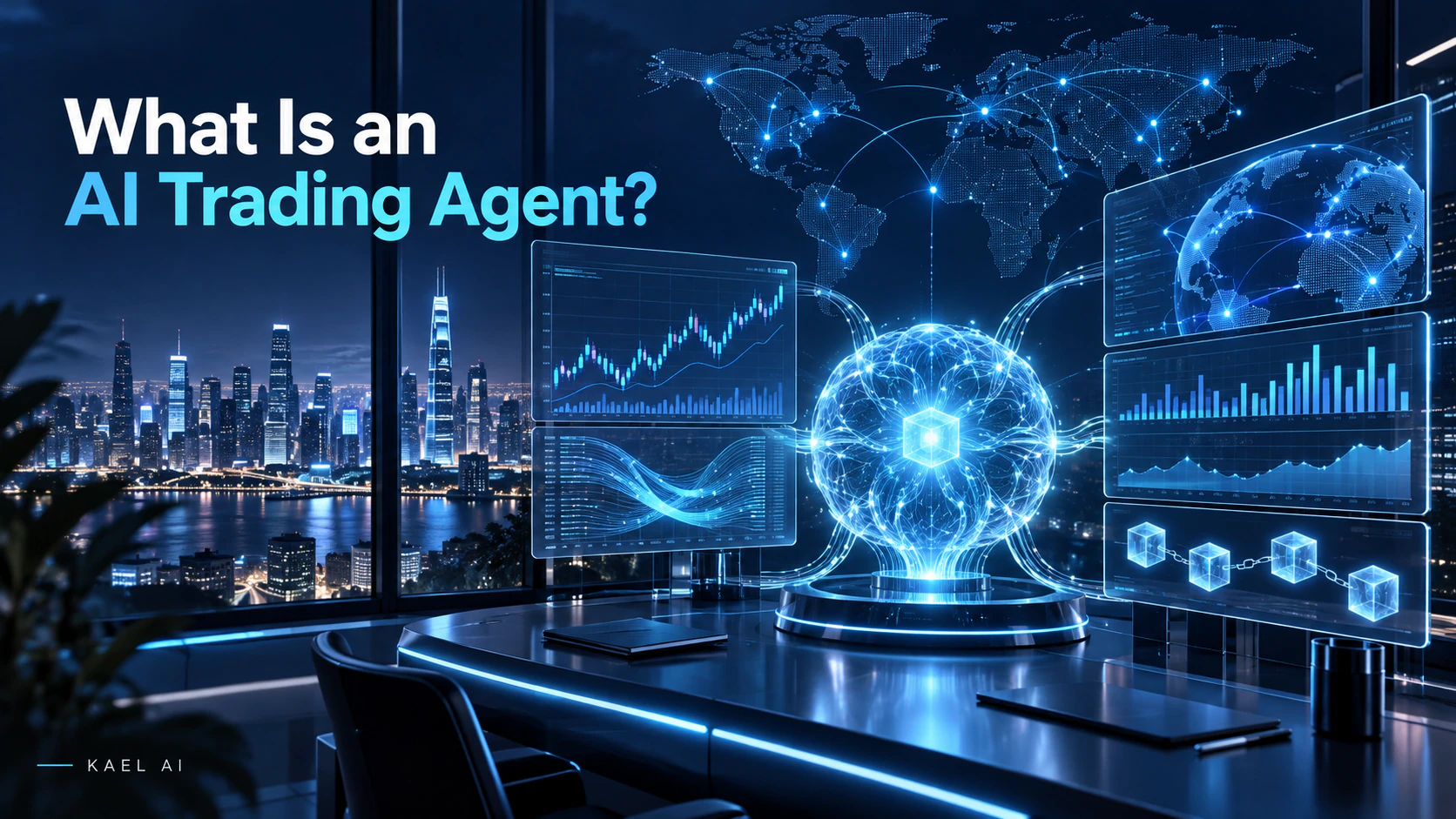
An AI trading agent is an autonomous software system designed to analyze financial markets, make decisions, and execute trading actions. It typically combines machine learning, predictive analytics, and natural language processing to extract signals from price movements, order books, economic indicators, financial news, market sentiment, and onchain data. Based on defined objectives and risk parameters, the agent can decide whether to buy, sell, hold, or adjust a position.
The main difference between an AI trading agent and a traditional algorithmic trading system is adaptability. Conventional trading programs usually follow fixed rules written in advance. For example, a system might automatically place an order when an asset reaches a specified price. These rules can automate repetitive tasks efficiently, but they may struggle when market conditions change in unexpected ways.
AI trading agents use learning-based models to identify more complex relationships across historical and real-time data. As new information becomes available, an agent may update its analysis and adjust its decisions. This does not mean it can predict every market movement. Its performance still depends on the quality of its data, the design of its models, the reliability of its execution infrastructure, and the strength of its risk controls.
A typical AI trading workflow includes four stages: data collection, market analysis, decision-making, and execution.
First, the agent gathers information from sources such as centralized exchanges, decentralized protocols, economic databases, news platforms, and blockchain networks. Natural language processing may also help it interpret unstructured information, including earnings reports, regulatory announcements, and social media discussions.
Next, the system analyzes the collected data. It may evaluate price trends, volatility, liquidity, order-book depth, correlations, and market sentiment. Predictive models can then estimate possible outcomes, while risk models assess whether a potential trade is compatible with the system’s limits.
During the decision stage, the agent compares expected returns with potential losses and determines whether to open, close, maintain, or resize a position. If a trade is approved, it sends instructions through a broker API, exchange interface, or smart contract. The system can then monitor settlement, transaction fees, and slippage before feeding the result back into its models.
AI trading agents can be designed for different strategies and market environments. Arbitrage agents search for price differences between exchanges or liquidity venues. Sentiment analysis agents process news and public discussions to detect changes in market expectations. Portfolio agents rebalance assets according to investment objectives, while risk-monitoring agents track exposure, collateral levels, and unusual market behavior.
Some institutions also use predictive models for high-frequency trading and execution optimization. These systems analyze short-term price movements and order-book conditions to determine how and when to place orders. In decentralized finance, an AI agent may monitor liquidity pools, lending positions, collateral ratios, and onchain prices before interacting with decentralized exchanges or lending protocols.
The benefits of AI trading agents largely come from their ability to operate continuously and process information at scale. Digital asset markets run around the clock, and global financial events can affect prices at any time. An autonomous agent can monitor these developments without fatigue and respond according to predefined policies.
AI systems can also analyze more data than a human trader could review manually. They may compare historical patterns with current conditions while simultaneously monitoring news, macroeconomic indicators, and activity across multiple markets. Because their actions follow programmed objectives and risk parameters, they can reduce the influence of fear, greed, and other emotional biases on execution.
However, automation does not eliminate risk. A model may become overfitted to historical data, performing well in simulations but failing in live markets. Incomplete, delayed, biased, or manipulated information can also produce unreliable signals. Models may misinterpret unusual inputs or generate conclusions that are not supported by market conditions.
Black swan events create another major challenge. Sudden geopolitical developments, economic shocks, liquidity crises, or regulatory changes may produce conditions that are absent from the model’s training data. During these periods, correlations can break down, volatility can rise rapidly, and an agent’s normal assumptions may no longer apply.
Technical and security risks are equally important. System outages, API failures, execution delays, excessive slippage, and unauthorized access can all affect trading outcomes. In decentralized markets, smart contract vulnerabilities and manipulated data sources may expose managed funds to additional risks.
For these reasons, a reliable AI trading system requires more than an advanced model. Position limits, stop-loss policies, data validation, permission controls, anomaly detection, audit logs, human oversight, and emergency shutdown mechanisms should be built into the operating framework. Human-in-the-loop supervision remains especially important when market conditions fall outside the system’s expected range.
An AI trading agent is best understood as a tool for improving the speed, consistency, and scale of financial analysis and execution—not as an intelligent trader that guarantees profits. As artificial intelligence, blockchain networks, and real-time data infrastructure continue to converge, these agents may play a larger role in both traditional and decentralized finance. Their long-term value, however, will depend on whether they can operate with security, transparency, accountability, and effective risk management.
Follow KAEL AI on [Facebook](https://www.facebook.com/profile.php?id=61594050729769) and [X](https://x.com/KAELAI002) for more insights into AI automation, digital assets, and the future of financial technology.