
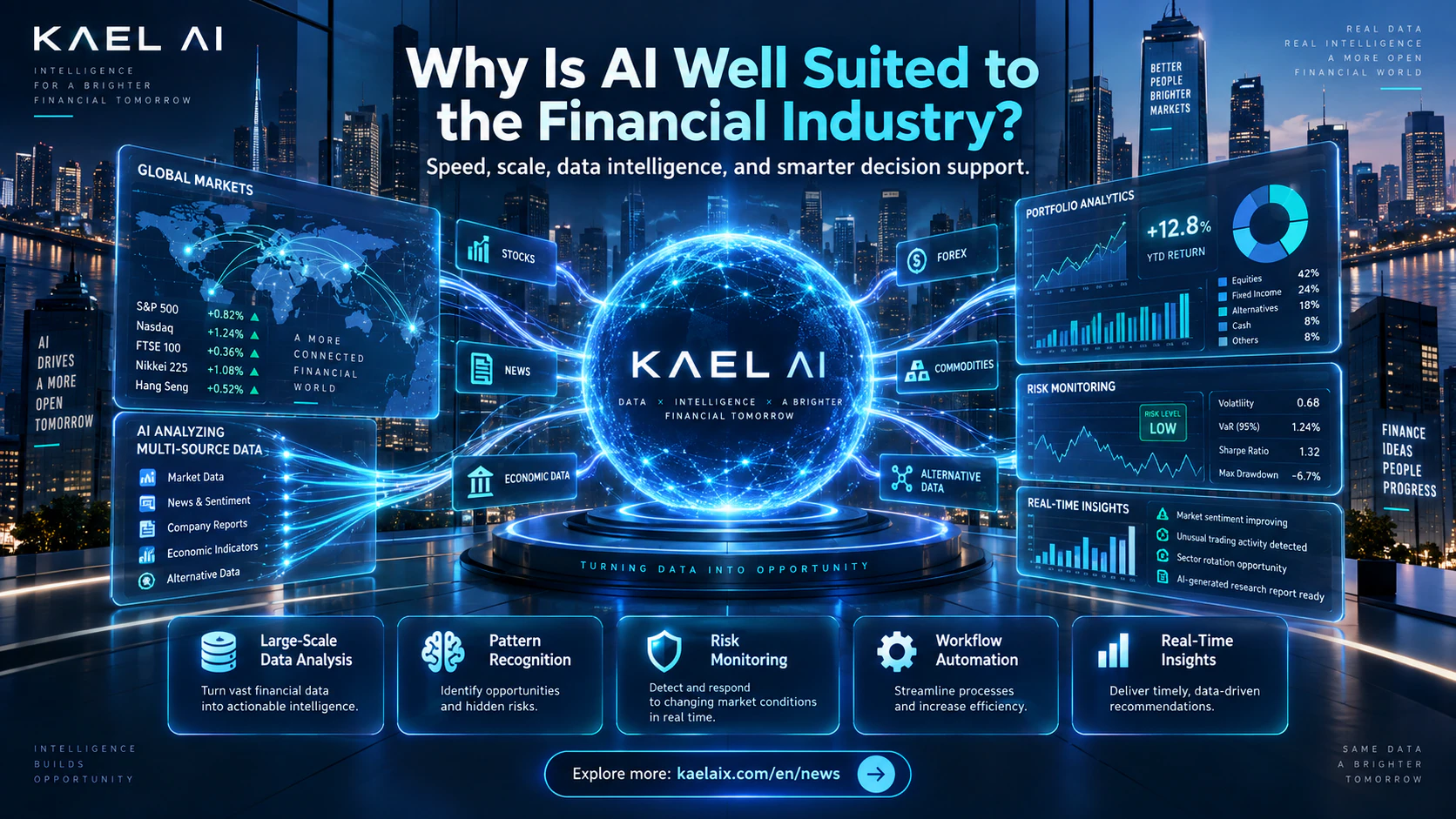
The financial industry is fundamentally a highly data-driven industry.
Every day, it generates large amounts of:
Market Prices
Transaction Data
Corporate Financial Information
Customer Data
Macroeconomic Data
News
Research Reports
Regulatory Documents
and:
Other Unstructured Information.
Traditional systems can process clearly defined and structured financial data very effectively.
However, as data volumes increase and relationships among variables become more complex, the efficiency of manual analysis and fixed-rule systems can become limited.
One of AI’s most important advantages is its ability to help financial systems:
Process More Data Simultaneously
Identify Complex Relationships
Detect Unusual Patterns
Analyze Textual Information
Automate Certain Repetitive Processes
Therefore:
The real value of AI in finance is not simply replacing people, but expanding the range of information financial systems can process and understand.
What Core Technologies Are Used in Financial AI?
Financial AI is not a single technology.
It usually combines several major technological fields.
Machine Learning
Machine Learning is one of the most important technologies in financial AI.
Machine learning models can use historical data to study statistical relationships among different variables.
For example:
A model can analyze:
Customer transaction behavior.
Corporate financial data.
Market volatility.
Asset prices.
Credit history.
and attempt to identify:
Risk patterns or unusual changes.
Machine learning can be applied to:
Credit Assessment
Risk Classification
Fraud Detection
Market Research
Portfolio Analysis
and many other financial areas.
However, the value of machine learning models depends heavily on:
Data Quality and Validation Methods.
Relationships found in historical data may not continue to exist in the future.
How Is Natural Language Processing Used in Finance?
A large amount of important information in finance is not numerical.
It exists in:
Text.
Examples include:
Corporate earnings reports.
Financial news.
Company announcements.
Central-bank statements.
Policy documents.
Analyst reports.
Traditional computer systems have difficulty truly understanding this type of information.
Natural Language Processing, or NLP, can help computers extract:
Company Names
Events
Industry Topics
Keywords
Market Sentiment
and other structured information from text.
This means financial information that previously depended mainly on human reading can increasingly become part of data-analysis workflows.
How Is Generative AI Changing Financial Services?
The development of Generative AI is expanding financial AI from:
Analyzing Numbers
toward:
Understanding Knowledge and Content.
Large language models can help financial professionals:
Summarize research reports.
Organize company announcements.
Search internal knowledge.
Analyze large volumes of financial documents.
Extract key information.
Generate preliminary research summaries.
For example:
In the past, an analyst might need to read many corporate documents to find a specific piece of information.
In the future, an appropriately authorized AI system may help locate relevant information more quickly.
Therefore, one of the most important values of generative AI in finance is:
Improving the efficiency of financial knowledge retrieval and processing.
However, this does not mean:
Large language models can automatically and accurately predict financial markets.
Important financial conclusions still require:
Data Validation + Professional Analysis + Human Review.
How Is AI Used in Credit Scoring?
Credit assessment has long been an important part of the financial industry.
Traditional credit scoring usually analyzes:
Income.
Debt.
Repayment history.
Credit records.
and other financial information.
Machine learning can help systems analyze more variables at the same time and identify more complex relationships within the data.
This can potentially support more detailed:
Credit Risk Assessment.
However, AI-based credit scoring is also a high-risk application.
If historical data contains bias:
The model may learn and amplify those problems.
Financial institutions therefore need to pay particular attention to:
Fairness
Model Transparency
Lawful Data Use
Explainability
and:
Human Oversight.
How Is AI Used in Fraud Detection?
Fraud Detection is one of the most common applications of financial AI.
Financial systems may process enormous numbers of transactions every day.
Only a very small percentage of these transactions may be truly unusual.
Manual review of every transaction is inefficient.
AI can help analyze:
Transaction Amounts
Transaction Frequency
Device Information
Account Behavior
Login Location
Time Patterns
and:
Combinations of multiple variables.
When behavior deviates significantly from normal patterns:
The system can generate a risk alert.
This is often referred to as:
Anomaly Detection.
However:
An anomaly does not necessarily mean fraud.
A more appropriate role for AI is:
Identifying information that deserves further investigation.
Final decisions still need to incorporate:
Risk rules and human review.
How Is AI Used in Financial Risk Management?
Risk management is a critical part of financial AI systems.
Financial institutions need to continuously analyze:
Market Risk
Credit Risk
Liquidity Risk
Operational Risk
Portfolio Risk
AI can help process more information simultaneously and detect changes in risk indicators more quickly.
For example:
The volatility of a particular asset suddenly rises.
The behavior of a particular account changes significantly.
Correlations among portfolio assets suddenly increase.
A company’s financial condition continues to deteriorate.
The system can help risk teams identify:
Issues that require further attention.
However:
Artificial intelligence cannot eliminate financial risk.
A more mature system should combine:
AI Analysis + Risk Rules + Human Oversight
working together.
How Is AI Used in Algorithmic Trading?
Algorithmic Trading is an important technology in modern financial markets.
Algorithmic trading generally means:
Automatically executing trades according to computer-based rules.
AI Trading can go further by using:
Machine Learning
Natural Language Processing
and:
Other artificial intelligence technologies
to study more complex data.
For example, AI can help analyze:
Market prices.
Trading volume.
Volatility.
News.
Market sentiment.
and other financial information.
However, it is important to note:
Algorithmic Trading is not the same as AI Trading.
Many algorithmic trading systems rely only on fixed rules and do not use artificial intelligence.
AI Trading focuses more on:
Using machine learning and data analytics to study market patterns and trading signals.
How Is AI Used in Portfolio Management?
Portfolio management requires continuous analysis of:
Asset Performance
Asset Correlations
Market Risk
Portfolio Volatility
Macroeconomic Conditions
AI can help investment managers process all of this information simultaneously.
For example:
Machine learning can study:
Whether correlations among assets change under different market conditions.
AI can also help systems continuously monitor:
Portfolio Risk.
Portfolio Exposure.
Market Conditions.
and provide analytical alerts when important indicators change significantly.
However, AI Portfolio Management should not be understood as:
“AI can permanently identify the best portfolio.”
Because:
Financial markets continuously change.
A more realistic value is:
Helping investment managers continuously analyze asset allocation and portfolio risk structures.
How Is AI Changing Customer Service?
Artificial intelligence is also changing the way financial institutions interact with customers.
AI Chatbots and Virtual Assistants can help handle:
Common questions.
Account-information inquiries.
Product information.
Customer-service routing.
Generative AI further improves the ability of systems to understand natural language.
Future financial customer service may increasingly follow a model where:
AI Handles Large Volumes of Basic Information
Human Professionals Handle Complex Issues
This allows customer-service teams to spend more time on:
Tasks that require professional judgment.
How Can AI Enable Personalized Financial Services?
Traditional financial services often categorize customers based on:
Age.
Asset size.
Income.
Risk level.
AI can go further by analyzing:
Customer behavior.
Product usage.
Cash flow.
Investment preferences.
Risk tolerance.
This can help financial institutions provide:
More relevant information.
This approach is often referred to as:
AI Personalization.
However:
Financial personalization must be built on:
Data Authorization, Privacy Protection, and Compliance Rules.
The fact that more data can be analyzed:
Does not mean all available data should be used.
How Can AI Improve Operational Efficiency in Financial Institutions?
Financial institutions have many repetitive processes.
Examples include:
Data Entry
Document Classification
Transaction Reconciliation
Regulatory Reporting
Customer Information Organization
Traditional systems may require significant human involvement.
Automation and AI can help reduce:
Repetitive work.
For example:
RPA can process tasks based on fixed rules.
AI can further process:
Text, complex data, and unusual situations.
When combined:
They can form:
Intelligent Automation.
This may become an important trend in financial back-office operations.
How Is AI Used in Financial Regulation and Compliance?
Financial institutions need to manage large amounts of regulatory requirements.
AI can help:
Organize regulatory documents.
Monitor transaction activity.
Analyze risk events.
Generate certain compliance information.
Natural language processing can also help teams:
Quickly identify:
Regulatory content relevant to specific business activities.
However:
Financial compliance cannot be fully automated.
Important decisions still require:
Accountability
Explainability
Human Oversight.
Why Does Financial AI Require High-Quality Data?
All artificial intelligence systems share one common foundation:
Data.
No matter how advanced a model is:
If the data quality is poor:
The result may still be wrong.
Common financial-data issues include:
Missing Data
Incorrect Data
Duplicate Data
Time Delays
Data Bias
Therefore:
High-quality data is often more important than simply pursuing a more complex model.
Mature financial AI systems need:
Data Infrastructure
and:
Data Governance.
What Is Financial Data Governance?
Data Governance is fundamentally about answering questions such as:
Where did the data come from?
Who can access it?
Is the data accurate?
Can it be used for AI?
How long should the data be retained?
Does it contain sensitive information?
Modern financial AI systems often access large amounts of data.
Therefore:
Access control and security are extremely important.
A mature data-governance framework usually requires:
Identity Verification
Access Control
Data Encryption
Data Quality Management
Access Logging
Audit Mechanisms
working together.
Why Can AI Be Biased?
Machine learning learns from historical data.
If historical data contains bias:
The model may learn that bias.
For example:
Historical credit data may contain systematic differences.
An AI model may mistakenly interpret those differences as:
Normal patterns.
This can create:
Historical Bias
↓
Training Data
↓
AI Model
↓
Biased Output
Financial institutions therefore need to continuously evaluate:
Whether the data is representative.
Whether model results are fair.
Whether certain groups are being affected in unreasonable ways.
What Is Explainable AI?
Explainable AI is commonly abbreviated as:
XAI.
It attempts to answer one very important question:
Why did the AI produce this answer?
For the financial industry:
This is especially important.
For example:
If AI determines that a particular risk is high,
an institution needs to understand:
Why?
Was it because of:
Income?
Debt?
Transaction behavior?
Or another variable?
If the system cannot explain its result:
Risk teams and regulators may find it difficult to determine:
Whether the conclusion is reasonable.
Future financial AI therefore requires not only:
Powerful models.
It also requires systems that are:
Explainable
Auditable
Traceable.
How Can AI Agents Be Used in Financial Services?
AI Agents are one of the areas worth watching in the future of financial AI.
Traditional AI often works like this:
A user asks a question.
AI provides an answer.
AI Agents may go further by completing:
Sequences of connected tasks.
For example:
Retrieve Financial Data
↓
Analyze Information
↓
Check Risk
↓
Update Reports
↓
Monitor Changes
↓
Alert Staff
This means AI may gradually evolve from:
A Single Tool
into:
An Intelligent System Participating in Workflows.
However, financial AI Agents require strict:
Permissions
Data Security
Risk Rules
Activity Logging
and:
Human Oversight.
Will Artificial Intelligence Replace Financial Professionals?
A more likely outcome is:
The way people work will change.
AI is better suited to:
Large-scale information processing.
Data analysis.
Document search.
Pattern recognition.
Repetitive tasks.
Human professionals are generally better at:
Strategic judgment.
Complex communication.
Risk accountability.
Business understanding.
Handling problems without clear historical patterns.
The future of financial services is therefore more likely to rely on:
Human Judgment + AI Intelligence
working together.
How Does KAEL AI View Artificial Intelligence in Finance?
Within the KAEL AI technology philosophy:
Artificial Intelligence in Finance is not simply about:
Using a more complex AI model.
A complete financial AI framework should include:
Financial Data
↓
Data Infrastructure
↓
AI & Machine Learning
↓
Quantitative Research
↓
Risk Management
↓
Intelligent Applications
↓
Continuous Monitoring
In other words:
Financial Data → Data Infrastructure → AI & Machine Learning → Quantitative Research → Risk Management → Intelligent Applications → Continuous Monitoring
KAEL AI focuses more on:
How these technologies can work together as a complete system.
Data provides the foundation.
AI processes information.
Quantitative research creates analytical methods.
Risk management controls uncertainty associated with models and strategies.
Only then can these technologies form:
Practical financial applications.
KAEL AI Financial Intelligence Framework
KAEL AI can further summarize an intelligent financial framework as:
Data
AI
Quantitative Research
Risk Management
Intelligent Automation
Human Oversight
Where:
Data
provides information.
AI
improves analytical efficiency.
Quantitative Research
creates systematic research capabilities.
Risk Management
identifies and limits risk.
Intelligent Automation
improves operational efficiency.
Human Oversight
provides final judgment and accountability.
Therefore:
AI is not the entire financial system, but an important component of future intelligent financial infrastructure.
What Challenges Does Financial AI Face?
The development of AI in finance still faces many challenges.
Data Quality
Incorrect data can affect model outputs.
Data Privacy
Financial data often contains sensitive information.
Model Risk
Models may fail in new environments.
Model Bias
Historical data may contain unreasonable bias.
Explainability
Complex models may be difficult to explain.
Cybersecurity
AI systems can also become targets for attack.
Regulatory Compliance
Different jurisdictions may impose different AI and financial regulations.
Human Oversight
Important financial decisions still require clearly defined accountability.
Therefore:
The more capable AI becomes, the more important AI Governance becomes.
What Are the Future Trends in Financial AI?
In the future, AI may become increasingly integrated into complete financial workflows.
Several areas are worth watching.
Generative AI
Helping understand large amounts of financial knowledge and text.
AI Agents
Completing more continuous financial tasks.
Multimodal AI
Analyzing:
Data, text, images, and other forms of information together.
Real-Time Risk Monitoring
Continuously monitoring changes in risk.
Explainable AI
Improving model transparency.
Intelligent Automation
Further automating financial workflows.
Alternative Data
Expanding the range of information financial systems can analyze.
Future competition in financial AI may not simply be about:
Who has the most powerful model.
More importantly:
Who can build more reliable data, stronger risk systems, and more secure intelligent financial infrastructure.
Frequently Asked Questions
What Is Artificial Intelligence in Finance?
Artificial intelligence in finance refers to the application of machine learning, natural language processing, data analytics, and other AI technologies to financial data, financial operations, and financial decision-making processes.
What Are the Applications of AI in Finance?
AI can be used in credit assessment, fraud detection, market analysis, quantitative trading, portfolio management, risk control, customer service, compliance, and automation.
Can AI Accurately Predict Financial Markets?
AI can help analyze data and identify statistical patterns, but it cannot guarantee accurate predictions of future financial markets.
Why Does Financial AI Require High-Quality Data?
AI models depend on data for analysis. If the data is incorrect, incomplete, or biased, model results may also be unreliable.
How Is Generative AI Used in Finance?
Generative AI can help process financial reports, news, regulatory documents, and internal knowledge, improving the efficiency of information search, summarization, and research.
Can AI Agents Be Used in Financial Services?
Yes. AI Agents can help perform continuous tasks such as data analysis, report updates, and risk monitoring, but they require strict permissions, data security, and human oversight.
How Does KAEL AI View Financial AI?
KAEL AI focuses on the integration of artificial intelligence, financial data, quantitative research, risk management, and intelligent automation.
KAEL AI believes that financial AI with long-term value is not simply about building more complex models.
It is about:
Building reliable data, analytical, risk-management, and intelligent-system infrastructure.
Conclusion
Artificial intelligence is gradually changing the technological foundation of financial services.
From:
Credit Assessment
Risk Management
Fraud Detection
Quantitative Trading
Portfolio Management
to:
Customer Service
Compliance
Operational Automation
AI can now participate in many parts of the financial industry.
Machine learning helps systems analyze complex data.
Natural language processing helps computers understand financial text.
Generative AI improves knowledge-processing efficiency.
AI Agents may further automate financial workflows.
However, AI does not eliminate:
Financial Risk and Market Uncertainty.
Reliable Financial AI still requires:
High-Quality Data
Reliable Models
Rigorous Validation
Risk Management
Model Transparency
Data Security
and:
Human Professional Judgment.
KAEL AI continues to explore how:
Artificial Intelligence + Financial Data + Quantitative Research + Risk Management + Intelligent Automation
can be integrated into a more complete intelligent financial technology framework.
The most valuable financial AI systems of the future may not necessarily be:
The systems that appear the most intelligent.
Instead, they may be the systems that:
Reliably process data, understand risk, support professional judgment, and remain subject to continuous validation in real financial environments.
Risk Disclosure
This article is provided by KAEL AI for educational and informational purposes relating to artificial intelligence, financial technology, quantitative research, and related technologies.
It does not constitute investment, securities trading, legal, or financial advice.
Artificial intelligence models, financial forecasts, data-analysis results, and historical performance all have inherent limitations. No AI system, analytical result, or historical dataset can guarantee future financial or investment outcomes.