
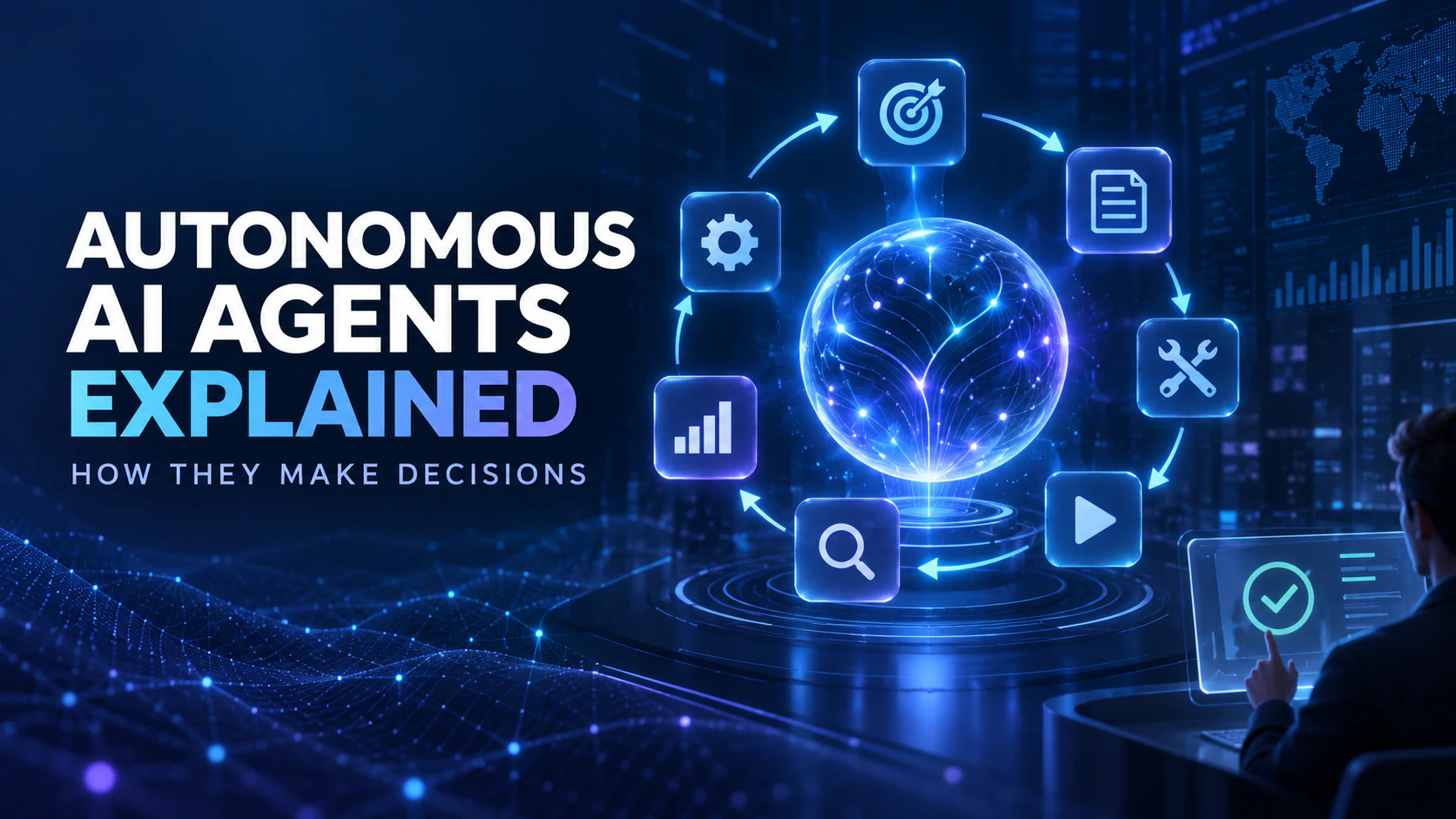
Autonomous AI agents are changing how artificial intelligence handles complex tasks. Unlike traditional AI systems that generate a response to a single prompt, autonomous agents can interpret goals, create plans, use external tools, take action and adjust their behavior as new information becomes available.
## What Is an Autonomous AI Agent?
An autonomous AI agent is an intelligent system capable of completing tasks with limited human intervention. According to [IBM’s overview of AI agents](https://www.ibm.com/think/topics/ai-agents), these systems can perform functions beyond natural language processing, including decision-making, problem-solving, interaction with external environments and real-world actions.
However, autonomy does not mean operating without boundaries. Developers, deployers and users still define the agent’s objectives, rules, permissions and available tools. Its autonomy comes from deciding what to do next within those established limits.
## How Do Autonomous AI Agents Make Decisions?
### 1. Understanding the Goal and Environment
The decision-making process begins with a goal. The agent interprets the desired outcome and examines the information available in its environment, including existing data, task restrictions, accessible tools and success criteria.
A clearly defined goal helps the agent identify an appropriate course of action. When instructions are incomplete, it might ask the user for clarification or use predefined rules to narrow the task.
### 2. Breaking the Goal Into Smaller Tasks
Complex goals are often too broad to complete in a single step. An autonomous agent can decompose them into smaller, manageable tasks.
For example, an agent preparing a market-entry strategy might divide the assignment into market research, competitor analysis, customer identification, risk assessment and report preparation. It can then determine how these tasks depend on one another and arrange them in a practical sequence.
This planning capability allows the agent to work toward a long-term outcome instead of reacting only to the most recent instruction.
### 3. Gathering Information and Calling Tools
A language model’s internal knowledge may be incomplete, outdated or unsuitable for a specialized task. Autonomous agents address this limitation by connecting to tools such as search engines, databases, APIs, calculators, enterprise applications and other specialized agents.
The agent evaluates what information is missing, selects an appropriate tool and reviews the result before proceeding. If the information is insufficient, it can call another resource or reformulate the request.
Tool use is one of the main features that separates an AI agent from a conventional chatbot. A chatbot primarily generates answers, while an agent can interact with external systems to help complete a task.
### 4. Comparing Options and Selecting an Action
Once the necessary information has been collected, the agent evaluates possible actions and their likely outcomes.
A goal-based agent looks for a sequence of actions that can reach a defined objective. A utility-based agent goes further by comparing factors such as cost, time, risk, resource consumption and expected value. It can then choose the option that performs best according to its evaluation criteria.
This does not mean that the agent possesses human awareness or intuition. Its decisions result from model-based reasoning, available context, programmed constraints and the standards used to evaluate possible actions.
### 5. Acting, Observing and Correcting
After selecting an action, the agent executes it and observes the result. It then compares the outcome with its original objective.
If a tool fails, the environment changes or the result does not meet expectations, the agent can revise its plan, select another tool or attempt a different approach. This continuing cycle of action, observation and correction enables autonomous agents to operate in changing environments rather than simply follow a fixed script.
## How Memory and Feedback Improve Decisions
Some AI agents can store relevant information from previous interactions, including task results and user preferences. That memory can help them avoid unnecessary repetition and make future decisions more relevant to the user.
Feedback also plays an important role. Human evaluations, predefined performance standards and input from other agents can help an agent identify weaknesses and refine its approach. This iterative process can improve accuracy over time.
Memory must nevertheless be carefully governed. Organizations need clear policies defining which information may be stored, how long it can be retained and who is allowed to access it. Incorrect or sensitive information should not become a permanent influence on future decisions.
## Why Human Oversight Still Matters
Autonomous agents can make mistakes because of inaccurate data, ambiguous instructions, faulty tools or flawed reasoning. Multi-agent systems introduce additional risks, including shared errors and dependencies between agents. Poorly designed systems can also become trapped in repetitive tool calls or feedback loops.
Effective safeguards can include limited permissions, detailed activity logs, spending or execution limits and mechanisms that allow people to interrupt an operation. These controls make the agent’s actions easier to inspect and reduce the impact of unexpected behavior.
Human approval is especially important before high-impact actions such as executing financial transactions, changing critical business systems, sending mass communications or making decisions that affect health and safety.
The real value of autonomous AI agents is not the removal of human judgment. It is their ability to support people by gathering information, comparing options, coordinating tools and performing repeatable tasks. As planning, reasoning, memory and tool-use capabilities improve, autonomous agents are likely to become an increasingly important bridge between AI models and real business operations.
Follow KAEL AI on [Facebook](https://www.facebook.com/profile.php?id=61594050729769) and [X](https://x.com/KAELAI003) for more practical insights into autonomous AI, intelligent agents and their real-world applications.