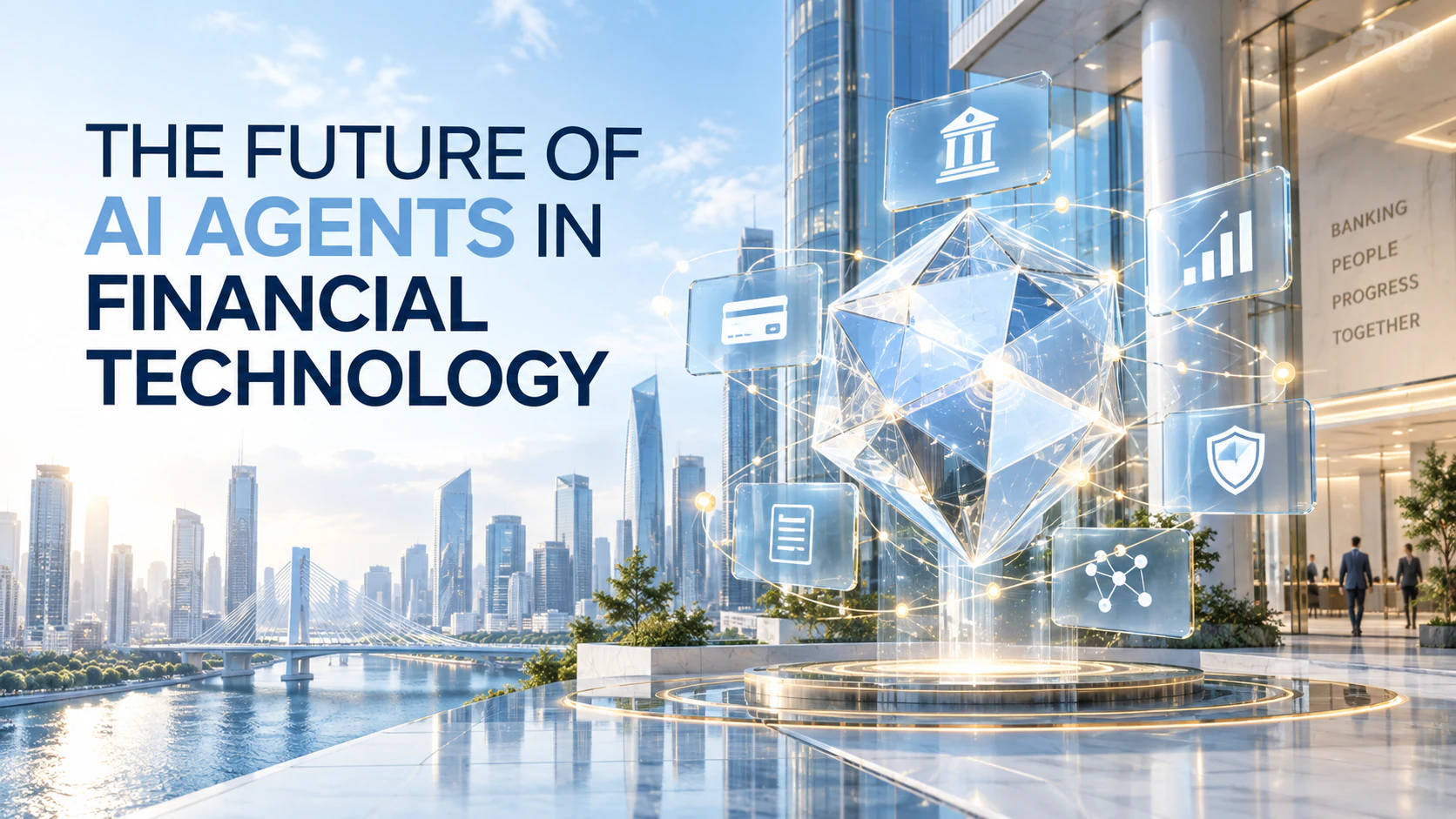
Financial technology is entering a new phase of development. Until recently, artificial intelligence was primarily used to support isolated tasks such as detecting fraud, analyzing market data, assessing credit risk, or responding to customer questions. The next generation of AI agents will go further. Instead of simply producing information, these systems will be able to interpret objectives, plan actions, access approved tools, and complete multistep financial processes.
This transition could make AI agents an important operating layer across banking, payments, insurance, investment services, and enterprise finance. However, their long-term impact will depend on more than model performance. Financial institutions will need to combine autonomous capabilities with reliable data, interoperable infrastructure, embedded controls, and clearly defined human responsibility.
## From Individual Tools to Coordinated Agent Systems
Many financial organizations currently deploy AI through separate applications. One system may monitor suspicious transactions, while another supports customer service or reviews documents. Future platforms are likely to connect these capabilities through groups of specialized agents.
Each agent could be assigned a specific responsibility. A customer-service agent might interpret a request, a compliance agent could verify applicable rules, and a payment agent could prepare an authorized transaction. Other agents might assess liquidity, evaluate currency exposure, or identify operational risks. By exchanging relevant information within controlled boundaries, these agents could coordinate an entire workflow.
Consider a company preparing a cross-border payment. An AI agent could review the transaction context, while another checks sanctions and compliance requirements. A treasury-focused agent might analyze exchange-rate exposure, and a payment-routing agent could compare available settlement options. Human specialists would remain involved when the transaction exceeds a risk threshold or requires professional judgment.
This collaborative model could reduce delays without placing every decision in the hands of a single general-purpose system.
## Financial Services Become More Proactive
Today, most financial applications wait for users to select a function or submit a request. AI agents could transform that relationship by continuously evaluating authorized information and responding to emerging needs.
For an individual customer, an agent might identify unusual spending, anticipate a cash-flow shortage, or detect unnecessary fees. It could then explain the situation and recommend an appropriate next step. With explicit permission, it might also prepare a transfer, adjust a savings plan, or connect the customer with a financial professional.
For businesses, agents could monitor working capital, payment schedules, foreign-exchange exposure, and financing needs. Instead of presenting another dashboard that employees must interpret, an agent could identify a developing issue, assemble the relevant evidence, and propose a response.
The objective is not to remove customers from financial decisions. It is to reduce the effort required to understand complex information and take timely action.
## AI Agents Connect Embedded Financial Ecosystems
The future of financial technology will also be shaped by embedded finance. Banking and payment services are increasingly integrated into commerce platforms, accounting software, marketplaces, and supply-chain systems. AI agents could become the coordination layer connecting these environments.
A small business using an accounting platform, for example, might receive financing options based on current cash flow and verified invoices. An agent could compare the offers, explain the costs, and prepare an application without forcing the business owner to move repeatedly between unrelated systems.
Similar models could support insurance, trade finance, procurement, and subscription management. Financial products would appear within the customer’s existing workflow at the moment they become relevant.
This development will require strong interoperability. Agents must be able to communicate with legacy banking systems, cloud applications, partner platforms, and external data providers without weakening security or data governance.
## Real-Time Data Becomes Essential Infrastructure
AI agents can only make dependable decisions when they receive accurate, timely, and properly governed information. Fragmented data is therefore one of the greatest barriers to large-scale adoption.
Financial institutions will need to connect operational records, transaction data, customer information, market events, and risk signals through a unified data foundation. They must also define which agent can access each category of information and for what purpose.
Data lineage will be particularly important. When an agent recommends or performs an action, the institution should be able to determine which information influenced the result. Without that traceability, it becomes difficult to investigate errors, explain decisions, or demonstrate regulatory compliance.
Real-time access does not mean unrestricted access. The strongest systems will combine speed with identity controls, privacy protections, data-quality checks, and detailed audit records.
## Governance Must Be Built Into Every Action
Financial autonomy creates risks that ordinary conversational AI does not face. An inaccurate answer may inconvenience a user, but an unauthorized payment, unfair credit decision, or incorrect account restriction can cause direct financial harm.
For that reason, governance cannot be added after deployment. Every agent should operate within a defined identity, permission set, transaction limit, and escalation policy. Critical decisions should require human review, particularly when they affect customer rights, move substantial funds, or create regulatory obligations.
Institutions will also need continuous monitoring. Teams should be able to see which tools an agent used, what data it accessed, which actions it attempted, and whether its behavior remained within approved policy.
Human oversight will not disappear as agents become more capable. Instead, it will become more structured. People will establish objectives, authorize sensitive actions, review exceptions, and remain accountable for the operating framework.
## The Financial Workforce Will Evolve
AI agents are likely to change financial jobs more than they eliminate entire professions. Repetitive research, document collection, reconciliation, and workflow coordination can increasingly be handled by software. Human professionals can then concentrate on complex judgment, client relationships, unusual cases, and strategic decisions.
New responsibilities will also emerge. Financial teams will need people who can supervise agent behavior, evaluate automated recommendations, design escalation rules, and understand where an agent’s authority should end.
The most effective organizations will therefore treat AI agents as governed collaborators rather than independent replacements for employees.
## From Experimentation to Trusted Infrastructure
The future of AI agents in financial technology will not be defined by the number of automated features an institution launches. It will be defined by whether those capabilities can operate reliably at production scale.
Organizations that combine specialized agents with modern core systems, real-time data, strong interoperability, and embedded governance will be better positioned to deliver faster and more personalized services. Institutions that remain limited to disconnected pilot programs may struggle to achieve the same operational value.
AI agents could eventually help financial services become more accessible, responsive, and efficient. Yet autonomy alone is not progress. Sustainable adoption requires a balance between intelligent execution and accountable control.
KAEL AI will continue examining this balance and the technologies shaping intelligent finance through its analysis on [Facebook](https://www.facebook.com/profile.php?id=61594050729769) and [X](https://x.com/KAELAI001), with a focus on practical applications, emerging risks, and the evolving relationship between financial professionals and autonomous systems.