
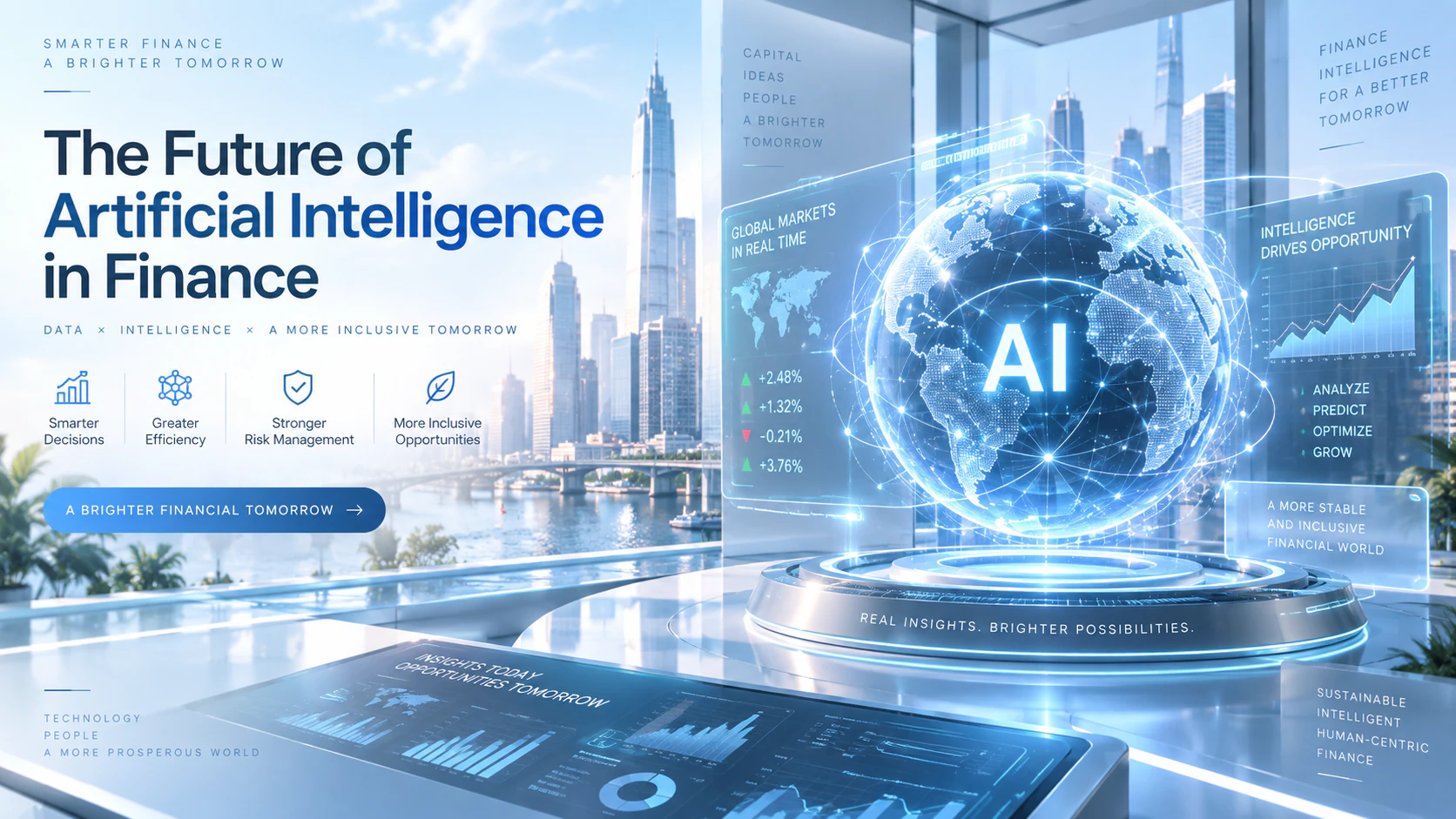
Artificial intelligence is gradually evolving from an auxiliary tool in finance into an important component of modern financial technology infrastructure.
From:
Financial Data Analysis
Fraud Detection
Credit Risk Assessment
Financial Forecasting
Quantitative Research
to:
Customer Service
Compliance Management
Financial Automation
and:
AI Agents
artificial intelligence is becoming increasingly integrated into financial workflows.
However, the most important direction for AI in finance is not:
Allowing machines to completely replace financial professionals.
A more realistic direction is:
Using AI to expand data-processing capabilities, improve analytical efficiency, automate repetitive tasks, and help professionals identify risks and changes earlier.
Competition in the financial industry may gradually shift from:
“Who has AI?”
toward:
Who can use AI more reliably, securely, and systematically?
KAEL AI continues to explore the integration of artificial intelligence, machine learning, financial data, quantitative research, risk management, and AI Agents to build a more complete intelligent financial technology framework.
How Is Artificial Intelligence Changing Finance Today?
Artificial intelligence is already being used across many financial scenarios.
Common applications include:
Automating Repetitive Processes
Analyzing Large-Scale Financial Data
Detecting Unusual Transactions
Supporting Risk Monitoring
Generating Financial and Research Summaries
Supporting Financial Forecasting
Improving Customer Service Efficiency
Searching Regulatory and Internal Knowledge
and:
Continuously Monitoring Business Metrics.
This means financial AI is no longer simply:
A single algorithm.
More systems are evolving into architectures based on:
Data + AI + Workflow
working together.
What Will Be the Most Important Change in Financial AI?
In the past, financial AI focused more heavily on:
Prediction
Classification
Detection
In the future, it may increasingly expand toward:
Understanding
Automation
Coordination
and:
Continuous Intelligence.
This means:
AI may not simply analyze one dataset.
In the future, it may:
Continuously read information.
Call different models.
Check for anomalies.
Generate reports.
And alert professionals when important changes occur.
How Is AI Changing Financial Data Analysis?
The financial industry generates large amounts of:
Transaction Data
Market Data
Financial Data
Customer Data
Macroeconomic Data
News
Regulatory Documents
and:
Corporate Operating Information.
Traditional financial analysis relies heavily on:
Databases.
Spreadsheets.
Statistical models.
And:
Human analysis.
These methods remain important.
However, AI can help:
Process larger volumes of data.
Connect different data sources.
Automatically organize information.
Identify complex patterns.
Detect unusual changes.
As a result, future Financial Analytics may gradually evolve from:
Dashboard-Based Analytics
toward:
AI-Assisted Financial Intelligence.
How Is Generative AI Changing Financial Data Analysis?
Generative AI is introducing new capabilities into financial analytics.
Traditional analytical tools are better suited to:
Processing numbers.
Generative AI can additionally process:
Financial Reports
Research Materials
Corporate Announcements
Regulatory Documents
News
and:
Other textual information.
For example:
A finance professional may ask:
“What were the main reasons for the increase in costs this quarter?”
The system can:
Search relevant data.
Organize key changes.
Combine textual information.
Generate a preliminary analysis.
This is moving financial analysis from:
Clicking Through Charts
toward:
Asking Questions Directly About Data.
What Is Conversational Financial Analytics?
Conversational Financial Analytics is one of the most important areas to watch.
Users may no longer need to:
Manually search data tables.
Or:
Navigate through multiple dashboard layers.
Instead, they may directly ask:
“Which region experienced the largest sales decline this month?”
“How has cash flow changed compared with the budget?”
“Which risk indicators have changed the most recently?”
AI systems can help:
Retrieve relevant information.
Perform basic analysis.
Then:
Explain the results in natural language.
This could significantly reduce:
The difficulty of using complex financial data systems.
How Will Financial Automation Develop?
Automation has long been an important direction in financial technology.
Traditional automation usually relies on:
Rule-Based Automation.
For example:
If condition A is met:
Execute action B.
AI can further help handle:
Tasks where rules are not completely fixed.
For example:
Document classification.
Report summarization.
Anomaly detection.
Information retrieval.
Preliminary analysis.
Future financial automation may increasingly combine:
Rules + AI + Human Review.
Which Financial Processes Can AI Automate?
Financial tasks that are generally well suited to automation tend to have:
High repetition.
Large amounts of data.
Relatively clear rules.
Examples include:
Invoice Processing
Billing Organization
Data Reconciliation
Accounts Receivable
Accounts Payable
Financial Report Preparation
Transaction Classification
Customer-Service Routing
Exception Alerts
The future value of AI may not be:
Completely removing humans.
Instead:
It may allow people to step away from large volumes of normal processes and focus attention on exceptions that genuinely require judgment.
What Is Agentic AI?
Agentic AI can be understood as:
Artificial intelligence systems capable of executing multi-step tasks around a defined objective.
Traditional AI usually works like this:
A user asks one question.
AI returns one answer.
An AI Agent may instead execute:
Retrieve Data
↓
Analyze Financial Information
↓
Check KPIs
↓
Detect Anomalies
↓
Run Risk Analysis
↓
Generate Report
↓
Notify Staff
In other words:
Retrieve Data → Analyze Financial Information → Check KPIs → Detect Anomalies → Analyze Risk → Generate Reports → Notify Staff
Why Could AI Agents Change the Financial Industry?
Financial work is rarely:
One question.
One answer.
It usually consists of:
A sequence of connected steps.
For example:
Risk analysis may require:
Retrieving market data.
Checking risk indicators.
Comparing historical changes.
Searching news.
Generating a summary.
Submitting findings to the risk team for review.
Previously:
These tasks might be distributed across different tools and employees.
The potential value of AI Agents is:
Connecting these steps.
As a result:
AI may evolve from:
A Financial Tool
toward:
Financial Workflow Intelligence.
Can Financial AI Agents Operate Fully Autonomously?
In financial environments:
Full autonomy is usually not the most appropriate goal.
Agents may:
Read incorrect data.
Call the wrong tools.
Misinterpret business rules.
Generate inaccurate content.
Or:
Perform actions outside their authorized scope.
A mature Financial AI Agent should therefore include:
Access Control
Risk Limits
Human Approval
Audit Logs
Fallback Mechanisms.
Therefore:
The value of financial AI Agents is not “operating without human control,” but improving workflow efficiency within clearly defined boundaries.
How Will AI Change Financial Forecasting?
Finance has long relied on forecasting.
Examples include:
Revenue forecasting.
Cash-flow forecasting.
Market analysis.
Risk forecasting.
Demand forecasting.
Artificial intelligence can help:
Analyze more variables simultaneously.
Update models more quickly.
Study:
Historical data.
Real-time data.
Macroeconomic indicators.
Market changes.
Corporate operating information.
However:
AI Financial Forecasting does not mean:
Knowing the future accurately.
A more realistic interpretation is:
Using more information and more flexible models to continuously evaluate different possible future outcomes.
From Forecasting to Scenario Intelligence
One important change in future financial AI may be:
Moving away from a single question:
“What will happen?”
toward:
Scenario Intelligence.
For example:
What happens if interest rates rise?
What happens if sales decline?
How does portfolio risk change if market volatility increases?
What happens to corporate cash flow if liquidity falls?
AI can help quickly:
Modify assumptions.
Recalculate.
Compare results.
This allows decision-makers to examine:
Multiple possible futures.
Does More Data Make AI Forecasts More Accurate?
Not necessarily.
This is one of the most important issues in financial AI.
More data creates value only when it is:
Accurate
Complete
Relevant
Timely.
Low-quality data may actually:
Cause models to produce incorrect results.
Therefore, the core competitive advantage of future AI financial forecasting may not be:
Who has the most data.
Instead:
Who has more reliable data and more rigorous model-validation systems.
What Is Model Drift?
Financial markets constantly change.
Customer behavior changes.
Economic conditions change.
As a result:
A model that worked in the past
may gradually become less effective.
This is commonly known as:
Model Drift.
Future financial AI systems need to continuously check:
Are forecast errors increasing?
Has the data distribution changed?
Is the model still effective?
Does it need retraining?
Therefore:
AI should not be viewed as:
Something trained once and then left to run permanently.
It requires:
Continuous Monitoring.
How Can AI Become an Early-Warning System for Risk?
Financial institutions generate large amounts of risk information every day.
Artificial intelligence can continuously monitor:
Transaction Behavior
Market Volatility
Credit Data
Liquidity Indicators
Corporate Financial Changes
Operational Information
and look for:
Changes that deviate significantly from normal conditions.
For example:
Asset volatility suddenly increases.
An account behaves unusually.
A risk indicator rises rapidly.
AI can help:
Identify these changes earlier.
However:
A risk signal does not mean a risk event has been confirmed.
The role of the system should be:
Helping professionals more quickly:
Identify problems.
Investigate problems.
How Is AI Changing Fraud Detection?
Fraud Detection is one of the more mature applications of AI in finance.
Machine learning can analyze:
Transaction amount.
Transaction time.
Location.
Device.
Transaction frequency.
Account behavior.
Systems can learn:
What normal transaction patterns look like.
Then identify:
Abnormal behavior.
However:
Anomaly ≠ Fraud
An anomaly:
Does not automatically mean fraud.
A more mature fraud-detection framework should combine:
Machine Learning
Fraud Rules
Case Investigation
Human Review.
How Is Generative AI Changing Risk Management?
Generative AI can help risk teams:
Summarize risk reports.
Search historical incidents.
Organize potential causes of risk.
Analyze regulatory documents.
Generate preliminary risk summaries.
For example:
A risk team might ask:
“Which recent events could affect our liquidity risk?”
AI can help search:
Authorized data and knowledge sources.
Then:
Organize the relevant information.
This can improve:
Risk-knowledge processing efficiency.
However, important risk judgments:
Still require professional responsibility.
Why Will Responsible AI Become a Core Issue in Finance?
As the influence of AI in finance increases:
Responsible AI
will become increasingly important.
Financial AI often affects:
Customer assets.
Credit decisions.
Transactions.
Risk.
Personal information.
Therefore, incorrect models can produce:
Real-world consequences.
Future financial AI governance will likely focus heavily on:
Fairness
Security
Transparency
Compliance
Accountability.
Why Can AI Be Biased?
Machine learning learns from:
Historical data.
If historical data contains:
Systematic bias,
AI may:
Learn that bias.
And potentially:
Amplify it.
For example:
Historical credit data may not fairly represent all groups.
Financial institutions therefore need to continuously:
Audit data.
Compare outcomes across different groups.
Review models.
Conduct fairness testing.
This means:
AI is not inherently neutral.
Model performance depends on:
Data.
Design.
Validation.
And:
Governance.
Why Is Transparency So Important?
Financial AI cannot simply:
Provide an answer.
In many cases:
Institutions also need to understand:
Why?
For example:
Why did a loan risk score increase?
Why was a transaction flagged as unusual?
Why did portfolio risk increase?
Future financial AI therefore increasingly needs to be:
Explainable
Auditable
Traceable.
This is why:
Explainable AI
is becoming so important.
What Kind of Data-Security Framework Does Financial AI Require?
Financial data often contains:
Highly sensitive information.
For example:
Accounts.
Transactions.
Identity information.
Income.
Assets.
Financial AI systems therefore need strict:
Identity Verification
Access Control
Data Encryption
Data Isolation
Activity Logging
Audit.
As AI systems gain more capabilities:
Permission governance may become even more important.
Because if AI can access:
More systems and data,
the consequences of incorrect permissions:
Can also become greater.
How Will AI Regulation Develop?
AI regulatory frameworks around the world continue to evolve.
Finance itself is already:
A highly regulated industry.
Financial institutions will therefore need to consider:
Financial regulation.
Data regulation.
AI governance.
Consumer protection.
Model risk.
and other areas simultaneously.
Institutions should not simply wait until:
Every regulation is completely finalized
before establishing governance.
A more mature approach is:
Building an:
AI Governance Framework
in advance.
Will AI Change Careers in Finance?
Yes.
But the change may not simply mean:
“AI replaces financial professionals.”
A more likely outcome is:
Job responsibilities will change.
In the past, financial analysts may have spent significant amounts of time:
Organizing data.
Preparing reports.
Copying information.
In the future, some of this work:
May be automated by AI.
The role of financial professionals may increasingly shift toward:
Analysis
Judgment
Business Understanding
Risk Management
Communication
and:
AI Oversight.
What Is AI Literacy?
AI Literacy means:
Understanding how artificial intelligence works, what it can do, and where its limitations are.
Future financial professionals may not all need to:
Become AI engineers.
However, more professionals may need to understand:
What can AI do?
What can AI not do?
Why can models fail?
When should outputs be validated?
What data should not be entered into AI systems?
How can AI outputs be evaluated?
This capability may eventually become as basic as:
Excel.
Financial systems.
Data analysis.
What AI Skills Will the Financial Industry Need?
Different roles will require different capabilities.
Technical roles may need:
Python
R
Machine Learning
Data Engineering
Software Engineering
Model Development.
Financial professionals may increasingly need:
Data Analysis
AI Literacy
Financial Knowledge
Risk Management
Model Governance
Prompt & Workflow Design
and:
Human-AI Collaboration.
The most important professionals of the future may not be:
Those who understand only finance.
Or:
Only AI.
Instead:
They may be people who understand the relationship between Finance + Data + AI + Risk.
What New Financial Roles Could AI Create?
As AI systems become more integrated into organizations:
Some jobs may change.
New roles may also emerge.
For example:
Financial AI Engineer
Machine Learning Engineer
Financial Data Engineer
AI Risk Specialist
Model Governance Specialist
AI Product Manager
Financial AI Analyst
AI Compliance Specialist
These roles reflect one clear trend:
Future financial technology teams may become increasingly:
Interdisciplinary.
How Will AI Research Drive Financial Innovation?
The future of financial AI will not depend only on:
Larger models.
It will also depend on:
Better research.
For example:
How can model hallucinations be reduced?
How can financial reasoning be improved?
How can model bias be reduced?
How can explainability improve?
How can AI be used securely with sensitive data?
How can language models be combined with quantitative models?
How can Agents execute tasks within controlled risk boundaries?
These questions may ultimately be more important than:
Simply increasing model size.
Will Generative AI Become Financial Infrastructure?
Generative AI may gradually evolve from:
Standalone chat tools
into:
Part of enterprise financial infrastructure.
For example:
Future financial systems may directly integrate:
AI Assistants.
Employees may be able to:
Query data.
Generate reports.
Search documents.
Explain indicators.
Perform scenario analysis.
This trend can be described as:
Embedded Financial AI.
AI may no longer be:
A separate tool that users open.
Instead:
It may exist throughout financial workflows.
How Will AI and Quantitative Models Work Together?
Large language models are well suited to:
Processing text and knowledge.
Quantitative models are better suited to:
Structured financial data and mathematical relationships.
A mature future financial-intelligence framework may connect both.
For example:
Market Data
Quantitative Models
News & Reports
Large Language Models
Risk Management
This structure can allow AI to:
Process numbers.
And also:
Understand text.
However, final outputs still require:
Rigorous validation.
Why Is Human-AI Collaboration Critical in Finance?
Artificial intelligence is particularly strong at:
Scale
Speed
Automation
Pattern Recognition.
Humans are generally stronger at:
Judgment
Context
Accountability
Strategy.
Therefore, the most valuable future model for financial AI may not be:
AI vs. Human
but:
AI Intelligence + Human Judgment
working together.
Will Artificial Intelligence Completely Replace Financial Decision-Makers?
In many high-risk scenarios:
This is unlikely to be the most appropriate direction.
Financial decisions involve more than:
Data.
They also involve:
Responsibility.
Regulation.
Strategy.
Ethics.
And:
Complex real-world environments.
AI can:
Provide information.
Organize evidence.
Run models.
Generate analysis.
But critical final decisions:
Still require:
Clearly accountable decision-makers.
Therefore:
The future of financial AI is more likely to be about “augmenting decisions” rather than “eliminating decision-makers.”
How Does KAEL AI View the Future of Artificial Intelligence in Finance?
Within the KAEL AI technology philosophy:
The Future of AI in Finance is not simply about:
Making models larger.
Or:
Increasing automation.
A more complete future financial AI framework should include:
Financial Data
↓
Data Infrastructure
↓
Machine Learning
↓
Generative AI
↓
Quantitative Research
↓
Risk Management
↓
AI Agents
↓
Intelligent Applications
↓
Continuous Monitoring
↓
Human Oversight
In other words:
Financial Data → Data Infrastructure → Machine Learning → Generative AI → Quantitative Research → Risk Management → AI Agents → Intelligent Applications → Continuous Monitoring → Human Oversight
KAEL AI focuses on:
How these technologies can form:
A complete intelligent financial ecosystem.
KAEL AI Future Financial Intelligence Framework
KAEL AI can further summarize the future financial-intelligence framework as:
Data
AI
Machine Learning
Generative AI
Quantitative Research
Risk Management
AI Agents
Human Oversight
Where:
Data
provides a reliable information foundation.
Machine Learning
identifies statistical relationships.
Generative AI
processes language and knowledge.
Quantitative Research
creates systematic financial-research methods.
Risk Management
controls model and market risk.
AI Agents
connect different workflows.
Human Oversight
provides final judgment and accountability.
Therefore:
A truly mature future financial AI system is not one that “automatically does everything,” but intelligent infrastructure capable of reliably connecting data, models, risk management, and professional judgment.
What Challenges Will AI Face in the Future of Finance?
Although AI has significant potential:
Its future development still faces many challenges.
These include:
Data Quality
Low-quality data directly affects model outputs.
Data Privacy
Financial data is often highly sensitive.
Model Bias
Historical data may introduce bias into AI.
Model Drift
Changing environments may reduce model effectiveness.
Hallucination
Generative AI may produce incorrect information.
Explainability
Complex models may be difficult to explain.
Cybersecurity
AI can expand the security attack surface.
Regulatory Compliance
AI must operate within financial regulatory frameworks.
Access Control
AI Agents require strict operational boundaries.
Human Accountability
High-risk decisions still require clearly defined responsibility.
Therefore:
The more capable financial AI becomes, the more important AI Governance becomes.
What Are the Core Future Trends of AI in Finance?
Several major areas are worth watching over the coming years.
Generative AI
Becoming more integrated into financial knowledge and research systems.
AI Agents
Executing more continuous workflows.
Conversational Analytics
Analyzing financial data through natural language.
Real-Time Financial Intelligence
Processing new financial developments more quickly.
Multimodal AI
Analyzing:
Numbers.
Text.
Images.
And other forms of data together.
Explainable AI
Making models more transparent.
Continuous Risk Monitoring
Continuously monitoring financial risk.
Human-AI Collaboration
Creating more mature human-AI working models.
AI Governance
Embedding risk and accountability throughout the AI lifecycle.
Embedded AI
Making AI a foundational feature of financial software.
Frequently Asked Questions
What Is the Future of Artificial Intelligence in Finance?
AI is likely to become increasingly integrated into financial data analysis, risk management, automation, customer service, quantitative research, forecasting, compliance, and AI Agent workflows.
Will AI Replace Financial Professionals?
A more likely outcome is that the way people work will change. AI will handle more data processing and repetitive tasks, while financial professionals focus more on strategy, risk, communication, and complex judgment.
Will AI Agents Become Important in Finance?
Very likely. AI Agents can help connect continuous tasks such as data retrieval, analysis, risk checks, reporting, and monitoring, but they require strict permissions and human oversight.
Can AI Accurately Predict Future Financial Markets?
AI can analyze more data and identify statistical patterns, but it cannot guarantee accurate predictions of financial markets.
Why Is Responsible AI So Important in Finance?
Financial AI can affect assets, credit, transactions, and personal information. Therefore, fairness, security, transparency, compliance, and accountability are essential.
Will Financial Professionals Need to Learn AI?
Increasingly, yes. Financial professionals do not all need to become engineers, but understanding AI capabilities, risks, and validation methods may become an important professional skill.
How Does KAEL AI View the Future of Financial AI?
KAEL AI focuses on the integration of:
Financial Data + Machine Learning + Generative AI + Quantitative Research + Risk Management + AI Agents + Human Oversight.
KAEL AI believes that the long-term value of financial AI is not simply:
Automating more tasks.
Instead, it is about:
Building intelligent financial infrastructure that can reliably process data, understand risk, connect financial knowledge, and support professional decision-making.
Conclusion
Artificial intelligence is gradually changing:
The technological foundation of finance.
From:
Financial Data Analysis
Forecasting
Risk Management
Fraud Detection
Financial Automation
to:
Generative AI
AI Agents
and:
Real-Time Financial Intelligence
AI is becoming increasingly integrated into financial workflows.
The future of financial AI may no longer focus only on:
How many things a model can do.
Instead, greater attention may be placed on:
Is the data reliable?
Are the models stable?
Is the system secure?
Is risk controlled?
Can the results be explained?
and:
Do humans retain final accountability?
Artificial intelligence can improve:
Speed.
Scale.
Analytical capabilities.
Automation.
However:
It does not eliminate:
Financial Risk
or:
Uncertainty About the Future.
KAEL AI continues to explore how:
Artificial Intelligence + Financial Data + Machine Learning + Generative AI + Quantitative Research + Risk Management + AI Agents + Human Oversight
can be integrated into a more complete future intelligent financial technology framework.
The Financial AI systems with the greatest long-term value may not necessarily be:
The most automated systems.
Nor:
The models with the largest number of parameters.
Instead, they may be the systems that:
Reliably understand data, continuously control risk, support professional judgment, and operate stably over the long term in real financial environments.
Risk Disclosure
This article is provided by KAEL AI for educational and informational purposes relating to artificial intelligence, financial technology, financial analysis, machine learning, quantitative research, and related technologies.
It does not constitute investment, securities trading, legal, or financial advice.
Artificial intelligence models, financial forecasts, machine learning results, scenario analyses, and historical data all have inherent limitations. No AI system, model, automated workflow, analytical result, or historical performance can guarantee future financial, business, or investment outcomes.