
Financial institutions do not lack data, models, or automation tools. The harder problem is coordination. Market signals, client activity, risk limits, regulatory obligations, and execution conditions can all change quickly. When one AI agent is expected to manage every step, it can become difficult to maintain consistent reasoning, reliable tool use, and clear accountability.
Multi-agent systems offer a more structured approach. Instead of assigning an entire workflow to one general-purpose agent, they organize multiple specialized AI agents around a shared objective. Each agent has a defined responsibility, exchanges structured information with the others, and operates within rules that support oversight and control.
## Turning Complex Financial Workflows into Clear Roles
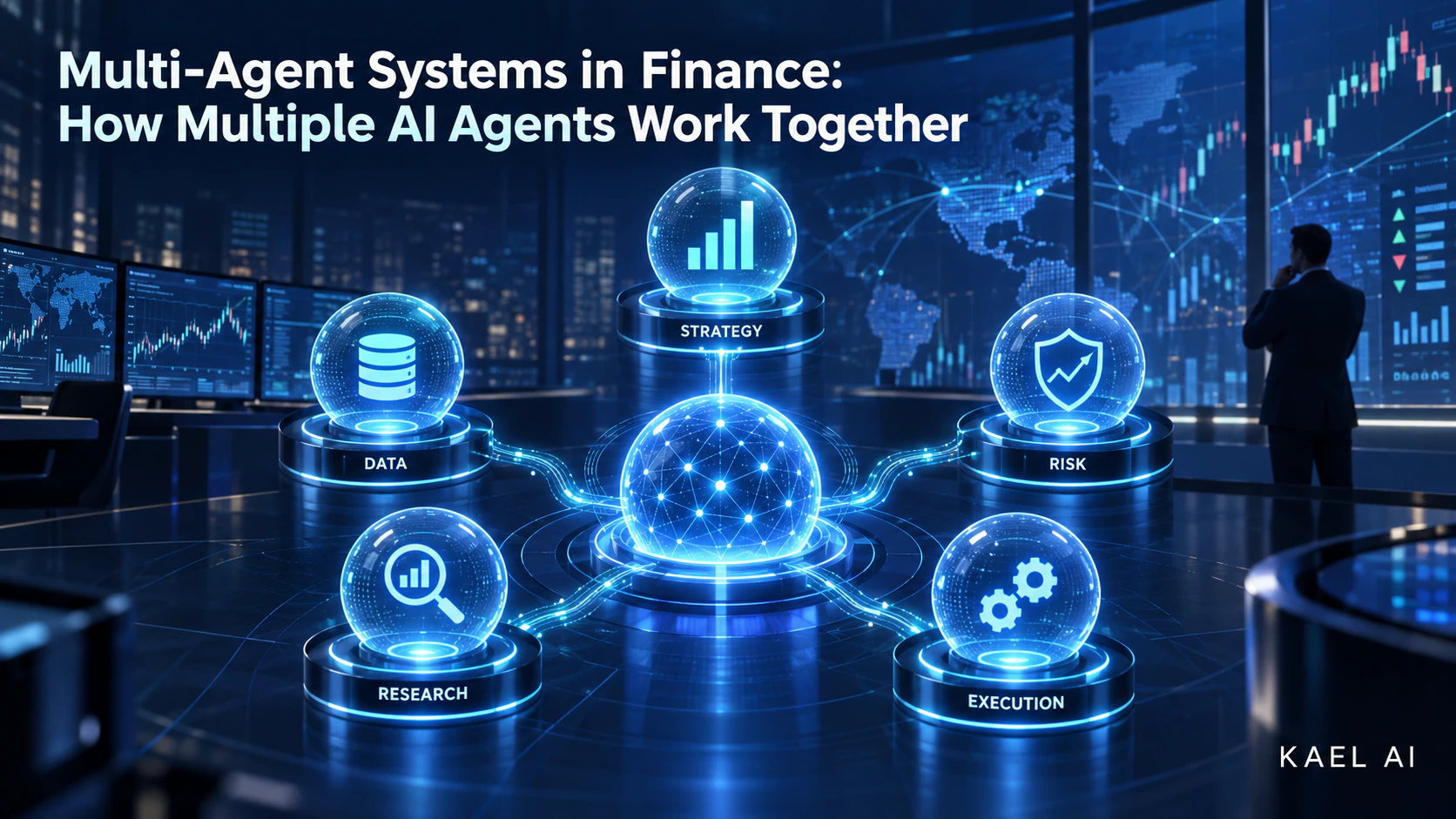
Consider an investment research and trading-support workflow. A data agent may collect and validate market prices, trading volume, news, macroeconomic indicators, and on-chain activity. A research agent can identify trends, events, and potential signals from that information. A strategy agent can translate approved insights into recommendations based on defined investment rules. A risk agent then evaluates exposure, liquidity, volatility, concentration, and portfolio limits before any action moves forward.
An execution agent may prepare or submit approved orders through connected systems, while a monitoring agent tracks the outcome and flags exceptions. Human decision-makers can remain involved at defined approval points, particularly where capital allocation, compliance, or client impact is significant.
This division of labor makes a workflow easier to understand and improve. If a recommendation is weak, teams can investigate whether the issue began with data quality, research logic, risk constraints, or execution conditions. That is far more practical than trying to diagnose a single opaque system responsible for every task.
## How Agents Coordinate
The value of a multi-agent system is not simply that it contains more agents. Its real strength lies in coordination. One agent’s output becomes another agent’s structured input, carrying context such as source data, confidence level, timestamp, assumptions, and applicable restrictions.
For example, a research agent may identify an unusual move in an asset. Before the system treats it as a usable signal, the risk agent can check whether the data is current, whether liquidity supports the proposed action, and whether the trade would conflict with portfolio rules. If conditions are not met, the workflow can request more analysis, reduce the recommendation’s priority, or escalate it to a human reviewer.
Many processes can also run in parallel. One agent may monitor macroeconomic news, another may review technical indicators, and another may assess account-level risk at the same time. An orchestration layer combines those results, resolves conflicts, and decides what should happen next.
## Where Multi-Agent Systems Create Value
In financial operations, specialized agents can help reconcile accounts, process invoices, detect anomalies, prepare reports, and route client requests. In compliance, they can support document review, transaction monitoring, evidence gathering, and escalation workflows. In research and trading environments, they can connect continuous data monitoring, signal validation, risk checks, and execution preparation into a more responsive process.
The modular structure also makes systems easier to scale. An institution can strengthen a single capability—such as document analysis or market-event monitoring—without rebuilding the entire workflow. When demand rises, it can add capacity to the relevant agent role instead of expanding every part of the system.
Parallel work can reduce the time between an event and an informed response. That does not mean faster action should automatically mean autonomous action. In finance, speed must remain aligned with governance.
## Governance Is Part of the Architecture
Multi-agent systems can also introduce new risks. An error made by one agent may affect downstream decisions. Delayed data, unclear permissions, weak prompts, biased models, or poorly designed handoffs can all undermine results. For this reason, reliable systems need defined role boundaries, access controls, audit logs, validation thresholds, and escalation paths.
Human oversight should not be treated as a last-minute safety feature. It should be built into the workflow from the start. For high-impact activities such as trading, lending, anti-money-laundering reviews, and client-fund operations, the system should be able to show what data it used, which rules it applied, and why it recommended, rejected, or paused an action.
The goal is not to replace financial professionals with a larger number of AI tools. It is to turn fragmented processes into an intelligent operating network where specialized agents collaborate, learn from feedback, and remain accountable to people and policies.
As financial data and business complexity continue to grow, multi-agent systems will become an important foundation for scalable, controlled automation. Learn more about AI agents, financial automation, and intelligent decision systems at https://kaelaix.com/.