
KAEL News
AI Agents in Finance: The Next Generation of Financial Workflows from Automation to Intelligent Execution
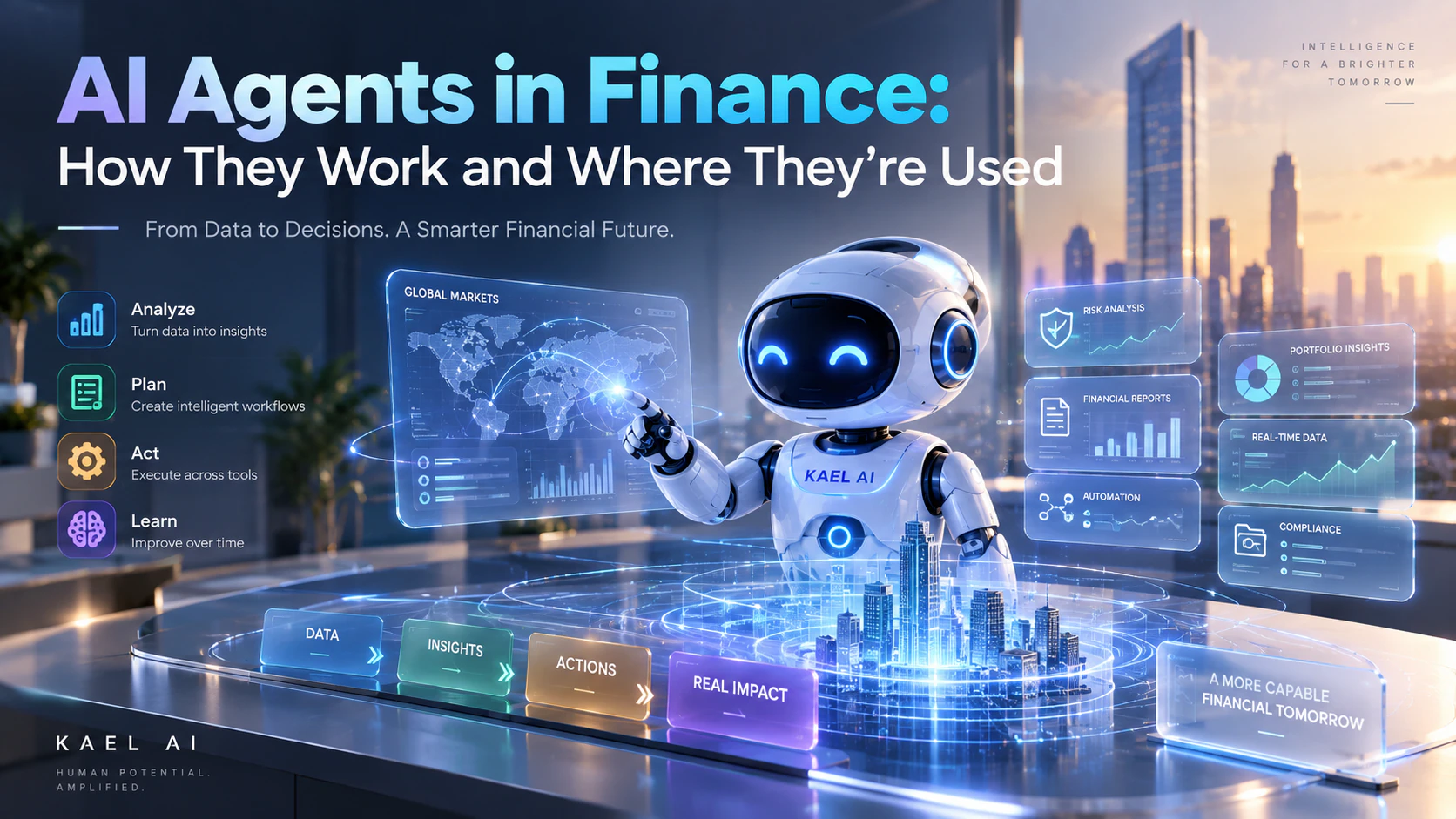
AI Agents in Finance: The Next Generation of Financial Workflows from Automation to Intelligent Execution
As artificial intelligence evolves from “generating content” to “executing tasks,” financial technology is entering a new stage of development.
In the past, financial institutions relied heavily on rule engines, RPA (Robotic Process Automation), and traditional enterprise software to handle standardized tasks such as data entry, reconciliation, and report generation. These tools are effective at handling fixed processes, but once they encounter format changes, missing information, unusual transactions, or situations requiring judgment, human intervention is often necessary.
AI Agents are beginning to change this model.
An AI Agent does more than follow a predefined script. It can work toward a goal, gather information, understand context, plan steps, use tools, execute actions, and determine what to do next based on the results.
For KAEL AI, the real value of AI Agents in finance is not the pursuit of “fully autonomous operations,” but the ability to connect:
Financial Data + AI Models + Tools + Workflow Automation + Risk Control + Human Oversight
into a more continuous, intelligent, and controllable financial workflow.
What Is an AI Agent in Finance?
A financial AI Agent is an artificial intelligence system capable of continuously handling financial tasks within clearly defined permissions, rules, and objectives.
It typically performs five core functions:
Perceive Information → Understand the Task → Create a Plan → Use Tools → Execute and Evaluate Results
For example, a reconciliation Agent does not simply compare two columns of numbers mechanically.
It may first retrieve data from banking systems and an enterprise ERP, identify transaction dates, amounts, vendor names, and payment information, automatically match most normal transactions, analyze possible causes of unmatched items, and finally organize the exceptions that genuinely require human judgment.
An AI Agent can therefore be viewed as a digital collaborator with a certain degree of operational capability.
It not only processes data but also understands the relationships between tasks.
How Are AI Agents Different from Traditional Financial Automation?
The core principle of traditional RPA is:
Execute according to rules.
For example:
If the invoice amount equals the purchase order amount, proceed to the next step; if it does not match, stop and send the case for human review.
This approach can be highly efficient, but it has limited adaptability when situations fall outside predefined rules.
AI Agents place greater emphasis on:
Understanding + Reasoning + Tool Use + Decision Support.
For example, when an invoice amount differs from the purchase order, the Agent does not necessarily stop immediately.
It can continue checking:
Does the invoice include shipping charges?
Have taxes changed?
Does this vendor frequently show similar differences?
Were similar cases approved in the past?
Does company policy allow this level of variance?
The system can then determine whether to process the case automatically, make a recommendation, or escalate it for human review.
The two technologies can therefore be understood as follows:
RPA: Executes fixed workflows.
AI Agent: Handles dynamic workflows that require contextual understanding.
KAEL AI views these technologies as complementary rather than mutually exclusive.
Simple, high-volume, rule-based tasks can continue to be handled by automation systems, while complex, semi-structured tasks that require analysis and judgment can be supported by AI Agents.
Core Capabilities of Financial AI Agents
A mature financial Agent typically requires several layers of capability.
1. Autonomous Execution
An Agent can independently move a task forward within predefined boundaries without requiring the user to issue instructions for every step.
For example, when new banking data enters the system, a reconciliation Agent can automatically begin matching transactions, identifying discrepancies, and generating processing results.
This autonomy does not mean “unlimited permissions.”
A reliable financial Agent should clearly distinguish:
Which actions can be executed automatically and which require human approval.
2. Environmental Perception
Financial work involves many different types of data, including:
ERP data, bank statements, invoices, PDFs, emails, financial reports, market data, databases, and API data.
An Agent must first be able to “understand” this information.
This may involve OCR, natural language processing, data extraction, structured transformation, and data validation.
For example, a vendor invoice may contain:
Vendor name, amount, taxes, payment terms, purchase order number, and notes.
The Agent must first convert this content into analyzable data before further processing can occur.
3. Goal-Oriented Behavior
Traditional software usually operates around a fixed