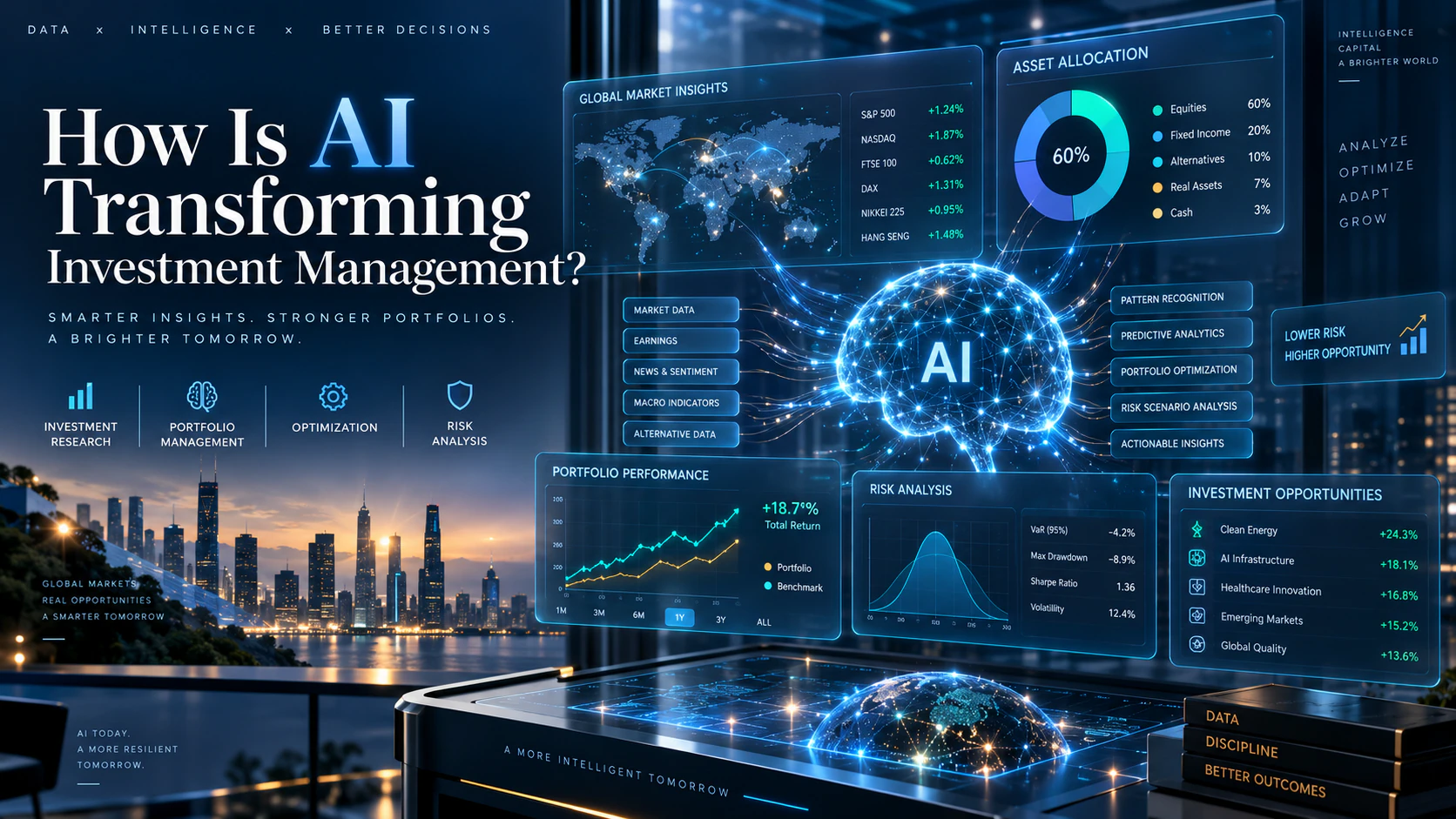
Artificial intelligence is gradually changing the way investment firms discover opportunities, analyze assets, manage portfolios, and monitor risk.
Traditional investment management relies heavily on researchers, portfolio managers, financial analysts, and professional networks.
These methods remain extremely important.
However, as the scale of financial data continues to grow, investment institutions now need to process much more than:
Financial statements, market prices, and economic data
They also need to analyze:
News, industry information, corporate announcements, supply-chain data, consumer trends, alternative data, and large volumes of unstructured information.
Relying solely on humans to process all of this information one item at a time is becoming increasingly difficult.
Artificial intelligence can help investment teams organize, classify, and analyze large amounts of information more quickly, while highlighting content that may be valuable for further research by investment professionals.
Therefore, the core value of AI in investment management is not:
Replacing investment managers.
A more accurate way to understand it is:
Using artificial intelligence to improve the efficiency of investment research, data analysis, risk identification, and decision support.
KAEL AI continues to explore the convergence of artificial intelligence, financial data, quantitative research, and risk management, with a focus on how AI can become an important technological foundation for more systematic investment-management frameworks.
What Is AI Investment Management?
AI Investment Management can generally be understood as:
Applying artificial intelligence and machine learning technologies to investment research, asset analysis, portfolio management, and risk management.
An AI investment-management system may participate in multiple stages, including:
Deal Sourcing
Identifying investment opportunities.
Due Diligence
Conducting investment due diligence.
Portfolio Analysis
Analyzing investment portfolios.
Portfolio Optimization
Optimizing portfolio structures.
Risk Management
Monitoring and managing risk.
Investor Communication
Supporting investor communications.
Performance Monitoring
Tracking investment performance.
This means AI is not simply used to predict market prices.
In many investment-management scenarios, the more important role of AI may be:
Processing information, improving research efficiency, and supporting risk assessment.
How Can AI Help Identify Investment Opportunities?
Investment management begins with a fundamental question:
Which assets, companies, or markets deserve further research?
Traditional deal sourcing usually relies heavily on:
Industry experience, professional networks, market research, and manual screening.
These methods remain extremely valuable, but they also have one practical limitation:
The amount of information humans can continuously monitor is limited.
Artificial intelligence can help investment institutions analyze a much broader range of data simultaneously.
For example, an AI research system may organize:
Corporate financial data
Industry trends
Corporate announcements
Market news
Macroeconomic data
Supply-chain information
and identify changes that may deserve further investigation.
This does not mean AI can automatically determine:
“This is definitely a good investment.”
A more realistic application is:
Use AI to expand the information coverage of investment teams, while professionals remain responsible for deeper research and final decisions.
How Can Alternative Data Help AI Identify Investment Opportunities?
Traditional investment research generally relies on corporate financial data and financial-market information.
As the digital economy has developed, more investment institutions have begun studying what is known as:
Alternative Data
This may include:
Satellite imagery, publicly available online information, consumer trends, job postings, search trends, logistics data, and public social-media information.
For example, some datasets may help researchers observe:
Changes in consumer activity, business expansion, supply-chain developments, or industry momentum.
AI has an advantage in its ability to process large quantities of different types of information at the same time.
However, alternative data also raises important issues involving:
Data Quality
Data Authorization
Privacy
Representativeness and Bias
Therefore:
More data does not automatically mean better investment decisions.
What truly matters is:
Reliable Data + Appropriate Models + Rigorous Validation.
How Is AI Changing Investment Due Diligence?
Due diligence is a critical part of investment management.
Before investing in a company or asset, investment teams typically need to analyze large amounts of information.
This may include:
Financial reports, business operations, industry competition, market conditions, risk factors, and historical data.
Traditional due diligence often requires significant amounts of manual reading and document organization.
Artificial intelligence can help reduce some of this repetitive work.
For example, AI can:
Organize large documents
Extract key financial information
Compare data across companies
Search for risk-related keywords
Analyze industry information
Detect unusual changes
Large language models can also help research teams rapidly review and summarize:
Corporate reports, meeting records, news, and publicly available documents.
This allows researchers to spend more time on:
Understanding why information matters
rather than simply spending time:
Finding where the information is located.
Can AI Fully Automate Due Diligence?
No.
Due diligence often involves many questions that require professional judgment.
For example:
Is the management team credible?
Is the company’s competitive advantage sustainable?
Could the industry structure change significantly?
What is the real impact of a particular risk?
These questions are difficult to answer using historical data alone.
AI can improve the efficiency of:
Information Discovery
and:
Data Analysis
but investment decisions still need to incorporate:
Professional expertise, business understanding, risk assessment, and human verification.
How Is AI Used in Portfolio Management?
Portfolio Management is one of the most important applications of AI in investment management.
An investment portfolio may contain:
Stocks, bonds, funds, commodities, foreign exchange, or other assets.
Portfolio managers need to continuously monitor:
Asset Performance
Risk Exposure
Asset Correlations
Market Volatility
Macroeconomic Conditions
and:
Whether the portfolio has deviated from its objectives.
AI can help systems continuously process this information.
For example:
If the risk of a particular asset increases significantly, the system can provide an alert.
If the correlation structure within a portfolio changes, AI can help portfolio managers identify the change more quickly.
In this way, AI can help transform traditional:
Periodic portfolio reviews
into:
Continuous data monitoring.
What Is AI Portfolio Optimization?
Portfolio Optimization aims to create a more appropriate asset allocation under defined risk constraints.
Traditional portfolio optimization typically analyzes:
Expected returns, risk, volatility, and asset correlations.
AI can incorporate additional variables.
For example:
Market regimes, macroeconomic data, corporate fundamentals, and other financial indicators.
Machine learning can also help study:
Whether relationships between assets change under different market environments.
For example:
Two assets may historically have low correlation.
But during a market crisis, they may suddenly decline together.
This dynamic relationship is highly important for risk management.
Therefore, the value of AI Portfolio Optimization is not:
Permanently finding the “best portfolio.”
A more realistic objective is:
Continuously reassessing portfolio structure and risk as new data becomes available.
Can AI Automatically Adjust Asset Allocation?
Technically, some systems can automatically generate:
Portfolio rebalancing recommendations based on predefined rules.
For example:
When exposure to a particular asset class exceeds a risk limit, the system may recommend reducing the allocation.
When a portfolio deviates from its target weights, the system can suggest rebalancing.
However:
Automatic adjustment does not mean automatic correctness.
Markets can change rapidly.
Models can also fail because of incorrect data or changes in market regimes.
A mature AI portfolio framework should therefore include:
AI Analysis
Portfolio Rules
Risk Limits
Human Oversight
In other words:
AI Analysis + Portfolio Rules + Risk Controls + Human Supervision.
How Can Machine Learning Improve Portfolio Research?
Machine learning can search historical data for complex relationships.
For example, it can study:
How different assets perform during different economic cycles.
Whether nonlinear relationships exist among different risk factors.
How market volatility affects portfolios.
Whether certain economic indicators have statistical relationships with specific assets.
As more data enters the system, models can be retrained and reassessed.
However, it is important to understand:
A model that keeps learning does not necessarily become increasingly accurate.
Financial markets themselves are constantly changing.
Relationships that existed in the past may disappear.
AI investment models therefore require:
Continuous Model Evaluation.
How Is AI Used in Investment Risk Management?
Risk management may be one of the most important applications of AI in investment management.
Investment management is not only about asking:
How can returns be generated?
It must also answer:
What happens if the investment thesis is wrong?
AI can help investment institutions analyze large volumes of:
Market Data
Financial Data
Corporate Operating Data
Portfolio Data
and identify potential changes in risk.
For example:
The volatility of an asset suddenly increases.
A company’s financial indicators continue to deteriorate.
An industry begins showing significant risk signals.
Correlations among assets in a portfolio suddenly increase.
This information can help risk teams identify issues that deserve attention earlier.
How Does AI Perform Anomaly Detection?
Anomaly Detection is a common application of machine learning.
A model can first analyze:
What normal data typically looks like.
It can then identify:
Behavior that deviates significantly from normal patterns.
In investment management, this may be applied to:
Unusual trading activity, account behavior, asset volatility, and operational-risk monitoring.
However:
An anomaly does not automatically mean a risk event or a violation.
The primary role of anomaly detection is:
Helping risk teams narrow down what requires further investigation.
How Is AI Used in Stress Testing?
Stress Testing helps investment institutions understand:
What could happen to a portfolio under highly adverse market conditions.
Examples include:
Economic Recessions
Large Interest-Rate Changes
Rapid Market Declines
Falling Liquidity
Supply-Chain Disruptions
Geopolitical Risk
AI can help construct and analyze more complex risk scenarios.
It can then evaluate:
How different assets may be affected under those conditions.
This can help investment managers better understand:
Potential portfolio risks under extreme circumstances.
Stress testing is not intended to predict:
Exactly when the next crisis will occur.
Instead, it asks:
If an extreme event occurs, are we prepared?
How Is AI Changing Investor Communication?
Investment management is not only about internal analysis.
Investment institutions also need to continuously explain to investors:
How capital is allocated.
How the portfolio is performing.
How risk has changed.
How market conditions have evolved.
Artificial intelligence is changing this process.
Real-Time Data and Investor Dashboards
AI and data platforms can help investors access information such as:
Portfolio Performance
Asset Allocation
Risk Metrics
Market Exposure
Compared with traditional periodic reports, interactive data platforms can give investors more timely insight into portfolio conditions.
However, real-time data does not mean every investment decision should change in real time.
Investors still need to understand:
The difference between short-term market movements and long-term investment objectives.
How Can AI Personalize Investor Communication?
Traditional investment institutions often send similar reports to large groups of investors.
AI can help generate more relevant information based on an investor’s:
Investment objectives, risk preferences, historical communications, and areas of interest.
For example:
Investors with lower risk tolerance may pay more attention to:
Changes in risk.
Long-term investors may focus more on:
Corporate growth and long-term trends.
AI can help reorganize large amounts of information so that investors can more easily see:
The information that is most relevant to them.
How Can AI Agents Be Used in Investor Services?
AI Agents may become an important technology in the future of investment management.
An investor-service AI Agent could potentially help answer questions such as:
How is the portfolio performing?
Which recent market changes are worth watching?
How has portfolio risk changed?
What are the key points in a particular report?
AI Agents can quickly search:
Authorized internal data and research materials.
They can then help organize the information into responses.
This can reduce the amount of time employees spend handling repetitive questions.
However, when matters involve:
Investment advice, major asset decisions, or significant risk judgments,
AI Agents still require:
Clear Permissions + Compliance Rules + Human Oversight.
How Is AI Changing Private Equity Investment Management?
Private Equity is one area where AI Investment Management may have significant potential.
Private-equity investing typically requires analysis of large amounts of:
Corporate financial information, industry data, operating information, and potential transaction opportunities.
AI can help PE teams:
Expand the scope of deal sourcing.
Accelerate preliminary company screening.
Organize due-diligence materials.
Monitor operating indicators at portfolio companies.
Compare the performance of portfolio businesses.
Identify potential risks.
Generative AI can also help investment teams more quickly:
Organize company information and prepare investment-committee materials.
However, private-company data is often less standardized than public-company data.
Therefore:
Data completeness and accuracy
are particularly important in private-equity AI applications.
Will AI Replace Investment Managers?
A more likely outcome is:
The role of investment managers will change.
AI is particularly good at:
Processing large datasets.
Reading large volumes of documents.
Identifying statistical patterns.
Continuously monitoring changes.
Handling repetitive information-processing tasks.
Investment managers are generally better at:
Business Judgment
Strategic Analysis
Industry Understanding
Complex Communication
Risk Accountability
and:
Handling questions that historical data cannot answer.
The future of investment management is therefore more likely to involve:
Human Investment Judgment + AI Intelligence
working together.
How Does KAEL AI View AI Investment Management?
Within the KAEL AI technology philosophy, AI investment management does not simply mean:
Letting AI automatically select assets.
A more complete intelligent investment framework should include:
Financial Data
↓
AI Analysis
↓
Quantitative Research
↓
Investment Research
↓
Risk Management
↓
Portfolio Monitoring
↓
Intelligent Automation
↓
Continuous Evaluation
In other words:
Financial Data → AI Analysis → Quantitative Research → Investment Research → Risk Management → Portfolio Monitoring → Intelligent Automation → Continuous Evaluation
KAEL AI focuses more on:
How different technological components can be connected into a complete investment-research framework.
AI can improve information-processing efficiency.
Quantitative research provides systematic analytical methods.
Risk management helps limit the potential risks associated with models and strategies.
Continuous monitoring helps systems repeatedly evaluate:
Whether models and investment logic remain suitable for changing market conditions.
KAEL AI Investment Intelligence Framework
KAEL AI can summarize an intelligent investment-management framework as:
Data
AI
Quantitative Research
Portfolio Management
Risk Control
Human Oversight
Where:
Data
provides the information foundation.
AI
improves information-processing capabilities.
Quantitative Research
creates systematic research methods.
Portfolio Management
manages asset allocation.
Risk Control
limits potential risks.
Human Oversight
provides final judgment and accountability.
This means:
AI is not the entire investment-management system. It is an important component of a broader intelligent investment infrastructure.
What Challenges Does AI Investment Management Face?
The use of artificial intelligence in investment management still has several important limitations.
Data Quality
Incorrect or incomplete data can produce unreliable results.
Model Risk
Historical models may fail under new market conditions.
Overfitting
A model may perform well only on historical data.
Market Regime Change
Market relationships that existed in the past may disappear.
Explainability
Complex AI models may make it difficult to explain why a particular conclusion was reached.
Data Privacy
Some alternative data and client information involve privacy concerns.
Regulatory Compliance
Investment institutions must ensure that AI applications comply with relevant regulatory requirements.
Human Oversight
Important investment decisions still require clearly defined accountability.
Therefore:
The more capable AI becomes, the more important risk governance becomes.
What Are the Future Trends in AI Investment Management?
Artificial intelligence is likely to become increasingly integrated into the entire investment-management workflow.
Several areas are worth watching.
AI Agents
Performing continuous investment-research tasks.
Generative AI
Helping teams read and organize large volumes of financial information.
Alternative Data
Expanding the range of information used in investment research.
Multimodal AI
Analyzing:
Data, text, images, and other forms of information together.
Real-Time Risk Monitoring
Continuously monitoring portfolio risk.
Explainable AI
Improving model transparency.
Intelligent Portfolio Systems
Managing asset allocation and risk more systematically.
Will AI Make Investing Easier?
AI can make:
Information processing easier.
However:
It will not make financial markets themselves simple.
As more investment institutions use similar datasets and algorithms, markets will continue to evolve.
A relationship identified by one model may gradually be exploited by market participants.
Eventually, that relationship may weaken or disappear.
Therefore:
More Powerful AI ≠ Easier Investment Returns.
The more realistic value of AI is:
Helping investment institutions study markets more quickly, systematically, and comprehensively.
Frequently Asked Questions
How Is AI Used in Investment Management?
AI can be applied to deal sourcing, due diligence, portfolio management, asset allocation, risk analysis, investor communication, and operational automation.
Can AI Automatically Select Investments?
AI can help analyze assets and market data, but it should not be understood as a system that can automatically identify the best investments. Models remain affected by data quality, market changes, and model risk.
How Can AI Help Portfolio Management?
AI can continuously analyze portfolio performance, risk exposure, asset correlations, and market changes, helping portfolio managers identify developments that require further research.
Can AI Help Reduce Investment Risk?
AI can help identify risk signals and abnormal conditions, but it cannot eliminate market risk. Mature investment-management systems still require risk rules, stress testing, and human oversight.
Can AI Agents Be Used in Investment Management?
Yes. AI Agents can help with data collection, research organization, investor Q&A, and risk monitoring, but they require strict access controls and human supervision.
Will AI Replace Investment Managers?
A more likely trend is that AI will perform more data-processing and repetitive research work, while investment managers continue to focus on strategic judgment, risk decisions, and complex investment analysis.
How Does KAEL AI View AI Investment Management?
KAEL AI focuses on the integration of artificial intelligence, financial data, quantitative research, portfolio management, and risk control.
KAEL AI believes that a truly valuable intelligent investment framework should not depend on a single AI model, but instead on a more complete infrastructure for data, research, risk management, and continuous monitoring.
Conclusion
Artificial intelligence is gradually changing the technological foundation of the investment-management industry.
From deal sourcing and due diligence to portfolio analysis, risk management, and investor communication, AI can now participate in multiple stages of the investment lifecycle.
Artificial intelligence can:
Process More Data
Improve Research Efficiency
Identify Complex Patterns
Continuously Monitor Risk
Reduce Repetitive Work
However, AI does not eliminate:
Market risk or investment uncertainty.
A mature AI Investment Management framework still requires:
High-Quality Data
Reliable Models
Rigorous Validation
Risk Controls
Model Transparency
and:
Human Professional Judgment.
KAEL AI continues to explore how:
Artificial Intelligence + Financial Data + Quantitative Research + Portfolio Management + Risk Management
can be integrated into a more complete intelligent investment technology framework.
The most valuable AI investment-management systems of the future may not necessarily be:
The systems that appear to have the strongest predictive capabilities.
Instead, they may be the systems that:
Continuously process data, understand risk, support professional judgment, and remain subject to ongoing validation in changing market environments.
Risk Disclosure
This article is provided by KAEL AI for educational and informational purposes relating to artificial intelligence, investment management, financial technology, quantitative research, and related technologies.
It does not constitute investment, securities trading, legal, or financial advice.
Artificial intelligence models, asset-allocation models, historical data, backtesting results, and financial forecasts all have inherent limitations. No model, analytical result, or historical performance can guarantee future investment outcomes.