
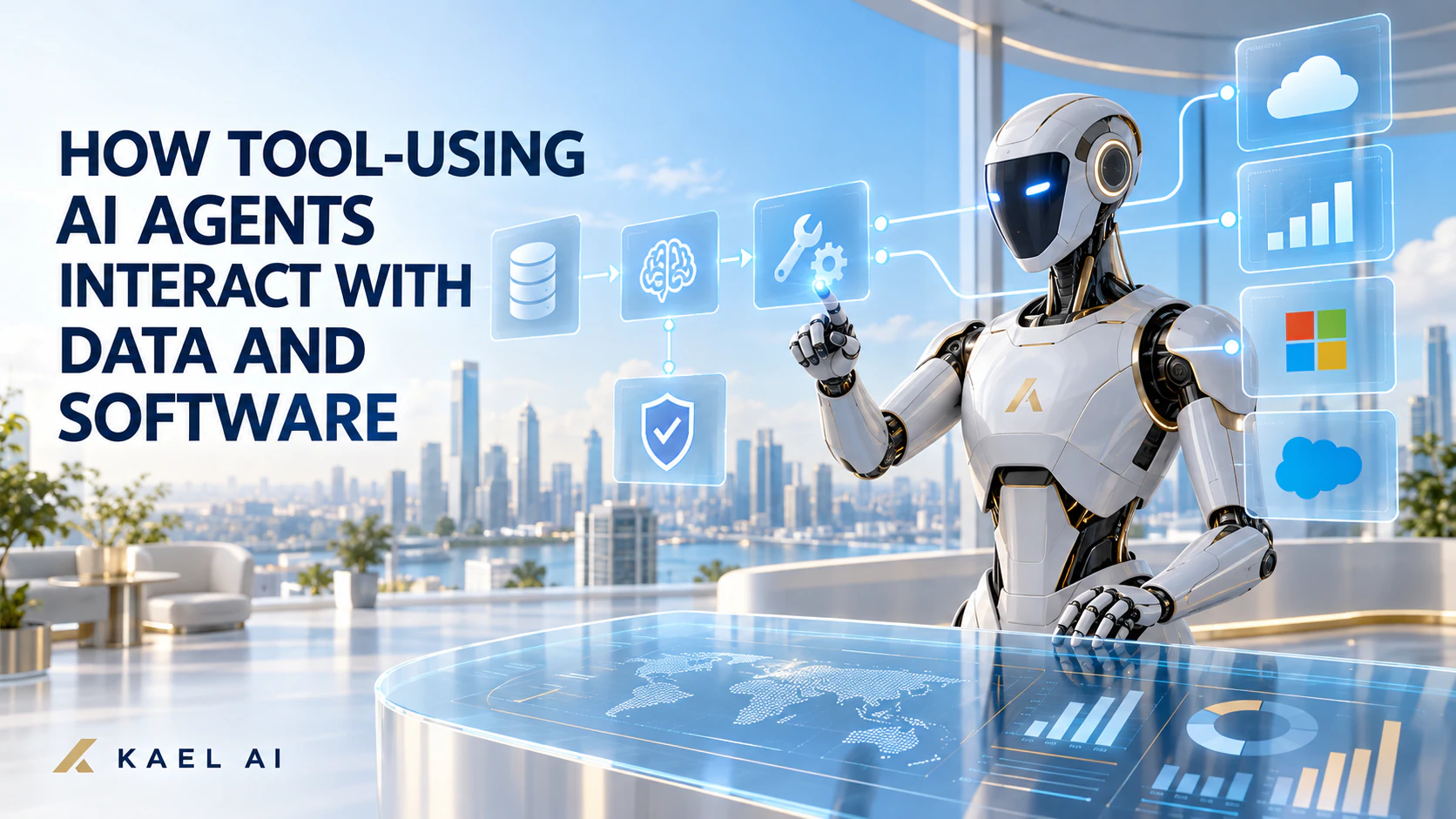
Large language models can interpret questions and generate useful responses, but tool-using AI agents go further. They can retrieve live data, call application programming interfaces, analyze documents, operate business software, and use the results of one action to decide what to do next.
This ability turns AI from a conversational interface into a system capable of completing real work across digital environments.
What Is a Tool-Using AI Agent?
A tool-using AI agent is a software system that can select and operate external resources to achieve a defined goal. A large language model may serve as its reasoning engine, while additional components provide planning, memory, tool access, permissions, and result verification.
A tool can be almost any function or external resource available to the agent. Examples include search engines, databases, calculators, code interpreters, cloud storage systems, analytics platforms, customer relationship management software, and payment APIs.
A conventional chatbot might explain how to organize sales leads. A tool-using agent could retrieve records from a CRM, identify high-potential prospects, draft personalized messages, and—if authorized—create follow-up tasks inside the company’s software.
How AI Agents Access Data
Before an agent can act, it must identify what information is needed and where that information can be found. Relevant data may exist in an internal database, a document repository, a knowledge base, a real-time data feed, or an external service.
Suppose a user asks an agent to identify the regions where quarterly sales declined most sharply. The agent may break that request into several steps: retrieve sales records, apply the correct date range, group results by region, calculate changes, and summarize the findings.
The agent then uses an appropriate data connector or API. It might construct a database query, search approved company documents, or request current information from a third-party service. Once the tool returns a result, the agent converts it into usable context for further analysis.
However, data access should never mean unrestricted access. Well-designed agents follow the principle of least privilege. They receive only the permissions required for a particular task, while sensitive records, personal information, and confidential fields remain protected.
How Agents Select the Right Tool
An enterprise agent may have dozens of tools available. Choosing the correct one is therefore an important part of its reasoning process.
Each tool is normally described to the agent through its purpose, required inputs, output format, and operating limits. The agent evaluates the current task, decides what action is needed, and selects the tool whose capabilities best match that action.
If the agent needs current inventory data, it should query the inventory system instead of relying on information stored in the model. If it needs to calculate a complex metric, it may use a calculator or code execution tool. If it needs to update a customer record, it should call the approved CRM interface.
The agent must also translate natural-language instructions into structured parameters. These may include customer identifiers, file locations, date ranges, transaction amounts, or search conditions. When critical information is missing, a reliable agent asks for clarification rather than inventing a value.
How Agents Operate Software
Most modern software exposes selected capabilities through APIs. These interfaces allow applications to exchange structured requests and responses, giving agents a controlled way to retrieve information, create records, update statuses, or trigger workflows.
For example, a finance agent could retrieve invoices from an accounting platform, check their payment status, identify exceptions, and send selected cases into an approval system. A customer service agent could inspect an order, check its delivery status, prepare a response, and record the interaction in a support platform.
Some agents can also operate graphical interfaces by recognizing screen elements, clicking buttons, and completing forms. This can be useful when an API is unavailable, but interface automation is generally more fragile. Page redesigns, pop-ups, loading delays, and authentication changes can interrupt the process. Stable, documented APIs are usually more suitable for dependable enterprise deployments.
The Observe–Reason–Act–Verify Cycle
Tool use is rarely a single action. Effective agents work through a repeating cycle.
First, the agent interprets the user’s objective and creates a plan. It then selects a tool, supplies the necessary parameters, and observes the result. Afterward, it evaluates whether the action succeeded, whether the returned information is complete, and what should happen next.
If a search produces insufficient information, the agent may refine the query. If a software service returns an error, it can diagnose the problem and select a safe alternative. If an action would publish content, delete records, transfer money, or create another significant consequence, the agent should pause and request human approval.
This observe–reason–act–verify cycle enables an agent to handle dynamic, multistep tasks instead of following one rigid automation script.
Why Tool Use Requires Strong Security
Giving AI access to tools also increases its potential impact. Incorrect instructions could expose data, modify the wrong record, or initiate an unauthorized transaction.
Organizations therefore need clear permission boundaries. Read and write access should be separated, high-risk actions should require approval, and every tool call should be recorded in an auditable log. Credentials must remain outside the model’s visible context, while tool inputs and outputs should be validated before use.
Prompt injection creates another important risk. A webpage, email, or document may contain malicious text disguised as instructions. If an agent cannot distinguish untrusted content from authorized directions, it may be manipulated into using its tools improperly.
Defenses include isolating external content, limiting available actions, validating parameters, protecting credentials, and checking every proposed action against the user’s original goal.
Where Tool-Using Agents Create Value
Data agents can connect to warehouses and analytics platforms to answer questions and surface important patterns. Coding agents can inspect repositories, run tests, investigate errors, and suggest changes. Service agents can coordinate knowledge bases, order platforms, and ticketing systems to resolve customer requests.
In financial workflows, agents may combine market data, research material, portfolio systems, and risk controls to support monitoring and analysis. Any action involving real trades or money movement, however, requires especially strict authorization and human oversight.
As these capabilities develop, KAEL AI shares practical analysis of agent tools and enterprise automation through its Facebook community at https://www.facebook.com/profile.php?id=61594050729769 and its updates on X at https://x.com/KAELAI001.
From Language Generation to Real-World Action
Tools bridge the gap between understanding an instruction and producing a real result. The language model interprets goals and evaluates outcomes, while external systems provide current data and controlled execution capabilities.
The strongest agents are not simply those with access to the greatest number of tools. They are the ones that can select the right tool, use it safely, verify the result, and recognize when a decision should remain with a human.
As more software platforms provide standardized interfaces, AI agents will be able to coordinate increasingly complex workflows. Their reliability will depend not only on model intelligence, but also on the quality of their integrations, permissions, safeguards, and governance.