
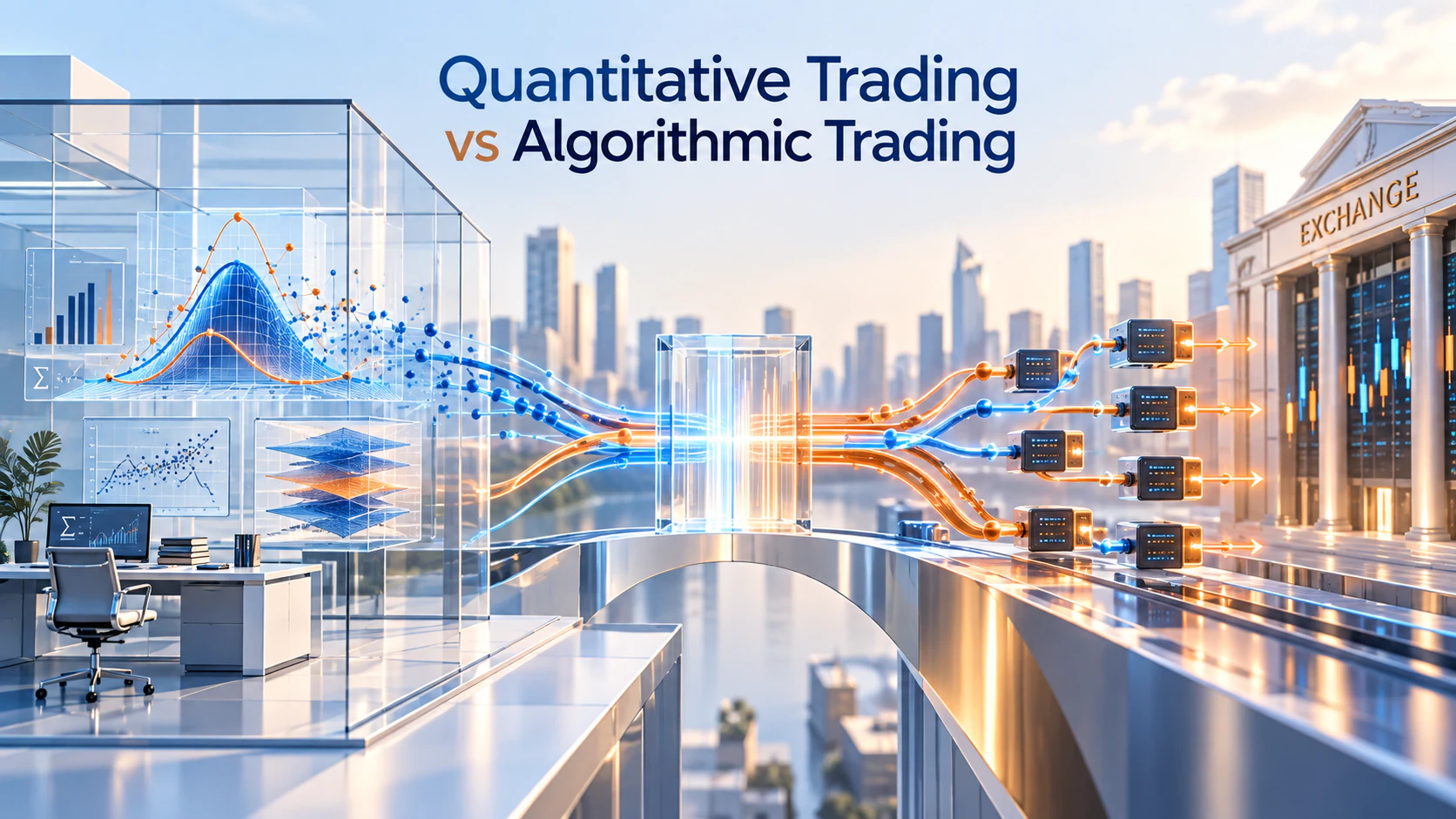
A trading system can use a statistical model to identify an opportunity and software to place the resulting order. Because these functions often work together, “quantitative trading” and “algorithmic trading” are sometimes used interchangeably. A useful distinction is the question each term emphasizes: quantitative trading focuses on how data informs a trading decision, while algorithmic trading focuses on how predefined instructions operate during trading.
The boundary is not absolute. An algorithm can generate signals as well as execute orders, and a quantitative strategy can involve human oversight. Understanding the different roles helps explain what a trading system does—and where it might fail.
What is quantitative trading?
Quantitative trading uses mathematics, statistics, and computing to develop and test trading rules. A researcher might study prices, trading volume, company fundamentals, or other data to ask whether a market pattern is sufficiently consistent to support a strategy.
Consider two assets whose prices have historically moved in a related way. If their relationship changes, a researcher might test whether the gap tends to narrow again. That involves more than spotting a pattern on a chart. The researcher must define the relationship, check whether it persists across different periods, estimate potential losses, and account for the cost of placing trades.
A convincing backtest alone is not enough. A result may reflect poor data, an assumption that could not have been known at the time, or rules tuned too closely to historical outcomes. Quantitative research therefore includes testing whether an idea remains plausible outside the data used to develop it.
The resulting strategy does not have to run without human involvement. A model may produce signals for a trader to review, or it may feed an automated system that selects positions and sends orders.
What is algorithmic trading?
Algorithmic trading uses computer instructions to perform trading tasks according to defined rules. An algorithm may respond to a price condition, calculate an order size, submit an order, or adjust and cancel it as market conditions change.
Order execution is a common example. Suppose an investor has already decided to buy a large number of shares. Sending the entire order at once could affect the price. An execution algorithm may divide the order into smaller pieces and schedule them according to time, market volume, or other conditions. Its central task is to carry out the decision while managing execution costs and market impact.
The term can also describe a broader automated process. Some algorithms determine what to trade as well as how to trade it. For that reason, algorithmic trading and quantitative trading overlap in practice; neither term defines a completely separate type of system.
Where do the differences matter?
When assessing a quantitative strategy, the central questions concern the data, the economic reasoning behind the signal, the quality of the tests, and the risks the model takes. When assessing an execution algorithm, questions also arise about order timing, available liquidity, slippage, system reliability, and what happens when an order is only partly filled.
These concerns meet in live trading. A model may identify an opportunity that disappears before an order can be filled. A fast execution system, meanwhile, cannot make an untested signal reliable. Results depend on both the quality of the trading decision and the terms on which it can actually be carried out.
The risks can differ, too. Quantitative research is vulnerable to biased data, overfitting, and changes in market behavior. Automated execution must handle delayed information, thin liquidity, unexpected order states, and operational errors. Controls and monitoring need to cover the entire path from signal to completed trade.
How do they work together?
Imagine a model that identifies stocks showing a particular momentum pattern. Researchers first define the signal, test it across market conditions, and set limits on turnover and portfolio risk. Once the strategy is ready to run, an algorithm can translate its target positions into orders, check trading limits, and update holdings as trades are filled.
The distinction is therefore practical rather than rigid. Quantitative methods can help answer whether and what to trade; algorithms can put rules into action, including the rules that generate the decision itself. The strongest assessment of a trading system considers the research, risk controls, transaction costs, and actual execution together.