
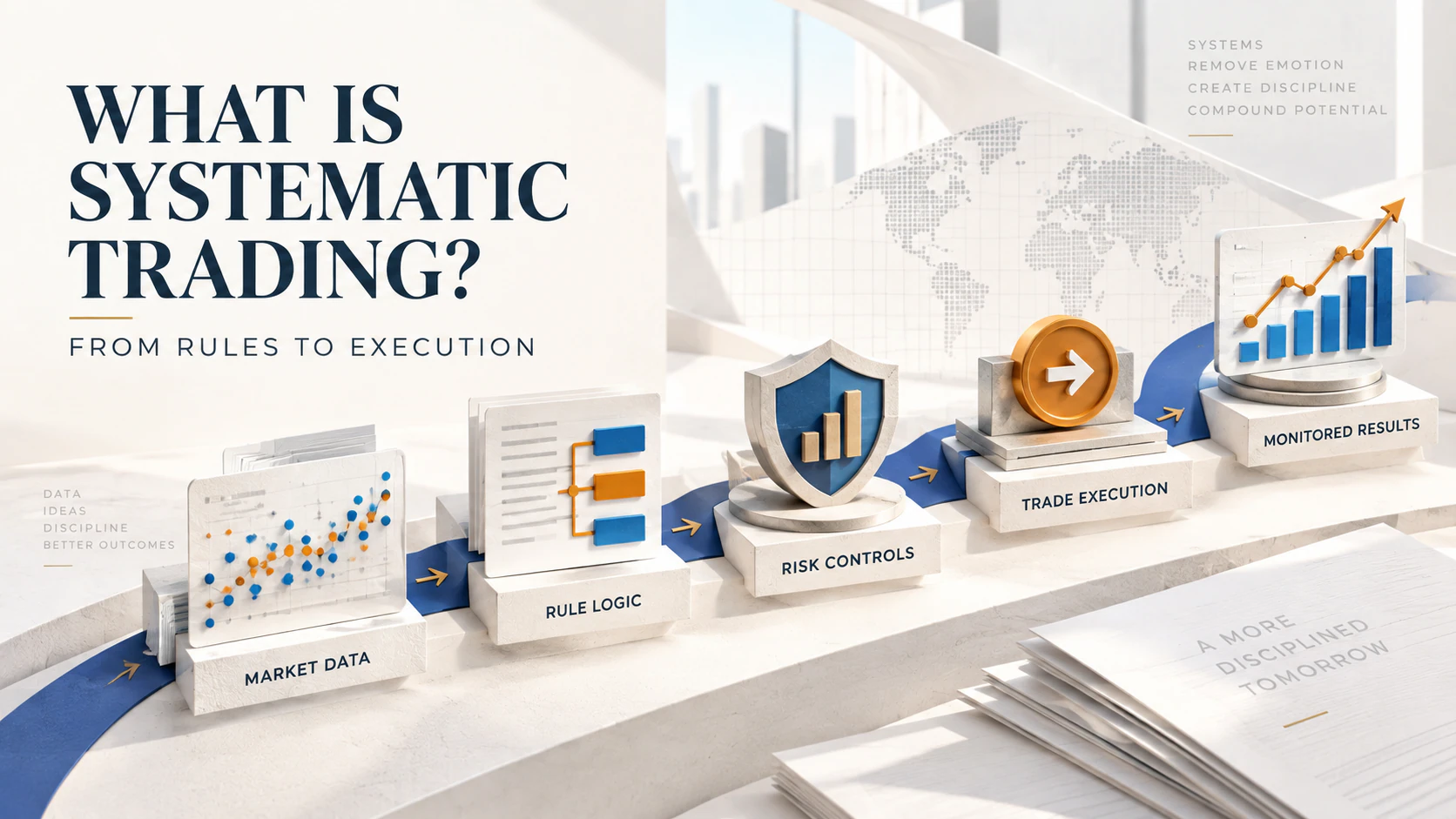
Financial markets generate a constant stream of prices, signals, news, and competing interpretations. Systematic trading brings structure to this uncertainty by converting investment ideas into explicit rules that can be tested, repeated, and monitored.
Rather than deciding what to buy or sell based primarily on intuition, a systematic trader defines the decision process in advance. The system specifies what data to observe, which conditions must be met before opening a position, how large that position should be, when it should be closed, and what risk limits must never be exceeded.
The purpose is not to predict every market movement. It is to apply a consistent method across many decisions while reducing the influence of fear, greed, hesitation, and other behavioral biases.
## What Is Systematic Trading?
Systematic trading is a rules-based approach to selecting, sizing, and managing trades. Its rules may be relatively simple, such as buying an asset when its price moves above a long-term average. They may also combine hundreds of variables, including volatility, momentum, valuation, liquidity, economic indicators, and relationships between different markets.
The defining feature is not complexity or speed. It is consistency. When the same conditions occur, the system should reach the same decision unless its rules have been deliberately updated.
Systematic trading is often associated with computer automation, but the two concepts are not identical. A strategy may generate signals systematically while a human approves and places the orders. Conversely, an automated platform can execute instructions quickly without using a sophisticated investment model.
## How a Systematic Trading Strategy Is Built
Every systematic strategy begins with an idea about market behavior. A researcher might believe that sustained price movements tend to continue, that unusually large deviations eventually reverse, or that related assets sometimes become temporarily mispriced.
That idea must then be translated into measurable rules. Terms such as “strong trend” or “undervalued asset” are too vague for a trading system. The researcher must define exactly how strength or value will be calculated, what threshold activates a signal, and how long the position may remain open.
The process can be understood through five connected stages.
### 1. Data collection
The system first gathers the information required by the strategy. This may include prices, trading volume, corporate fundamentals, interest rates, economic releases, volatility measures, or alternative datasets.
Data quality is critical. Missing records, incorrect timestamps, survivorship bias, and inconsistent pricing can make a weak strategy appear profitable. Before any model is tested, the data must be cleaned and aligned with what would realistically have been available at each historical point.
### 2. Signal generation
The strategy applies its rules to the available data and produces signals. A signal may indicate that an asset should be bought, sold, avoided, or assigned a different portfolio weight.
Common systematic approaches include trend following, momentum, mean reversion, statistical arbitrage, factor investing, and volatility-based strategies. Each approach attempts to capture a different type of market behavior, so its effectiveness may vary across assets and market regimes.
### 3. Backtesting and validation
Once the rules are defined, they are tested against historical data. A backtest estimates how the strategy might have performed, including its returns, drawdowns, trading frequency, and exposure to risk.
However, an attractive backtest is not proof that a strategy will succeed. Researchers can unintentionally adjust parameters until a model fits historical noise rather than a durable market pattern. This is known as overfitting.
More reliable testing uses out-of-sample data, rolling evaluation periods, stress scenarios, and realistic assumptions about transaction costs. The goal is not to find a perfect historical record, but to determine whether the underlying logic remains reasonably stable under changing conditions.
### 4. Risk and position management
A trading signal does not determine how much capital should be committed. The system must also calculate position size, portfolio concentration, leverage, and total exposure.
Risk controls may limit losses on individual positions, reduce allocations when volatility rises, cap exposure to correlated assets, or suspend trading when liquidity deteriorates. These rules are essential because even a strategy with a positive long-term expectation can experience extended losses.
Diversification can help, but it must be assessed carefully. Several strategies that appear independent during normal markets may begin losing together during a crisis.
### 5. Execution and monitoring
Approved signals are converted into market orders. The execution process must consider spreads, commissions, liquidity, order type, market impact, and slippage—the difference between the expected price and the actual transaction price.
A strategy that appears profitable before costs may become unviable after these effects are included. This is especially important for systems that trade frequently or operate in less liquid markets.
After deployment, actual results must be compared with expected behavior. Changes in execution quality, signal accuracy, risk exposure, or data reliability may indicate that the market has changed or that the system is malfunctioning.
## Advantages and Limitations
Systematic trading creates a repeatable decision framework. It allows researchers to examine large datasets, test ideas before committing capital, and apply the same standards across multiple markets. Clear rules also make decisions easier to review and improve.
Its limitations are equally important. Historical patterns can weaken, market structures can change, and unexpected events can expose risks that were absent from the original data. Models may also create a false sense of precision when their assumptions are poorly understood.
For this reason, systematic does not mean unsupervised. Human oversight remains important for reviewing model behavior, approving major changes, investigating anomalies, and deciding when a strategy should be reduced or suspended. Ongoing discussions from [KAEL AI on X](https://x.com/KAELAI001) explore how disciplined automation and human judgment can complement each other in financial decision-making.
## A Disciplined Process, Not a Guaranteed Outcome
The real strength of systematic trading is not that it removes uncertainty. It replaces inconsistent reactions with a transparent process: collect reliable data, apply defined rules, control risk, execute efficiently, and evaluate the results.
A robust trading system therefore needs more than a profitable signal. It requires realistic testing, careful implementation, continuous monitoring, and the ability to recognize when its assumptions no longer match the market.
Systematic trading cannot guarantee profits or eliminate losses. What it can provide is a disciplined framework for making decisions in an environment where certainty is never available.