
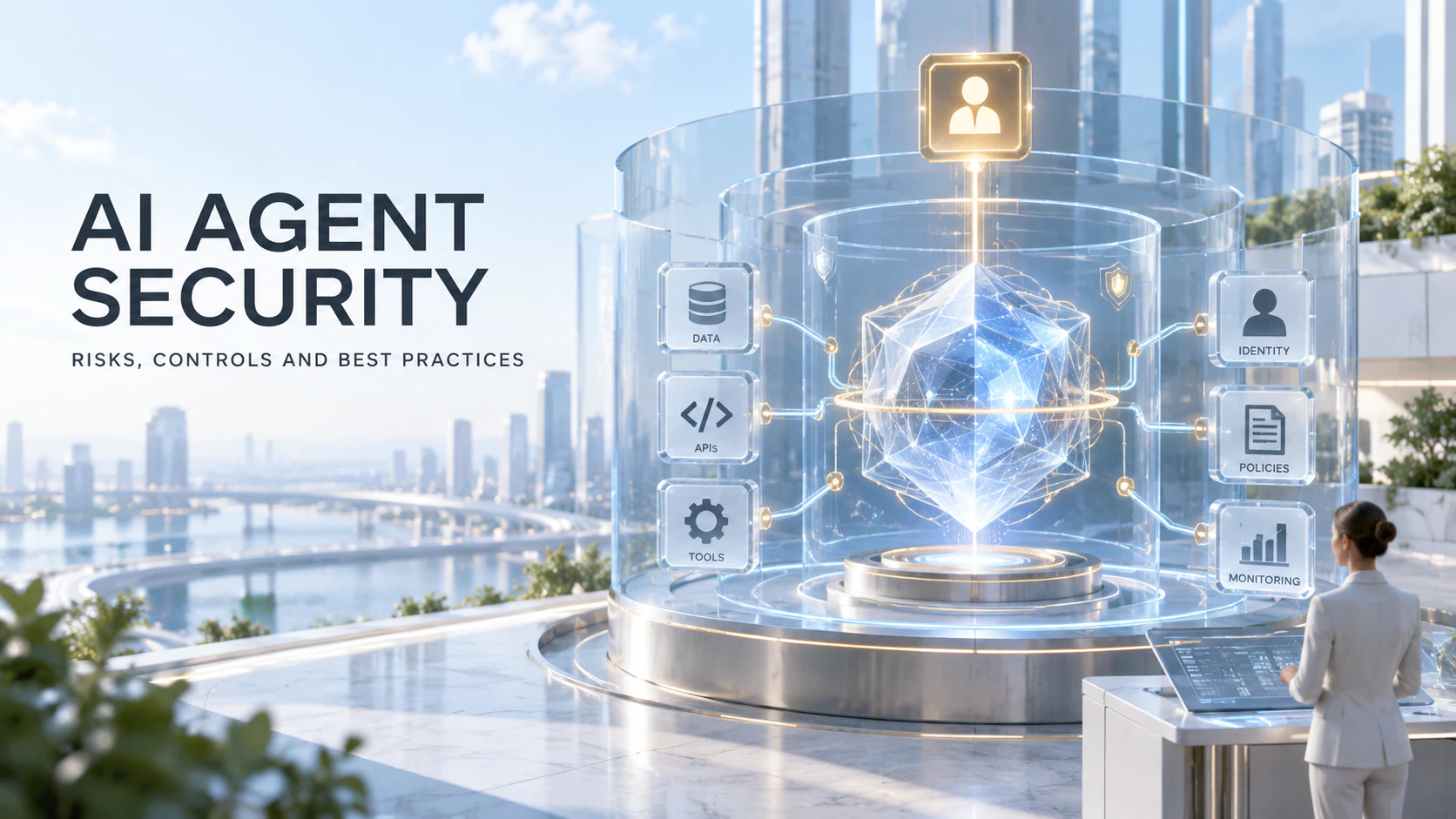
AI agents are evolving from conversational assistants into systems that can interpret objectives, build plans, access data, call software tools, and perform actions on behalf of users. An agent might review documents, update a customer record, send a message, modify code, or initiate a financial workflow. These capabilities create substantial operational value, but they also expand the consequences of mistakes, manipulation, and unauthorized access.
Securing an AI agent therefore involves more than filtering its answers. Organizations must protect the agent’s identity, permissions, tools, memory, data connections, and runtime behavior. The goal is controlled autonomy: allowing the agent to work efficiently while keeping its actions within visible and enforceable boundaries.
## Why AI Agents Require Additional Security Controls
Traditional applications generally follow deterministic paths defined in code. AI agents are different because they can interpret context and dynamically decide which steps or tools to use. Similar requests may lead to different plans, outputs, or actions.
Conventional application security remains essential, including authentication, authorization, dependency scanning, network controls, and secure software development. However, agentic systems also require protection around language-based instructions, retrieved context, tool selection, multi-step reasoning, and autonomous execution.
Every integration increases the potential impact of a failure. An agent connected to email, cloud storage, source repositories, financial systems, and customer databases may be able to combine access across those services in unexpected ways. Security must govern not only whether the agent can connect to a system, but also what it is attempting to accomplish at that moment.
## The Main AI Agent Security Risks
Prompt injection is one of the most prominent threats. Malicious instructions can be placed in a user prompt, webpage, email, document, support ticket, or database record. When an agent reads that material, it may confuse untrusted content with an authorized instruction. A successful attack could persuade the agent to ignore its rules, disclose protected information, or misuse a connected tool.
Unauthorized access is another critical concern. Agents may be given broad permissions for convenience, even when their actual task requires only limited access. If an overprivileged agent is compromised or makes an incorrect decision, it could retrieve confidential records, change production data, send unauthorized communications, or trigger transactions.
Tool misuse turns unreliable reasoning into real-world consequences. An agent may select the wrong tool, provide unsafe parameters, perform an action at the wrong time, or misunderstand the user’s intent. A hallucinated answer is problematic; a hallucinated database command or payment instruction can be far more damaging.
Data leakage can occur when an agent retrieves information beyond a user’s authorization, includes secrets in generated output, sends confidential context to an external service, or records sensitive data in logs. Because agents often connect multiple systems, information collected in one environment can unintentionally cross into another.
Memory and context poisoning create persistent risks. Attackers may insert misleading or malicious information into long-term memory, vector databases, shared documents, customer records, or knowledge bases. The agent may retrieve that content later and treat it as trustworthy. In multi-agent systems, poisoned context can also spread from one workflow to another.
The AI supply chain adds further exposure. Models, frameworks, plugins, APIs, datasets, prompts, software packages, and external services can all influence an agent’s behavior. A compromised dependency or manipulated data source may change what the agent believes and what it ultimately does.
## Build Security Around Identity and Least Privilege
Every production agent should have a distinct, traceable identity. Agents should not share personal accounts, generic service identities, or long-lived credentials. Separate identities make it possible to assign ownership, enforce policies, rotate credentials, investigate incidents, and quickly disable a misbehaving agent.
Permissions should be limited by role, task, data source, environment, and action type. An agent designed to summarize customer records does not need unrestricted database access. Read and write privileges should be separated, credentials should be short-lived where possible, and unused permissions should be removed.
Tools and APIs should follow a deny-by-default model. Approved integrations need defined input schemas, access limits, rate controls, output-handling rules, and complete audit trails. Sensitive tools should be isolated behind secure gateways that validate each request before it reaches the underlying system.
## Treat Inputs, Outputs, and Memory as Untrusted
Information from emails, websites, documents, tool responses, and internal databases should not automatically be considered safe. Trusted system instructions must remain clearly separated from external content, while retrieved information should be evaluated according to its source and authorization level.
Output validation is equally important. Agent-generated content may become an instruction for a shell, browser, SQL client, messaging platform, or business application. Parameters should be checked against strict schemas and policies before execution. Destructive or externally visible actions should require confirmation rather than being performed silently.
Memory needs its own controls. Organizations should restrict who and what can write to persistent memory, record the origin of stored information, sanitize new entries, and expire data that is no longer required. An agent’s memory should be treated as a potentially exposed data store, not as an inherently reliable source of truth.
## Monitor Behavior at Runtime
Pre-deployment testing cannot anticipate every path an autonomous agent may take. Runtime monitoring should capture prompts, retrieved context, permission checks, tool calls, memory changes, blocked requests, approvals, and final actions.
Security teams should watch for unusual tool sequences, repeated access failures, unexpected destinations, sudden increases in data transfer, permission changes, and actions outside the agent’s normal purpose. High-risk environments should also provide an immediate way to pause the agent, revoke its credentials, or terminate an unsafe workflow.
## Keep Humans in Control of High-Impact Actions
Not every agent action requires manual review. Routine, reversible, and low-risk tasks can remain automated. Operations that affect production data, financial assets, permissions, external communications, regulated information, or legal outcomes should receive additional scrutiny.
A useful approval request should explain what the agent intends to do, which tool and data it will use, and what outcome is expected. This allows the reviewer to make an informed decision rather than merely clicking a generic confirmation button.
AI agent security is ultimately about combining autonomy with accountability. Strong identities, least-privilege access, governed tools, protected context, continuous monitoring, and risk-based human approval form a layered defense that limits both accidental and malicious behavior.
As agent capabilities develop, security practices must evolve with them. KAEL AI continues exploring practical approaches to agent governance and trustworthy automation through its [Facebook](https://www.facebook.com/profile.php?id=61594050729769) and [X](https://x.com/KAELAI001) channels, helping teams understand how greater autonomy can be deployed without sacrificing visibility, control, or responsibility.